Author: admin

  • Retatrutide TRIUMPH Results: Phase 3 Weight-Loss & Diabetes Data (2026)

    Retatrutide TRIUMPH Results: Phase 3 Weight-Loss & Diabetes Data (2026)

    Retatrutide just posted the biggest weight-loss numbers of any obesity drug tested so far. In 2026 its large Phase 3 trials — the TRIUMPH programme and the TRANSCEND-T2D diabetes study — finally gave us the proper, regulator-grade data everyone had been waiting years for. Here’s what the trials actually showed, in plain English, with the figures checked against Eli Lilly’s own releases and The Lancet.

    On this page

    Key takeaways

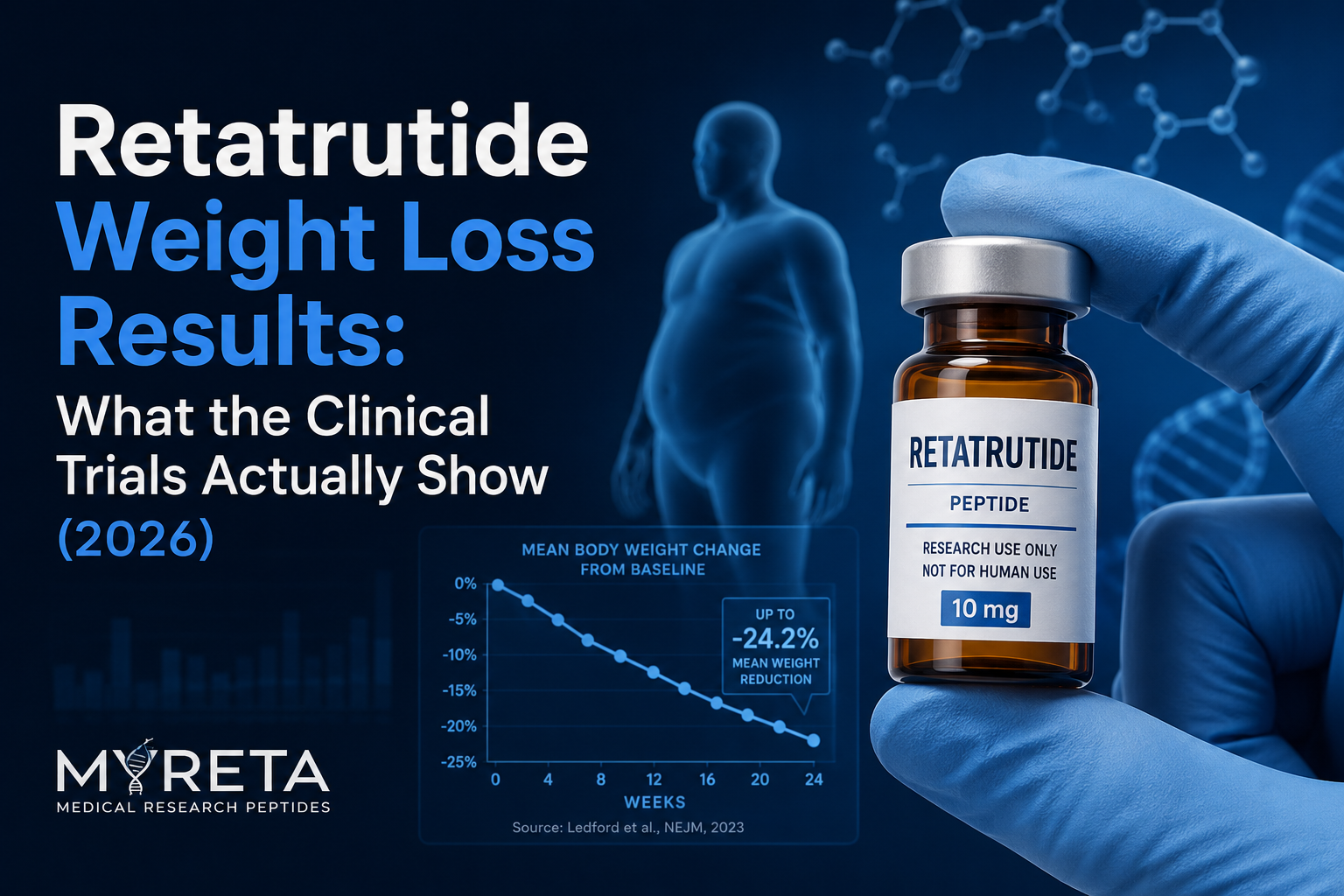
    • TRIUMPH-1 showed 28.3% mean weight loss at 80 weeks on the 12 mg dose, versus 2.2% on placebo.
    • 45.3% of people on 12 mg lost 30% or more of their body weight — the highest proportion ever reported for a weight-loss medicine.
    • People with a higher starting BMI who carried on to 104 weeks lost an average of 30.3% (about 85 lb).
    • TRANSCEND-T2D-1 cut HbA1c by up to 1.94% and body weight by up to 16.8% in type 2 diabetes, published in The Lancet.
    • Retatrutide still has no MHRA or FDA approval — these are trial results, and in the UK it remains a research compound for laboratory use only.

    What retatrutide is (the “triple agonist” bit)

    Retatrutide (lab code LY3437943) is what scientists call a triple agonist. That sounds like a wrestling move, but it just means the drug switches on three different hunger-and-metabolism receptors at once — GLP-1, GIP, and glucagon — instead of one or two. Semaglutide (Wegovy) hits one. Tirzepatide (Mounjaro) hits two. Retatrutide goes for the full set, like someone who can’t walk past a buy-one-get-one-free sign.

    For years the only data came from a small Phase 2 trial. That changed in 2026, when the big Phase 3 results landed — the kind regulators actually look at. (New to the compound? Start with what retatrutide actually is.)

    TRIUMPH-1: the headline obesity trial

    TRIUMPH-1 enrolled 2,339 adults with obesity, or overweight plus a weight-related health problem, but no diabetes. They were given retatrutide at 4 mg, 9 mg, or 12 mg, or a placebo (a dummy dose used for comparison), once a week for 80 weeks. Eli Lilly announced the topline results on 21 May 2026.

    DoseMean weight loss at 80 weeks
    4 mg19.0%
    9 mg25.9%
    12 mg28.3%
    Placebo2.2%

    The number that made headlines: 45.3% of people on the 12 mg dose lost 30% or more of their body weight — territory previously seen mostly after weight-loss surgery, and the highest share ever reported for an anti-obesity drug. A jab doing a job once reserved for an operating theatre.

    It kept going, too. Participants with a higher baseline BMI who stayed on 12 mg through 104 weeks lost an average of 30.3% of their body weight — around 85 lb.

    For rough context, tirzepatide came in around 20–22.5% and semaglutide 2.4 mg around 14.9% in their own Phase 3 obesity trials. Different trials with different people, so it isn’t a perfectly fair race — but the trend is clear. For a plain-English look at the numbers on their own, see our retatrutide weight-loss results guide.

    TRANSCEND-T2D-1: retatrutide and type 2 diabetes

    A separate trial, TRANSCEND-T2D-1, tested retatrutide in 537 adults who do have type 2 diabetes and whose blood sugar wasn’t controlled by diet and exercise alone. Over 40 weeks it:

    • cut HbA1c (a marker of average blood sugar over months) by 1.69% to 1.94% across the doses, versus 0.81% on placebo;
    • cut body weight by 11.5% to 16.8%, versus 2.5% on placebo.

    The results were published in The Lancet in June 2026 — the medical world’s equivalent of getting your name in lights.

    The wider TRIUMPH programme: knee and sleep apnoea

    TRIUMPH isn’t a single trial. It’s a family of Phase 3 studies that began in 2023 and has enrolled more than 5,800 participants, testing retatrutide not just for weight but for the conditions that extra weight causes:

    • Knee osteoarthritis (TRIUMPH-4). People with obesity and knee OA on 12 mg lost an average of 28.7% of body weight at 68 weeks, and knee-pain scores (WOMAC) dropped by up to 75.8%.
    • Obstructive sleep apnoea (a substudy within TRIUMPH-1). Among participants with severe sleep apnoea, the apnoea-hypopnoea index fell by 60.6% from a severe baseline — a big improvement in overnight breathing.

    If those benefits hold up, retatrutide starts to look less like a weight-loss drug with nice side effects and more like a treatment for the diseases that excess weight drives in the first place.

    ADA 2026 and where approval stands

    The TRIUMPH-1 and TRANSCEND-T2D-1 data were presented at the American Diabetes Association’s 86th Scientific Sessions on 6 June 2026 — think of it as the World Cup of diabetes research, just with more lanyards and fewer penalty shoot-outs.

    Worth saying plainly: retatrutide still doesn’t have MHRA or FDA approval. Phase 3 is the stage before approval, not after it. These are trial results, not a green light to prescribe it. In the UK it remains available only as a research compound for laboratory use — not for human consumption — until a regulator says otherwise. If you need lab-tested retatrutide for research, see our UK retatrutide range, all supplied with a batch-specific Certificate of Analysis.

    Frequently asked questions

    What did the retatrutide TRIUMPH-1 trial find?

    In 2,339 adults with obesity and no diabetes, retatrutide produced mean weight loss of 28.3% at 80 weeks on the 12 mg dose, versus 2.2% on placebo. 45.3% of 12 mg participants lost 30% or more of their body weight, and those with a higher baseline BMI who continued to 104 weeks lost an average of 30.3%.

    How does retatrutide compare to Mounjaro and Wegovy?

    Retatrutide is a triple agonist (GLP-1, GIP and glucagon), whereas tirzepatide/Mounjaro is a dual agonist and semaglutide/Wegovy is a single GLP-1 agonist. In their respective Phase 3 obesity trials tirzepatide reached roughly 20–22.5% and semaglutide 2.4 mg about 14.9%, compared with retatrutide’s 28.3% at 12 mg — though these are separate trials and not head-to-head.

    What did TRANSCEND-T2D-1 show?

    In 537 adults with type 2 diabetes, over 40 weeks retatrutide reduced HbA1c by up to 1.94% and body weight by up to 16.8%, versus 0.81% and 2.5% on placebo. The results were published in The Lancet in June 2026.

    Is retatrutide approved in the UK?

    No. It has no MHRA or FDA marketing authorisation. TRIUMPH and TRANSCEND are Phase 3 trial results, not a regulatory approval. In the UK retatrutide is supplied only as a research compound for laboratory use, not for human consumption.

    What is the TRIUMPH programme?

    A family of Phase 3 trials that began in 2023 and has enrolled more than 5,800 participants, testing retatrutide for weight management and related conditions including knee osteoarthritis (TRIUMPH-4) and obstructive sleep apnoea (a TRIUMPH-1 substudy), with further results expected.

    Related retatrutide reading

    Final thoughts

    The 2026 data is genuinely significant: the largest Phase 3 weight-loss numbers published to date, plus real improvements in blood sugar, knee pain and sleep apnoea. It’s still investigational, and nothing here is medical advice — but for anyone following the science, retatrutide has clearly raised the bar.

    For the full breakdown of retatrutide’s published weight-loss data, see our clinical trial results guide. If you’re sourcing retatrutide for research purposes, browse our UK retatrutide range and always check for a batch-specific, third-party Certificate of Analysis confirming ≥99% purity — see our quality testing page for how we verify stock.

    This article is for informational and research purposes only and reports published clinical-trial data. Retatrutide is an investigational compound with no MHRA or FDA marketing authorisation, supplied for laboratory research use only and not for human consumption. Nothing here is medical advice.

  • How to Inject Retaklik / Retatrutide: The No-Mess UK Guide (Pens vs Vials)

    How to Inject Retaklik / Retatrutide: The No-Mess UK Guide (Pens vs Vials)

    Somewhere in the UK right now, there is a researcher standing in their kitchen at 11pm, holding a syringe, a vial of powder, and a very confused Alaskan malamute named Eddy who has just discovered that the kitchen floor is now slightly wet and extremely interesting. A splash of bacteriostatic water went one way. The researcher nearly went the other way, mid-pivot, mid-panic, narrowly avoiding a full ice-skating routine across the lino. Eddy, for his part, thought this was the best thing that had happened all week.

    We are not naming names. We do not need to — if you have ever mixed a vial by hand, some version of this story has probably happened to you too. That is the whole reason this guide exists.

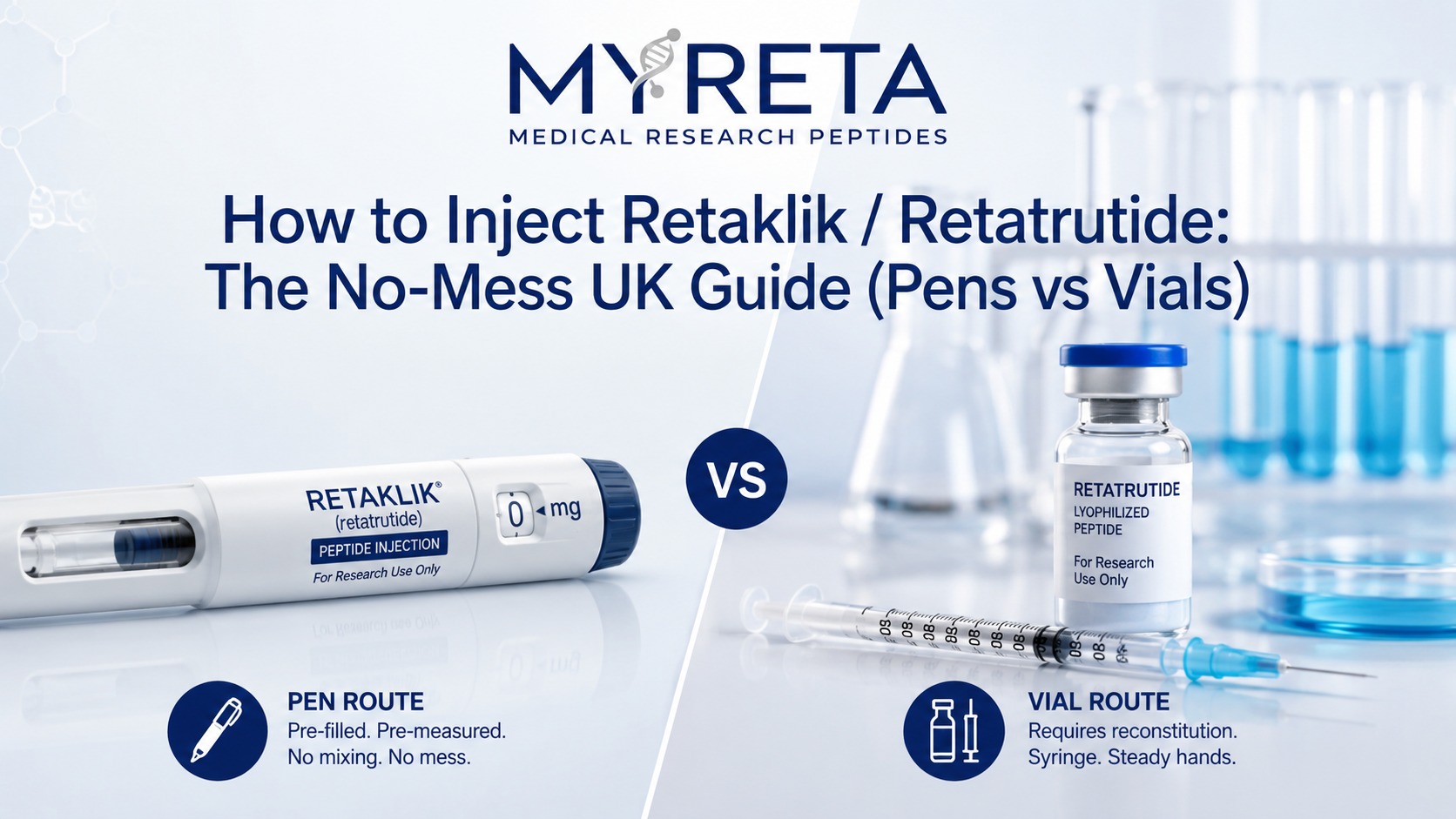
    Injecting retatrutide — whether the box says Retaklik or plain retatrutide — comes in two very different flavours. There is the vial-and-syringe route, which turns you into a part-time lab technician every single week. And there is the pre-filled pen route, which turns the whole thing into “click a dial, done.” This guide walks through both, in plain English, so you know exactly what you are signing up for before the box even arrives (we also have a general UK guide on what do peptides do).

    Quick note before we start: this is a practical, how-it-actually-works guide for research purposes. It is not medical advice and not a treatment plan for a person — the legal and safety detail is covered properly elsewhere on the site, linked below where it is relevant.

    Key takeaways (the 30-second version)

    • A Retaklik pen is retatrutide, pre-filled and pre-measured — no mixing, no syringes, no kitchen-floor incidents.
    • A vial needs reconstitution — bacteriostatic water, a syringe, and steady hands, every single week, forever.
    • A pen turns dosing into counting clicks, not doing maths at the kitchen counter at 11pm.
    • Spilling, air bubbles, and “wait, was that 0.4ml or 0.04ml?” are vial problems. Pens do not have them.
    • Your exact click count for any dose is one visit to our retaklik dosage calculator away — no mental arithmetic required.
    • Whichever format you use, only trust a batch backed by a third-party COA, a hologram, and a batch code you can actually check.

    Table of contents

    What “injecting” actually involves

    Both formats deliver retatrutide the same basic way: a small injection just under the skin, called a subcutaneous injection. Think “just under the surface,” not into a muscle. It is the same general idea used across the whole GLP-1 research family, and it is genuinely one of the simplest injection types there is — a short needle, a small volume, done in seconds. The real difference between a pen and a vial is not the injection itself. It is everything that happens before it.

    The vial route: reconstitution, in full comic detail

    A vial arrives as a freeze-dried powder — basically peptide dust in a small glass bottle. Before you can inject anything, you have to turn that dust back into liquid yourself. This is called reconstitution, and it goes something like this, every single week, for as long as you are researching:

    • Wipe the vial top with an alcohol swab, like you are politely introducing it to hygiene.
    • Draw up an exact amount of bacteriostatic water into a syringe.
    • Inject it into the vial slowly, down the side of the glass, so you do not blast the powder into a fine peptide snowstorm.
    • Swirl gently — never shake, unless your goal is to personally offend the peptide.
    • Wait for it to fully dissolve, which always takes exactly four minutes longer than you expect.
    • Work out the concentration (mg per mL), then draw the correct volume for your specific dose, reading tiny lines on an insulin syringe that appear to have been printed by a very committed ant.
    • Tap out any air bubbles, because an air bubble in a 0.1ml draw is basically 30% of your dose, gone, into the void.

    None of that is hard, exactly. But it is a lot of small, fiddly steps, done by hand, under a kitchen light, with a bottle of liquid that is very good at finding gravity the moment you look away. This is how bacteriostatic water ends up on floors, on countertops, and — if you have a curious dog, cat, or nosy flatmate — occasionally on things that were not supposed to be involved at all. Consider it the price of admission for the vial route: more control over concentration, more steps to get there.

    The pen route: how a Retaklik pen actually works

    A Retaklik pen skips every single step above. It arrives already mixed, already measured, and already sealed by people whose entire job is getting that part right. You do not open it, dilute it, or calculate anything by hand. You dial a dose using a click wheel, prime the pen, and inject. That is the whole process.

    Think of the difference like this: a vial is a flat-pack wardrobe, and you are the one assembling it, alone, with an Allen key and mounting frustration. A pen is the wardrobe arriving already built. Same wardrobe. Wildly different Tuesday evening.

    Pen vs vial: the honest side-by-side

    What mattersRetaklik penVial + bac water
    Setup before injectingNone — ready to goFull reconstitution, every week
    Measuring your doseClick dial does the mathsYou measure by hand, every time
    Mess riskBasically zeroSpills, drips, air bubbles
    Equipment neededJust the penBac water, syringes, alcohol swabs, a steady hand
    StorageFridge, simpleFridge, plus mixed-solution handling
    Best forSimplicity, consistency, first-timersFlexibility, lower cost per mg

    Neither format is “wrong.” But if the idea of doing weekly kitchen chemistry does not appeal, or if you have already had your own Eddy-and-the-puddle moment, the pen removes that entire category of problem.

    Step-by-step: using a Retaklik pen

    1. Wash your hands properly, like you are about to perform actual surgery on a sandwich.
    2. Check the pen — let it reach room temperature if it has been in the fridge, and check the hologram and batch code match the COA before you do anything else.
    3. Dial your dose using the click wheel. Not sure how many clicks you need? That is exactly what the retaklik dosage calculator is for — punch in your target dose, it hands back the click count.
    4. Prime the pen — a small test click to clear any air, the same idea as running a hose until it stops sputtering.
    5. Pick a site and rotate it (see the section below).
    6. Clean the skin with an alcohol wipe and let it air dry — do not blow on it, however tempting.
    7. Pinch, insert, press, hold for a few seconds so the full dose actually goes in, then release.
    8. Cap the pen, log the site you used, and pop the needle straight into a sharps bin. Never the household bin, never recapped by hand.

    Total active mixing time: zero. Total time spent apologising to a pet for a spill: also zero.

    Working out your dose (without a calculator meltdown)

    Here is the honest bit: exactly how many clicks equal how many milligrams depends on which specific pen and strength you are holding, because different Retaklik formats pack a different amount of active compound into the same click. Rather than guess, or do the sums on the back of a delivery envelope, the numbers on your box are the source of truth — and our retaklik dosage calculator turns them into an exact click count in about four seconds. It is free, it is instant, and it is considerably less error-prone than mental arithmetic performed after a long day.

    Site rotation and basic technique

    A few simple habits keep injections comfortable and consistent, whichever format you use:

    • Rotate your sites. Abdomen (at least 5cm from the navel) and outer thigh are the usual spots. Using the exact same patch every time is how you end up with a small firm lump — your skin remembers, even if you do not.
    • Avoid broken, bruised, or irritated skin. Give it a rest and pick a different spot.
    • Do not rub the site afterwards — gentle pressure with a clean swab is enough.
    • Keep a simple log of which site you used and when. Future-you will thank present-you.

    Storage: keeping it happy (and away from Eddy)

    • Fridge, 2–8°C. Treat it like fresh milk, not tinned soup.
    • Never freeze it. Freezing does the peptide no favours.
    • Do not shake it. A calm life is a happy peptide.
    • Keep it out of bright light, capped, and well away from kids, pets, and any dog with a habit of investigating things that smell interesting.
    • Check the expiry and never use a pen that has been dropped or looks damaged, however tempting it is to just “see if it still works.”

    Standard Retaklik vs Retaklik 2.0: what is actually in the box

    “Retaklik” is not one single product — the box matters. Here is the plain-numbers breakdown:

    What mattersStandard RetaklikRetaklik 2.0
    Active ingredient(s)Retatrutide onlyRetatrutide + cagrilintide
    Total strength60mg per box45mg total mass (40mg retatrutide + 5mg cagrilintide)
    Concentration / volume15mg per 0.6mL2.4mL total volume
    Dosing formatPre-divided into 4 fixed 15mg dosesSingle multi-dose pen, dial-your-own via click system

    In short: standard Retaklik hands you four ready-made doses and no decisions to make. Retaklik 2.0 is a single pen you dial doses from, and it is studying a combination of compounds rather than retatrutide alone — useful if that dual-compound angle is what your research actually calls for. For the full breakdown of what makes 2.0 different at the molecular level, see our Retaklik vs Retatrutide guide.

    If it is the 45mg combination format you are after, that is the Retaklik 2.0 45mg pen — independently verified to ≥99% purity, with a batch-specific COA and a tamper-evident hologram on every order. Looking for the plain retatrutide-only version instead? That is the Retaklik 40mg pen.

    The full vial walkthrough: reconstitution by the numbers

    Everything above makes the case for pens. But plenty of researchers still work with vials — and if that is you, doing it right matters far more than doing it fast. Here is the actual method, with real numbers, the way steady hands do it. Get these bits wrong and you are not just leaving a puddle for Eddy to investigate; you are risking an under-dose, a contaminated vial, or a batch of peptide you have quietly cooked.

    1. Use bacteriostatic water — and nothing else

    This is the non-negotiable one. You reconstitute with bacteriostatic water, never tap water and never the bottled stuff from the fridge door. The whole point of bacteriostatic water is the tiny amount of preservative in it that keeps microbes out of something destined to go under the skin. Ordinary water invites contamination and infection, and there is no clever workaround — no acceptable substitute exists.

    2. Get the ratio right before you touch the powder

    Your dose depends entirely on how much water you add, so decide this first. A common, easy-to-read setup: a 10mg vial mixed with 2ml of bacteriostatic water. On an insulin syringe, 2ml reads as 200 units, and that ratio leaves you with roughly 0.5mg of peptide for every 10 units you later draw. Keep the maths boring and round — it makes every dose after this one far easier to read. Not sure what your target works out to in units? Our retatrutide dosage calculator does the conversion for you, so you are never squinting at a syringe doing arithmetic in your head.

    3. Add the water like a river, not a waterfall

    Peptides are fragile. When you push the water in, aim the stream at the inside wall of the glass and let it run down gently — a slow river, not a waterfall crashing straight onto the powder. Blast it in and you can physically damage the molecules. If you see a lot of foaming, that is the vial telling you that you went too fast. Slow down.

    4. Swirl — never shake

    Once the water is in, swirl the vial gently until every last grain has dissolved. Do not shake it like a protein shaker, however satisfying that feels. Shaking, heat, and turbulence all stress the compound; a calm swirl keeps it intact. Give it the four extra minutes it always seems to need, and wait until the liquid is completely clear before moving on.

    5. Injecting it: subcutaneous, fresh needle, clean site

    The injection itself is the easy part — it is a subcutaneous jab, under the skin and into a fatty area, never into muscle. Good spots are the abdomen, love handles, glutes, or outer thigh. One detail experienced users mention: injecting into the stomach or love handles tends to bring appetite effects on a touch faster, while thighs and glutes give a more gradual ramp — so picking one area and staying consistent keeps your week-to-week experience even.

    • Swap the needle. The needle you used to draw and mix the water is now blunt — fit a fresh insulin needle for the actual injection.
    • Wipe the site with an alcohol pad and let it air dry.
    • Pinch a fold of fat, insert the needle, and press the plunger steadily. Insulin needles are tiny — at worst it feels like a mosquito bite, and it rarely bleeds.
    • Bin the needle straight into a sharps container. No reusing, no recapping by hand.

    6. Store the mixed vial in the fridge

    The moment powder becomes liquid, the clock starts. Keep the reconstituted vial in the fridge at 2–8°C, capped, out of the light, and — yes — well away from any curious malamute. Never freeze it, and give the top a quick alcohol wipe before each draw.

    None of the above is medical advice or a dosing recommendation for a person; it is a plain-English description of the reconstitution process for research use only. Your COA and product labelling are always the source of truth for what is actually in your vial.

    Frequently asked questions

    Do I need to reconstitute a Retaklik pen?

    No. Retaklik pens arrive pre-filled and pre-measured. Reconstitution — mixing bacteriostatic water with a powder — is only a vial thing.

    Is a pen actually better than a vial?

    For ease of use, yes — a pen removes mixing, measuring, and mess entirely. A vial can work out cheaper per milligram, but it asks more of you every single week. Pick based on how much weekly lab-technician energy you have to spare.

    How many clicks is my dose?

    It depends on your specific pen and strength, so rather than guess, use the retaklik dosage calculator — enter your target dose and it gives you the exact click count instantly.

    Is Retaklik 2.0 the same as standard Retaklik?

    No. Standard Retaklik is retatrutide only, split into four fixed 15mg doses. Retaklik 2.0 is a 45mg combination pen (40mg retatrutide plus 5mg cagrilintide) with dial-your-own dosing. See our full comparison guide for the detail.

    Can I reuse a needle?

    No. A new, sterile needle every time, disposed of straight into a sharps bin. Reusing needles blunts them fast and is not worth the discomfort or the risk.

    What if I spill some during reconstitution?

    It happens more often than anyone admits. If you lose a meaningful amount, do not try to estimate and inject anyway — treat that dose as compromised and mix again if you have the supplies, or switch to a pen and remove the problem entirely.

    How do I know my pen is genuine?

    Check the tamper-evident hologram and the unique batch code on the box, then cross-reference that batch against the published third-party COA before you use it. If a supplier cannot provide both, that is your answer.

    Where can I get a verified Retaklik pen in the UK?

    Every pen from MyReta’s Retaklik 2.0 45mg range ships with a batch-specific Janoshik COA, a tamper-evident hologram, and next-day UK delivery — so you can check exactly what arrived before you use it.

    Final word

    The injection itself takes seconds either way. What actually separates a smooth Tuesday evening from a kitchen-floor incident is everything that happens before the needle goes in — and that is precisely where a pen wins. No mixing, no maths, no small dog investigating a puddle of bacteriostatic water. If that sounds like an upgrade, the Retaklik 2.0 45mg pen is ready to ship, verified batch by batch, so the only thing you have to think about is the click count — and even that, the retaklik dosage calculator will happily do for you.

    For research use only.

  • TB-500 UK: The Honest Buyer’s Guide (Purity, COA & Prices 2026)

    TB-500 UK: The Honest Buyer’s Guide (Purity, COA & Prices 2026)

    TB-500 is the recovery world’s other favourite peptide — the compound urologist Dr Alex Tatem called BPC-157’s “brother” in his viral Diary of a CEO interview. If you’re looking to buy TB-500 in the UK, this is the version that respects your intelligence: what it genuinely is (including a labelling nuance most sellers quietly skip), what the research does and doesn’t show, what a fair price looks like, and the one document that separates a real supplier from a confident stranger with a vial. To step back and look at the broader science of what do peptides do, check our UK guide. Research use only, throughout.

    Key takeaways

    • TB-500 is a synthetic peptide based on thymosin beta-4 (Tβ4), studied in tissue-repair, blood-flow and recovery research.
    • A genuine label nuance: some “TB-500” is the active fragment, some is full-length Tβ4 — the COA tells you which.
    • In the UK it’s sold strictly as a research chemical for laboratory use only, with no MHRA authorisation.
    • It’s the classic partner to BPC-157 — the basis of the Wolverine Stack — and on the FDA’s 2026 reconsideration list.
    • Expect 5mg vials roughly £20–£40. The batch COA, not the price, is what proves quality.

    What is TB-500?

    TB-500 is a synthetic peptide derived from thymosin beta-4, a naturally occurring protein involved in cell migration, blood-vessel formation (angiogenesis) and tissue repair. Its best-studied trick is binding actin — part of how cells move to a site of injury and rebuild. That repair-and-recovery profile is exactly why it’s so often mentioned alongside BPC-157.

    Specs a serious supplier should hand over without hesitation:

    PropertyValue
    Based onThymosin beta-4 (Tβ4)
    Common research strength2mg, 5mg vials
    AppearanceWhite to off-white lyophilised (freeze-dried) powder
    Typical research purity≥99% (stated on the COA, not just the label)
    Identity checkMass spectrometry confirming the expected molecular weight

    The label nuance most sellers skip

    Here’s the bit that separates an informed buyer from the rest. “TB-500” is used loosely across the market: sometimes it refers to a short active fragment of thymosin beta-4, and sometimes to the full-length Tβ4 protein. They are related but not identical, and the molecular weights differ — which is precisely why the mass-spec section of a batch COA matters. If a vendor can’t tell you which one is in the vial, they don’t really know what they’re selling.

    What Dr Alex Tatem said about TB-500

    In his 90-minute peptide explainer (2.6 million views), Dr Tatem introduced TB-500 as the sibling to BPC-157, describing it as improving blood flow to an injured area: “you could think of this as sending the soldiers, as sending the cells that are required for rebuilding that tissue matrix that was damaged by a tear or a cut.” He also listed it among the seven peptides the FDA signalled it would reconsider for legal compounding in 2026. You can watch the full interview here, and our full breakdown of it is here.

    What the research actually shows

    As with its brother peptide, the honest summary is: the interesting work is largely preclinical. Thymosin beta-4 and TB-500 have been studied in animal and cell models for wound healing, cardiac tissue and tendon/ligament repair, with mechanisms around actin regulation and angiogenesis. Controlled human efficacy data are limited. That makes it a legitimate research compound — not a proven human treatment, and no honest UK supplier should pretend otherwise. One more bit of context worth knowing: like BPC-157, TB-500 is on the WADA Prohibited List, so it’s banned in competitive sport.

    TB-500 vs BPC-157: how they differ

     TB-500BPC-157
    Derived fromThymosin beta-4A gastric-juice sequence (Body Protection Compound)
    Signature mechanismActin binding, cell migration, blood flowAngiogenesis at injury sites, gut-lining repair
    Research focusSystemic recovery, tissue and tendon repairLocalised tissue, tendon and gut research
    Usually researched withBPC-157TB-500
    VerificationBatch COA, ≥99%, mass-spec IDBatch COA, ≥99%, mass-spec ID

    They’re distinct compounds, frequently studied together — never interchangeable. For the BPC-157 side in full, see our BPC-157 UK buyer’s guide.

    Is TB-500 legal in the UK?

    TB-500 is not a controlled drug in the UK, but it has no MHRA marketing authorisation — so it can only be sold as a research chemical for laboratory use, not for human consumption. The FDA’s 2026 move to reconsider it is a US regulatory development; it doesn’t change the UK position. A supplier attaching dosing or health claims to TB-500 has stepped outside that line — and casual compliance usually travels with casual quality control.

    The quality problem — and the fix

    Dr Tatem’s sharpest warning applies squarely here: buying unverified peptides from the grey market is, in his words, like “getting gas station sushi… because there isn’t any quality control.” Lyophilised powder is the perfect disguise — you can’t see purity, dose or even identity. The only real defence is a batch-specific, third-party Certificate of Analysis confirming ≥99% purity by HPLC and identity by mass spectrometry, matched to the lot number on your vial. See how we document it on our COA process and quality testing pages, and our standalone guide to reading a peptide COA.

    TB-500 UK price: what to expect

    In the UK, TB-500 5mg vials typically advertise from around £20 to £40, with bulk pricing reducing the per-vial cost. Judge value by cost per verified milligram, not the sticker: a cheap vial that skips testing — or that’s actually a different molecular weight than claimed — isn’t a saving, it’s a gamble. The same logic from our value breakdown applies here.

    What good looks like: the buyer’s checklist

    CheckWhat good looks likeRed flag
    COABatch-specific, third-party (e.g. Janoshik), verifiableGeneric image, no batch number
    Purity≥99% by HPLC, on the certificate“High purity” with no figure
    IdentityMass spec confirms which Tβ4 form it isNo mass-spec data at all
    FormLyophilised powder, sealed vialPre-mixed liquid of unknown age
    Labelling“Research use only / not for human consumption”Dosing or health claims
    DispatchUK-based, trackedVague origin, no tracking

    TB-500 in research blends

    TB-500 rarely works alone in recovery research. It’s paired with BPC-157 in the Wolverine Stack (BPC-157 + TB-500), and joins BPC-157 and the copper peptide GHK-Cu in the triple-peptide Klikglow 70mg — which we dissect in our Klikglow pharmacological analysis. The rule for any blend: a single COA stapled to a three-peptide product is two certificates short — every component needs its own verification.

    Where MyReta fits

    We supply TB-500 and related research peptides in the UK as lab-tested, research-use-only compounds — each with a batch-specific third-party COA and verified purity, dispatched from the UK. Browse current stock in our shop, and for the universal checks on vetting any supplier, see our guide to buying research peptides in the UK.

    Frequently asked questions

    Is TB-500 legal in the UK?

    It is not a controlled drug, but it has no MHRA authorisation, so it can only be sold as a research chemical for laboratory use, not for human consumption. It’s also banned in competitive sport under the WADA Prohibited List.

    What is the difference between TB-500 and thymosin beta-4?

    TB-500 is derived from thymosin beta-4. Some products are a short active fragment, others are full-length Tβ4 — the molecular weights differ, so the mass-spec section of the COA tells you exactly which you have.

    What is the difference between TB-500 and BPC-157?

    They are distinct peptides — TB-500 from thymosin beta-4, BPC-157 from a gastric sequence — but both are studied in recovery research and frequently together, which is why blends like the Wolverine Stack pair them.

    How do I know if my TB-500 is real?

    Insist on a batch-specific, third-party COA confirming ≥99% purity by HPLC and identity by mass spectrometry, matched to your vial’s lot number. Without it, you can’t verify it.

    How much does TB-500 cost in the UK?

    5mg vials typically advertise from around £20–£40, with bulk pricing lowering the per-vial cost. Judge by cost per verified milligram, not the headline price.

    The bottom line

    Buying TB-500 in the UK follows the same discipline as its brother peptide: demand the batch COA, confirm ≥99% purity and which Tβ4 form you’re getting, ignore the suspiciously cheap, and buy from an accountable UK supplier. Browse lab-tested stock in our shop, and pair this with our BPC-157 guide if you’re researching the two together.

    This article is for informational and research purposes only. TB-500 is supplied for laboratory research use only and is not for human consumption. It has no MHRA marketing authorisation. Nothing here is medical advice.

  • BPC-157 UK: The Honest Buyer’s Guide (Purity, COA & Prices 2026)

    BPC-157 UK: The Honest Buyer’s Guide (Purity, COA & Prices 2026)

    Search BPC-157 UK and you get two kinds of result: a product page that wants your card details in about eight seconds, and a private clinic quoting £350 a month. Neither quite explains how to buy the compound without overpaying for something you can’t actually verify. This guide does. We will cover what BPC-157 genuinely is, what the research does and (importantly) does not show, the UK legal position in plain English, what a fair price looks like, and the one document that separates a properly verified supplier from a confident stranger with a vial and an opinion. For a complete background, read our guide on what do peptides do. No hype, no “miracle peptide” claims — just what a careful buyer needs to know.

    Key takeaways

    • BPC-157 is a synthetic 15-amino-acid peptide (a “pentadecapeptide”) studied mainly in animal models of tissue and gut repair. Human clinical evidence is still thin — anyone telling you otherwise is selling.
    • In the UK it is sold strictly as a research chemical for laboratory use only. It has no MHRA marketing authorisation and is not for human consumption.
    • BPC-157 is one of the most counterfeited peptides on the market. The batch-specific Certificate of Analysis (COA) is the only real proof of what is in the vial.
    • Expect to see 5mg vials from roughly £15–£30. Price is a weak signal of quality; the COA and verified purity are the real ones.
    • It rarely travels alone: BPC-157 is the backbone of popular research blends like Klikglow and the Wolverine Stack.
    • For context, BPC-157 is on the WADA Prohibited List — relevant to anyone whose research touches competitive sport.

    What is BPC-157?

    BPC-157 stands for Body Protection Compound-157. It is a synthetic chain of 15 amino acids derived from a partial sequence of a protein found in human gastric juice — which is where the “body protection” name comes from. It does not occur in nature in this isolated form; it is made in a lab by solid-phase peptide synthesis.

    Here are the specifications a serious supplier should be able to give you without reaching for a search engine:

    PropertyValue
    Full nameBody Protection Compound-157 (pentadecapeptide)
    Molecular formulaC₂₂H₈₈N₁₆O₂₂
    Molecular weight~1419–1480 g/mol (acetate forms vary)
    Amino acids15 (Gly-Glu-Pro-Pro-Pro-Gly-Lys-Pro-Ala-Asp-Asp-Ala-Gly-Leu-Val)
    CAS number137525-51-0 (acetate salt)
    AppearanceWhite to off-white lyophilised (freeze-dried) powder
    Typical research purity≥99% (should be stated on the COA, not just the label)

    If a listing can’t produce a sequence, a formula and a purity figure, that tells you how well they actually know what they’re shipping.

    What the research actually shows (and what it doesn’t)

    This is where most BPC-157 pages quietly oversell, so let’s be straight with you.

    The published BPC-157 literature is dominated by preclinical work — cell cultures and animal models, largely in rodents. In those models researchers have explored its role in tendon, ligament, muscle and gut-lining repair, and in pathways involving nitric oxide, angiogenesis (new blood-vessel formation) and growth-factor signalling. That body of work is genuinely interesting, and it is why the compound has such a following.

    But — and it is a load-bearing “but” — robust human clinical trial data remain limited. There is no large, controlled efficacy trial in people that would license a treatment claim. A result observed in a rat tendon is a research finding, not a prediction about a human one. You can browse the primary literature yourself on PubMed and note how much of it is animal work. Promoting that as settled clinical fact is precisely the move regulators are watching for — and precisely the framing we avoid.

    Our position: the science is worth taking seriously as research. That is also the practical reason every batch should be tested. If you intend to study a compound, step one is confirming it is, in fact, that compound.

    Is BPC-157 legal in the UK?

    Short version: BPC-157 is not a controlled drug in the UK, but it is also not an approved medicine. It has no marketing authorisation from the MHRA, so it cannot legally be sold or supplied for people to take. It can only be sold as a research chemical, for laboratory use only — not for human consumption.

    That distinction isn’t small print; it is the entire legal basis the category stands on. Any UK seller attaching dosing instructions, health claims or “how to inject” advice to BPC-157 has stepped over that line — and a supplier relaxed about the regulations is usually just as relaxed about the analytics. Worth knowing too: BPC-157 sits on the World Anti-Doping Agency (WADA) Prohibited List, so it is banned in competitive sport regardless of everything above.

    Why BPC-157 attracts so many fakes

    Lyophilised peptide is the perfect disguise: a few milligrams of identical white powder in identical glass vials. You cannot distinguish ≥99% BPC-157 from under-dosed, degraded, or entirely different powder by sight, by smell, or even after reconstitution. Powder doesn’t blush — a mislabelled vial looks exactly as confident as the genuine article. The problem only becomes visible under a mass spectrometer.

    So the market accumulates three failure modes: under-dosed (you paid for 5mg, you received 3mg), impure (sloppy synthesis and uninvited by-products), and mislabelled (a cheaper peptide entirely, or mostly mannitol bulking agent wearing a BPC-157 badge). Paying more doesn’t fix it — expensive fakes exist too. Demanding proof does.

    The COA: the one check that actually matters

    A Certificate of Analysis is a lab report confirming what is in a specific batch. Done properly, it is the most useful document in this entire category — the adult supervision in a market that otherwise runs on optimism. Done lazily, it is wallpaper. Here is how to tell them apart.

    A COA worth trusting will:

    1. Be batch-specific. It must reference the exact batch/lot number on the vial you are buying — not a single certificate quietly reused across every order.
    2. Come from an independent third-party lab. In peptides, Janoshik is the name you’ll see most; a self-graded “we tested it ourselves” certificate is worth considerably less.
    3. Show purity by HPLC — a figure you want at ≥99% — and identity by mass spectrometry confirming the molecular weight matches BPC-157.
    4. Be dated and recent, and ideally independently verifiable, so the certificate can’t simply be edited in an image app.

    An undated image, a certificate for a different batch, or a cheerful verbal “it’s fine” is itself the answer. This is the exact standard we hold ourselves to — see our Certificate of Analysis process and quality testing pages for how we do it.

    BPC-157 UK price: what you should actually pay

    In the UK, 5mg BPC-157 vials typically advertise from around £15 to £30, with bulk and multi-buy pricing pulling the per-vial cost down. That is the honest market range; anyone wildly outside it deserves a second look in either direction.

    The figure the bargain-hunters miss is cost per verified milligram. A £15 vial that skips testing isn’t cheap — it is a gamble with a price tag. If it is under-dosed to 3mg, or it isn’t BPC-157 at all, your cost per real milligram is infinite, which is poor value in any currency. A slightly dearer vial with a batch COA and ≥99% purity becomes the cheaper purchase the moment you account for what you are actually receiving. Price is the weakest quality signal in the category; the COA is the strongest.

    What good looks like: the buyer’s checklist

    CheckWhat good looks likeRed flag
    COABatch-specific, third-party (e.g. Janoshik), verifiableGeneric image, no batch number, in-house only
    Purity≥99% by HPLC, stated on the certificate“High purity” with no number attached
    IdentityMass spec confirms ~1419–1480 g/molNo mass spec data at all
    FormLyophilised white powder, sealed vialPre-mixed liquid of unknown age
    Labelling“Research use only / not for human consumption”Dosing or health claims on the listing
    DispatchUK-based, tracked, sensible handlingVague origin, no tracking, slow ambient post
    AccountabilityReal UK company details, contactable supportAnonymous seller, no returns policy, no address

    Handling & storage (the part that exposes a careless supplier)

    We don’t give human-use instructions — but correct laboratory handling is part of judging a supplier, so the basics are worth knowing. Research-grade BPC-157 ships as a lyophilised powder precisely because dry peptide is far more stable than liquid. Stored sealed at -20°C, a good vial is generally stable for around two years. Once reconstituted (typically with bacteriostatic water in a lab setting), it is usually considered stable for up to roughly 28 days refrigerated at 2–8°C, minimising freeze-thaw cycles.

    Why should a buyer care? Because a supplier who ships pre-mixed liquid of indeterminate age, or posts vials in a padded envelope with no thought to temperature, has just told you how much they understand the product they sell.

    BPC-157 in the real world: Klikglow and the Wolverine Stack

    In recovery research, BPC-157 rarely works the night shift alone — it is usually studied alongside its regular collaborators. That is exactly what our two most popular blends are built around, and BPC-157 is the common thread through both.

    The headline act is KLIKGLOW (BPC-157 + TB-500 + GHK-Cu) 70mg — a triple-peptide research blend pairing BPC-157 with TB-500 and the copper peptide GHK-Cu for tissue, mobility and collagen studies. BPC-157 is the backbone of the formula. If you want the full molecular teardown — pharmacology, the evidence base and the regulatory framing, in rather more depth than a product label allows — we wrote a deliberately thorough Klikglow 70mg pharmacological analysis to sit beside it.

    For a leaner pairing, the Wolverine Stack (BPC-157 + TB-500) combines the two repair-research staples without the copper peptide. Note that BPC-157 and TB-500 (thymosin beta-4) are distinct compounds with different sequences — frequently researched together, never interchangeable.

    The rule that governs all of them: a blend is only as trustworthy as its least-tested ingredient, so every component should carry its own verification. A single COA stapled to a three-peptide product is two certificates short.

    Where MyReta fits

    We supply BPC-157 and related research peptides in the UK as lab-tested, research-use-only compounds — each with a batch-specific third-party COA and verified purity, dispatched from the UK. No mystery vials, no “trust us”, no claims we can’t hand you the certificate for. See current research stock in our shop, and for the universal checks on vetting any supplier, see our guide to buying research peptides in the UK.

    Frequently asked questions

    Is BPC-157 legal in the UK?

    It is not a controlled drug, but it has no MHRA marketing authorisation — so it can only be sold as a research chemical for laboratory use, not for human consumption. It is also banned in competitive sport under the WADA Prohibited List.

    How do I know if my BPC-157 is real?

    Insist on a batch-specific, third-party COA (such as Janoshik) confirming ≥99% purity by HPLC and identity by mass spectrometry, matched to the lot number on your vial. Without one, you cannot verify it — and BPC-157 is heavily counterfeited.

    How much does BPC-157 cost in the UK?

    5mg vials typically advertise from around £15–£30, with bulk pricing lowering the per-vial cost. Judge value by cost per verified milligram, not the headline price — ultra-cheap, untested vials are where the fakes live.

    What is the difference between BPC-157 and TB-500?

    They are two distinct peptides with different amino-acid sequences, often studied together in tissue-repair research — our Wolverine Stack pairs the two, and our Klikglow blend adds GHK-Cu on top.

    Does BPC-157 have strong human clinical evidence?

    No. The published evidence is mostly preclinical (cell and animal studies). Controlled human trial data are limited, which is why no legitimate UK supplier should be making treatment or efficacy claims.

    Why is BPC-157 sold “for research only”?

    Because it has no medicine authorisation in the UK. The research-use-only framing is the legal basis for supplying it at all — and a supplier who respects that boundary is usually one who respects quality standards too.

    The bottom line

    Buying BPC-157 in the UK comes down to one habit: never buy a vial you can’t verify. Demand the batch-specific COA, check for ≥99% purity confirmed by an independent lab, ignore the suspiciously cheap and the suspiciously over-claimed alike, and buy from an accountable UK supplier who treats the science as research rather than a marketing prop. Do that and you are already ahead of most of the market. Browse lab-tested stock in our shop.

    This article is for informational and research purposes only. BPC-157 is supplied for laboratory research use only and is not for human consumption. It has no MHRA marketing authorisation. Nothing here is medical advice.

  • MOTS-C UK: The Honest Buyer’s Guide (“Exercise in a Vial”, 2026)

    MOTS-C UK: The Honest Buyer’s Guide (“Exercise in a Vial”, 2026)

    MOTS-C is the peptide urologist Dr Alex Tatem called “exercise in a vial” on The Diary of a CEO — and UK research interest has climbed steadily since. If you’re looking to buy MOTS-C in the UK, here’s the honest version: what this unusual mitochondrial peptide actually is, what the science genuinely supports, what a fair price looks like, and the one check that stops you paying for a mystery vial. Research use only, throughout.

    Key takeaways

    • MOTS-C is a mitochondrial-derived peptide studied in metabolic, energy and exercise-capacity research.
    • Dr Tatem described it as improving “VO2 max and exercise tolerance” by helping cells make more ATP — hence “exercise in a vial”.
    • In the UK it’s sold strictly as a research chemical for laboratory use only, with no MHRA authorisation.
    • It’s one of the seven peptides on the FDA’s 2026 reconsideration list.
    • As ever, the batch-specific COA — not the price — is the only proof of what’s in the vial.

    What is MOTS-C?

    MOTS-C is genuinely unusual. It’s a short peptide encoded not in the cell’s main DNA but in mitochondrial DNA — a “mitochondrial-derived peptide”. Mitochondria are the cell’s power stations, and MOTS-C has drawn research attention for its role in metabolic regulation and cellular energy, including pathways linked to AMPK (a master energy sensor) and glucose handling. That’s why it sits in the same conversations as metabolism- and longevity-focused compounds rather than the tissue-repair peptides.

    Specs a serious supplier should provide:

    PropertyValue
    TypeMitochondrial-derived peptide (mtDNA-encoded)
    Research focusMetabolism, cellular energy, exercise capacity
    Common research strength10mg vials
    AppearanceWhite to off-white lyophilised powder
    Typical research purity≥99% (stated on the COA)

    What Dr Alex Tatem said about MOTS-C

    In his viral peptide explainer, Dr Tatem gave MOTS-C one of the episode’s most memorable descriptions: a compound “some people just will call exercise in a vial,” because it “improves your VO2 max and your exercise tolerance” by upregulating the energy pathway and “making more ATP… available.” He also named it among the seven peptides the FDA signalled it would reconsider for legal compounding in 2026. You can watch the full interview here, or read our complete breakdown of it.

    What the research actually shows

    The honest picture: MOTS-C is one of the more scientifically interesting peptides, but the compelling work is largely preclinical. In animal and cell studies it has been linked to improved metabolic flexibility, insulin sensitivity and exercise capacity, and to AMPK activation. Human data are early and limited. So it’s a legitimate research compound with a genuinely intriguing mechanism — not a proven human therapy, and no credible UK supplier should claim otherwise. “Exercise in a vial” is a great line; it isn’t a clinical conclusion.

    Is MOTS-C legal in the UK?

    MOTS-C is not a controlled drug in the UK, but it has no MHRA marketing authorisation — so it can only be sold as a research chemical for laboratory use, not for human consumption. The FDA’s 2026 reconsideration is a US development and doesn’t change the UK position.

    How to judge MOTS-C quality — the gas-station-sushi test

    Dr Tatem’s blunt warning applies perfectly here: unverified grey-market peptides are like “getting gas station sushi… because there isn’t any quality control.” You can’t eyeball purity — a white powder is a white powder. The fix is a batch-specific, third-party Certificate of Analysis:

    CheckWhat good looks likeRed flag
    COABatch-specific, third-party (e.g. Janoshik)Generic image, no batch number
    Purity≥99% by HPLC, on the certificate“High purity” with no figure
    IdentityMass spec confirms the expected massNo mass-spec data
    Labelling“Research use only / not for human consumption”Dosing or health claims
    DispatchUK-based, trackedVague origin, no tracking

    See how we document testing on our COA process and quality testing pages, and our guide to reading a peptide COA properly.

    MOTS-C UK price: what to expect

    MOTS-C 10mg vials in the UK typically advertise in a sensible mid-range, with bulk pricing lowering the per-vial cost. As always, judge value by cost per verified milligram, not the sticker — a cheap, untested vial isn’t a bargain, it’s an unknown. The reasoning is laid out in full in our value-vs-false-economy breakdown.

    Where MyReta fits

    We supply MOTS-C in the UK as a lab-tested, research-use-only compound with a batch-specific third-party COA and verified purity. See it in the shop as KIIKMOTS-C 10mg, browse the wider range in our shop, and if you’re new to choosing a supplier, our guide to vetting a UK peptide supplier applies to every compound, MOTS-C included.

    Frequently asked questions

    Is MOTS-C legal in the UK?

    It is not a controlled drug, but it has no MHRA authorisation, so it can only be sold as a research chemical for laboratory use, not for human consumption.

    What is MOTS-C studied for?

    As a mitochondrial-derived peptide, it’s researched in metabolism, cellular energy and exercise-capacity contexts — Dr Tatem’s “exercise in a vial” refers to its links to VO2 max and ATP production. The evidence is mostly preclinical.

    How do I know if my MOTS-C is real?

    Insist on a batch-specific, third-party COA confirming ≥99% purity by HPLC and identity by mass spectrometry, matched to your vial’s lot number.

    Is MOTS-C being legalised?

    In the US, MOTS-C is one of seven peptides the FDA signalled it would reconsider for legal compounding in 2026. That’s a US regulatory move; in the UK it remains research use only.

    How much does MOTS-C cost in the UK?

    10mg vials sit in a sensible mid-range, with bulk pricing reducing the per-vial cost. Judge by cost per verified milligram, not the headline price.

    The bottom line

    Buying MOTS-C in the UK comes down to verification: batch COA, ≥99% purity confirmed by an independent lab, honest research-use labelling, and an accountable UK supplier. The “exercise in a vial” nickname is a great hook — just remember it describes a research mechanism, not a guarantee. See lab-tested KIIKMOTS-C 10mg or browse the full shop.

    This article is for informational and research purposes only. MOTS-C is supplied for laboratory research use only and is not for human consumption. It has no MHRA marketing authorisation. Nothing here is medical advice.

  • Retatrutide 40mg Pen UK: Doses, Pen Guide, Price & COA (2026)

    Retatrutide 40mg Pen UK: Doses, Pen Guide, Price & COA (2026)

    So you have seen the words “retatrutide 40mg pen” and thought: what is that, why 40mg, how many doses do I get, and is the one I am looking at even real? Good — those are exactly the right questions. This guide answers all of them in plain English: the pen format, how the click system works, dosing and titration context, what a fair UK price looks like, how to read a COA, and what every researcher should check before ordering. If you are starting from the basics, we also have a UK guide on what do peptides do. No jargon soup, no lab-coat lecture.

    One note up front: retatrutide is a research peptide, supplied for laboratory research only and not for human use in the UK.

    Key takeaways (the 30-second version)

    • A retatrutide 40mg pen is a pre-filled pen holding 40 milligrams of retatrutide in total — a triple-receptor research peptide (GLP-1, GIP and glucagon).
    • The 40mg is the whole tank, not one dose. How long it lasts depends on the dose size you draw.
    • On a Retatrutide 2.0 pen, 3 clicks = 0.5mg and 6 clicks = 1mg — so a 40mg pen has roughly 240 clicks in it.
    • A pen means no mixing, no bac water, no syringes — the easy-mode format next to a vial.
    • The only thing that proves what is inside is a batch-specific third-party COA (think Janoshik), backed by a hologram and unique batch code you can check the second it arrives.
    • UK 40mg pens usually sit around £150–£180. Buy on cost per verified milligram, not the lowest sticker.

    Short version: the only thing that separates a real pen from an expensive fake is proof you can check — and that is exactly what MyReta is built to solve.

    Table of contents

    What is a retatrutide 40mg pen?

    Retatrutide is a peptide that pokes three receptors at once: GLP-1, GIP and glucagon. Most weight-research peptides only hit one or two. Retatrutide hits all three, which is why scientists call it a “triple agonist” and why it gets so much attention. A 2023 Phase 2 trial in the New England Journal of Medicine is the study most people are talking about.

    A 40mg pen is that peptide, already mixed and sealed inside a pre-filled injector pen, with 40 milligrams of it in total. Think of it like a marker pen with a dial: the ink is already inside, and you set how much comes out. No bottle to open, no powder to mix, no separate syringe of water to add.

    Why does 40mg matter? Because it is one of the larger, better-value pen sizes on the UK research market. A bigger tank usually means a lower price per milligram and fewer reorders. It is the sweet spot most researchers land on. For the wider science and the UK legal picture, our main Retatrutide UK page has you covered; this guide stays laser-focused on the pen.

    Retatrutide 40mg pen vs vial: what is the difference?

    Retatrutide comes two ways: as a pen (pre-filled, ready) or as a vial (a little bottle of dry powder you mix yourself). Both can be excellent. They just ask different things of you.

    With a vial you have to reconstitute it — add bacteriostatic water, work out the right amount, swirl gently, and draw each dose with an insulin syringe while doing a bit of mental arithmetic every time. A pen skips all of that: it is pre-mixed, and you dial the dose. Here is the honest side-by-side:

    What mattersPre-filled penVial + bac water
    FormatReady to use, sealedDry powder you mix
    Ease of useHigh — dial and goLower — mixing required
    Measuring / dosingClick system does the mathsYou measure each dose by hand
    StorageFridge, simpleFridge, plus bac-water handling
    COA availabilityShould come with batch COAShould come with batch COA
    Cost per mgSlightly higherOften lower
    Best forSimplicity, consistencyFlexibility, lowest cost per mg

    New to this? The pen is the gentler start. If you do choose a vial, our how to reconstitute retatrutide guide walks the mixing step-by-step.

    Retatrutide dosing: how the 40mg pen is usually understood

    This is not a dosing plan for a person — it is how dosing is understood in the research context, so the pen maths makes sense.

    Three things decide what a “dose” means on a pen:

    • Concentration — how much peptide is packed into the liquid.
    • The click system — how many clicks the device gives per milligram (more on this below).
    • The intended research protocol — what the study is set up to look at.

    In the Phase 2 research, retatrutide was given once weekly and titrated — started low and stepped up slowly so the gut had time to settle. A common pattern: 2mg to begin, then 4mg, then 8mg, up to 12mg in some arms — a research reference, not a recommendation. Always follow the supplier’s device guide and the COA.

    How many doses are in a 40mg retatrutide pen?

    This is the question almost no one answers properly, so here it is in plain numbers. 40mg is the total in the pen, not one dose. How many doses you get is just simple division:

    If each dose is…Doses in a 40mg penRoughly how many weeks (once weekly)
    0.5 mg80 doses~80 weeks
    1 mg40 doses~40 weeks
    2 mg20 doses~20 weeks
    4 mg10 doses~10 weeks
    8 mg5 doses~5 weeks
    12 mgabout 3 doses~3 weeks

    So a 40mg pen is a lot of small doses or a few big ones. Once you picture it as a fuel tank, the number stops being scary.

    Retatrutide pen guide: how the click system works

    Most research pens use a click dial. You turn the end of the pen and it clicks, one notch at a time. Each click pushes out a tiny, measured amount — so instead of measuring liquid by eye, you just count clicks.

    On the Retatrutide 2.0 pen, the click system is straightforward:

    • 3 clicks = 0.5 mg
    • 6 clicks = 1 mg

    From there the maths is easy — every 6 clicks adds another milligram:

    Target doseClicks
    0.5 mg3 clicks
    1 mg6 clicks
    2 mg12 clicks
    4 mg24 clicks
    8 mg48 clicks
    12 mg72 clicks

    Here is a neat way to picture the whole pen: at 6 clicks per milligram, a 40mg pen holds about 240 clicks in total. That is your full tank, counted out in little notches.

    Two honest caveats. First, the number of clicks per milligram depends on the specific device and its concentration — the figures above are for the Retatrutide 2.0 pen, so always check the guide that comes with your pen. Second, a pen is built around three simple moves: dial (turn to your dose), prime (push out a tiny test amount first to clear air, like flicking a hose until it runs clean), and dispense (press and hold). The leaflet in the box is the boss — follow it.

    How long does one 40mg pen last?

    Because research dosing is usually stepped up over time, a single 40mg pen does not last a fixed number of weeks — it depends on the ramp. Here is a worked example using a typical step-up, just so you can see the maths:

    WeeksDose each weekUsed in this blockLeft in the 40mg pen
    1–42 mg8 mg32 mg
    5–84 mg16 mg16 mg
    9–108 mg16 mg0 mg

    Add it up and one 40mg pen covers roughly the first 10 weeks of a standard step-up. Hold a steady low dose and it stretches much further; jump straight to big doses and it empties faster. Want to plan your own numbers without doing sums on the back of an envelope? That is exactly what a dosing calculator is for — ask us and we will point you to ours.

    Retatrutide 40mg pen price UK 2026

    Most UK 40mg pens land around £150–£180. To compare sensibly, look at both the price per pen and the price per milligram — bigger pens usually win on the latter, the same way a family-size cereal box does:

    Pen sizeTypical UK priceRough price per mgGood for
    20 mg~£120~£6.00Trying it out, short studies
    30 mg~£149~£4.97Middle ground
    40 mg~£165–£175~£4.13–£4.38Best all-round value
    50 mg~£176–£220~£3.52–£4.40Longer research runs

    Why cheap is not always better. A £130 pen with no COA is not cheap — it is a mystery box with a price tag. If it is under-filled, or it is not even retatrutide, your “cost per real milligram” is basically infinite, because you got nothing you can trust. When you weigh up price, weigh up the whole package: COA, purity, third-party testing, storage and cold-chain, customer support, and supplier reputation. A slightly dearer pen that ticks those boxes is the cheaper buy the moment you count what you actually received. We make the full case in our cheapest retatrutide UK breakdown and price guide.

    What should a retatrutide COA show?

    A Certificate of Analysis (COA) is the lab report that proves what is in your batch. A shiny pen tells you nothing — the label is just a sticker. A COA worth trusting shows all of this:

    On the COAWhat you want to see
    Compound identityConfirmed as retatrutide (not a cheaper stand-in)
    Purity≥99%
    Batch / lot numberPresent, and matches your pen
    Test dateRecent and clearly dated
    Testing labIndependent third party (e.g. Janoshik)
    HPLC / LC-MSHPLC for purity, mass spec for identity
    Endotoxin / microbialReported where available — a sign of a careful supplier

    For a deeper walkthrough of how to read each number, see how to verify a peptide COA in the UK, plus our own COA page and quality testing page.

    How to check if a 40mg pen is legit

    You do not need to be an expert to smell a dodgy pen. Run down this red-flag list — if you tick more than one or two, walk away:

    • No COA — or only a blurry image with no lab named.
    • No batch number, or one that does not match the pen.
    • Unrealistic claims (miracle results, “100% guaranteed”).
    • No storage guidance — a real supplier tells you to keep it cold.
    • No clear concentration or click guide.
    • No supplier details — no company, no contact, no returns.
    • Suspiciously low pricing — if it is way under the market, ask why.

    The best suppliers make this easy: a tamper-evident hologram and a unique batch code on the back of the box that you match to the COA the moment it arrives. If a seller gets twitchy when you ask to verify a batch — that twitchiness is your answer.

    Retaklik 40mg vs retatrutide 40mg — what is the difference?

    This one trips everyone up, so let us clear it fast. Retatrutide is the compound — the actual peptide. Retaklik is a brand name used for retatrutide products. So a “retaklik 40mg” pen and a “retatrutide 40mg” pen are talking about the same core compound, just under different labels. It is a bit like “hoover” and “vacuum cleaner.” Our Retaklik UK guide tells the full brand story, and the homepage covers Retaklik 40mg and Retatrutide UK in one place.

    Storage and handling

    Peptides are a bit fussy, but the rules are easy:

    • Keep it cold. Fridge temperature, around 2–8°C. Treat it like fresh milk, not tinned beans.
    • Never freeze it. Freezing can wreck the peptide — keep it off the ice shelf.
    • Do not shake it. A gentle life is a happy peptide.
    • Keep it out of bright light, capped, and away from kids and pets.
    • Check the expiry and follow the supplier’s cold-chain instructions — do not use a pen that has been dropped or looks damaged.

    Side effects and safety: what the research shows

    Retatrutide is a research compound, not a treatment. So this is a plain-English round-up of what trials and the wider GLP-1 family have reported — not advice for anyone to dose themselves.

    Common, mild effects seen in trials

    Most reported effects were tummy-related. They mostly showed up during the step-up weeks and then calmed down as the body got used to it:

    • Feeling sick (nausea)
    • Being sick (vomiting)
    • Diarrhoea or constipation
    • Less hunger
    • Feeling tired

    Where an injection is involved, the spot can react too — a bit of redness, mild swelling, bruising, itching, or a small firm lump if the same spot is used again and again. These are usually minor and fade in a few days. Rotating the spot each time helps.

    When to get help fast

    Some signs are not “wait and see”. Get medical help quickly for any of these:

    • Bad or lasting tummy pain (a possible sign of pancreatitis)
    • Signs of an allergy — rash, a swollen face, or trouble breathing
    • Pain in the upper-right belly, fever, or yellow skin (a possible gallbladder problem)
    • Lots of vomiting or diarrhoea with dizziness or very little wee (dehydration)
    • A racing heart, dizziness, or fainting
    • New or changing eyesight problems, especially with diabetes

    In the UK, call 999 for anything severe or life-threatening, or NHS 111 for urgent advice. A suspected bad reaction to a medicine can be reported through the MHRA Yellow Card scheme.

    Extra care points for this family of compounds

    Researchers flag a few areas of caution for incretin-class compounds: a past history of pancreatitis or gallbladder trouble, thyroid worries, pregnancy or breastfeeding, and use alongside insulin or similar medicines (which can push blood sugar too low). This class can also slow how fast the stomach empties, which may change how other medicines are taken up. That is background from the literature, not dosing advice.

    To be crystal clear: retatrutide is not licensed for human use in the UK. Anyone looking for a real weight or metabolic treatment should talk to a GP or pharmacist about approved options like semaglutide or tirzepatide.

    Retatrutide 40mg pen UK: who is it for?

    Plainly: this is for research customers, not for medical treatment. Retatrutide pens are bought by people studying the compound — its triple action on the GLP-1, GIP and glucagon receptor pathways, and how those pathways behave in metabolic research. If you are looking for a treatment for a person, this is not that, and a pharmacy or GP is the right door. If you are a researcher who wants a verifiable, pre-filled, easy-to-handle format, a 40mg pen is a sensible pick.

    Where to get a lab-tested retatrutide 40mg pen

    If you want a 40mg pen you can actually verify, that is the whole reason MyReta exists. Our Retatrutide 2.0 40mg pen ships with a batch-specific third-party COA, plus the tamper-evident hologram and unique batch code on the box so you can check it the second it arrives — and it uses the simple click system above (3 clicks = 0.5mg, 6 clicks = 1mg).

    Heads up: the 40mg pen is currently out of stock — we are restocking within about a week. Keep an eye on the product page for the restock, and meanwhile our where to buy retatrutide UK guide covers what to check before you buy from anyone. For the full range and the science, start at the Retatrutide UK homepage.

    Frequently asked questions

    Is retatrutide available in the UK?

    Yes, as a research peptide for laboratory use only. It is not a licensed medicine in the UK and is not approved for human use, so it cannot be prescribed or sold for treatment.

    Is a 40mg pen better than a vial?

    For ease of use, yes. A pen is pre-mixed, so there is no reconstitution and no measuring maths — you just count clicks. A vial is often cheaper per milligram but you mix and measure it yourself.

    How many doses are in a 40mg retatrutide pen?

    It depends on dose size: 80 doses at 0.5mg, 40 at 1mg, 20 at 2mg, 10 at 4mg, 5 at 8mg, or about 3 at 12mg. The 40mg is the total in the pen, not one dose.

    How long does a 40mg pen last?

    On a typical research step-up (2mg, then 4mg, then 8mg) one 40mg pen covers roughly the first 10 weeks. Held at a steady low dose it lasts much longer; used at high doses it empties faster.

    How does the click system work on a Retatrutide 2.0 pen?

    3 clicks equals 0.5mg and 6 clicks equals 1mg, so every 6 clicks adds another milligram (12 clicks = 2mg, 24 = 4mg, and so on). A 40mg pen holds about 240 clicks. Always check the guide for your specific pen.

    What does COA mean?

    COA stands for Certificate of Analysis — a lab report confirming a batch’s identity (by mass spec) and purity (by HPLC). It is the only real proof of what is inside your pen.

    What purity should I look for?

    Aim for ≥99% purity by HPLC on a batch-specific, third-party COA. Lower figures can mean synthesis by-products or off-target material.

    Is retatrutide the same as tirzepatide?

    No. Tirzepatide is a dual agonist (GLP-1 and GIP). Retatrutide is a triple agonist, adding glucagon as a third target. They are different compounds.

    Does retatrutide need to be refrigerated?

    Yes. Store it cold, around 2–8°C, out of light, and never freeze or shake it. Follow the supplier’s cold-chain instructions.

    Why is retatrutide expensive?

    It is a complex triple-agonist peptide, and quality suppliers add third-party testing, cold-chain handling and verification. Cheaper, untested products often cost more in the end because you cannot trust what is inside.

    Can you buy retatrutide online in the UK?

    You can buy it online as a research peptide for laboratory use only. It is not sold for human use. Always check the COA, batch details and supplier transparency first.

    What should I check before buying a 40mg pen?

    Check the concentration and click guide, the batch-specific COA (≥99% purity, independent lab), the batch number and hologram, storage instructions, and clear supplier details. If any are missing, treat it as a red flag.

    Where is retatrutide injected, and how often?

    In the trials it was given once a week as a small jab under the skin (subcutaneous), usually in the belly or the outer thigh. The spot is swapped each time so the same patch of skin does not get sore or lumpy. This is research background, not advice to inject anyone.

    Can you join a retatrutide clinical trial in the UK?

    You can look for live studies on the NHS “Be Part of Research” site (bepartofresearch.nihr.ac.uk) or on ClinicalTrials.gov. You may need a GP or specialist to refer you and check if you can take part.

    Scientific references

    1. Triple–Hormone-Receptor Agonist Retatrutide for Obesity — A Phase 2 Trial (NEJM, 2023)
    2. Retatrutide for people with type 2 diabetes — a Phase 2 trial (The Lancet, 2023)
    3. LY3437943 (retatrutide), a triple GIP/GLP-1/glucagon agonist — Phase 1b trial
    4. MHRA: avoid illegal online weight-loss medicines
    5. MHRA Drug Safety Update: GLP-1 / GIP agonists — pancreatitis warnings
    6. NICE TA875: Semaglutide for overweight and obesity
    7. NICE TA1026: Tirzepatide for overweight and obesity
    8. Incretin-based drugs and gallbladder / biliary disease (The Lancet)

    Final word for UK research customers

    A retatrutide 40mg pen is a pre-filled, ready-to-use research peptide with 40mg in the tank — roughly 240 clicks, enough for many small doses or a handful of big ones. The pen format saves you the mixing and the maths. The one thing that really matters is being able to verify what is inside — and that is exactly what MyReta solves: every pen ships with a batch-specific third-party COA, a tamper-evident hologram and a unique batch code you can check the moment it arrives. So check the concentration, COA, batch details and storage before you order — or simply start with a 40mg pen that already ticks every box.

    For research use only. Not for human consumption. Retatrutide is not licensed for human use in the UK.

  • How to Reconstitute Retatrutide: Step-by-Step UK Guide (2026)

    How to Reconstitute Retatrutide: Step-by-Step UK Guide (2026)

    So your vial of retatrutide has arrived, it’s sitting there looking like a tiny puff of freeze-dried cloud, and you’re wondering what on earth to do next. Good news: reconstituting it is genuinely straightforward once someone shows you the order of operations. Bad news: get the order wrong and you can waste a perfectly good vial. This is your step-by-step UK guide to how to reconstitute retatrutide properly — for research use only — with the maths handled for you at the end. To see how this fits into the broader picture of what do peptides do, see our plain-English guide.

    Key takeaways

    • Reconstituting means adding bacteriostatic (BAC) water to the freeze-dried powder to make a measurable solution.
    • The golden rule: aim the water at the side of the vial, never blast it onto the powder.
    • Swirl, don’t shake. This is a peptide, not a cocktail.
    • Use bacteriostatic water, not plain sterile water, for multi-use vials.
    • Use a calculator to get concentration and volume exactly right — guesswork is how vials get wasted.

    First, why peptides have to be reconstituted at all

    Retatrutide ships as a lyophilised (freeze-dried) powder because it’s far more stable that way for shipping and storage. Reconstitution simply means adding liquid — bacteriostatic water — to turn that powder back into a measurable solution for research handling.

    It’s also why peptides come as powder-in-a-vial rather than a pill. As urologist Dr Alex Tatem explained on The Diary of a CEO, if you swallowed a peptide your gut would break it into pieces like any protein — “your body wouldn’t be able to tell the difference between that and a piece of chicken.” That’s the reasoning behind the vial-and-solution format. Retatrutide itself is Eli Lilly’s investigational triple-agonist (LY3437943), still in clinical trials, as documented in its Phase 2 results in the New England Journal of Medicine. Worth repeating up front: it has no MHRA authorisation and is supplied strictly for laboratory research, not human use.

    What you’ll need

    • Your retatrutide vial (note the total mg printed on it — e.g. 10mg, 20mg, 45mg)
    • Bacteriostatic water (BAC water)
    • A sterile syringe to draw the water
    • Alcohol swabs
    • A clean, calm surface — this is a no-rushing job

    Bacteriostatic vs sterile water: use the right one

    Reach for bacteriostatic water, not plain sterile or distilled water. BAC water contains a small amount of benzyl alcohol (around 0.9%) that suppresses bacterial growth, which is what allows a reconstituted multi-use vial to stay stable over days in the fridge. Plain sterile water has no preservative and is better suited to single-use scenarios. For most research handling of a multi-dose vial, BAC water is the sensible default.

    How to reconstitute retatrutide, step by step

    Step 1 — Let everything reach room temperature

    If your vial has been in the fridge, give it a few minutes out. Cold glass and cold powder are less cooperative.

    Step 2 — Swab both stoppers

    Wipe the tops of the retatrutide vial and the BAC water vial with an alcohol swab. Boring, essential.

    Step 3 — Draw your bacteriostatic water

    Pull the amount of BAC water your calculation calls for into the syringe (the maths is below). The volume you choose sets your concentration, so this is the decision that matters most.

    Step 4 — Add the water against the glass, slowly

    Insert the needle and let the water run gently down the inside wall of the vial. Don’t fire it directly onto the powder like you’re putting out a small fire — peptides are delicate, and a direct jet can damage them.

    Step 5 — Swirl, don’t shake

    Gently swirl or roll the vial until the powder fully dissolves and the solution turns clear. Shaking introduces froth and mechanical stress the peptide doesn’t need. If you’ve ever been told off for shaking a protein shake too hard, channel the opposite energy.

    Step 6 — Store it correctly

    Once reconstituted, retatrutide should be refrigerated. Keep it cold, keep it dark, keep it labelled with the date.

    Storage & stability at a glance

    StateStorageTypical stability
    Lyophilised (unopened)-20°C, sealedLong-term (months+)
    Reconstituted (in BAC water)2–8°C, darkCommonly used within a few weeks
    Any stateAvoid repeated freeze-thawEach cycle risks degradation

    The maths: getting your concentration right

    This is the part people overthink. Your concentration is simply the peptide amount divided by the water you added:

    VialBAC water addedConcentrationOn a U-100 syringe
    10mg1mL10mg/mL10 units = 1mg
    20mg2mL10mg/mL10 units = 1mg
    45mg1.5mL30mg/mL10 units = 3mg

    Rather than do this on the back of an envelope at 11pm, use our free retatrutide reconstitution calculator. Enter your vial size, the BAC water you’re adding, and your intended research measure — it instantly returns the concentration, the volume per measure, and how many measures the vial contains.

    Common mistakes (and how to dodge them)

    • Blasting the powder directly — aim for the wall, always.
    • Shaking — froth is the enemy; swirl.
    • Guessing the water volume — this sets your whole concentration. Use the calculator.
    • Using plain water — reach for bacteriostatic water for multi-use vials.
    • Storing at room temperature afterwards — back in the fridge it goes.
    • Repeated freeze-thaw — hard on the peptide; minimise cycles.
    • Starting with a low-purity vial — no amount of careful mixing fixes a dodgy product. Which brings us to…

    Reconstitution only matters if the vial is real

    You can follow every step to the letter, but if the powder itself is under-dosed or impure, you’re carefully mixing a question mark. That’s why we supply retatrutide with batch-specific third-party Certificates of Analysis — see our COA page and quality testing page, and our guide to verifying a peptide COA. If you’re still choosing a supplier, our guide on where to buy retatrutide in the UK covers exactly what to check. You can see current stock on our retatrutide UK page.

    Frequently asked questions

    How much bacteriostatic water do I add to retatrutide?

    It depends on the concentration you want. A common choice is 1mL of BAC water per 10mg of peptide, giving 10mg/mL. Use a calculator to match the water to your intended research measures.

    Can you shake retatrutide to mix it faster?

    No — swirl gently instead. Shaking can degrade the peptide and creates froth that makes accurate measuring harder.

    How long does reconstituted retatrutide last?

    Stored refrigerated (2–8°C) and handled cleanly, reconstituted peptide is typically used within a few weeks. Keep it cold, dark, and avoid repeated freeze-thaw.

    What water do I use to reconstitute retatrutide?

    Bacteriostatic water. Its small amount of preservative helps keep multi-use vials stable, unlike plain sterile water.

    Where can I get a retatrutide reconstitution calculator?

    Right here — our free retatrutide reconstitution calculator does the concentration and volume maths instantly.

    The bottom line

    Reconstituting retatrutide is easy when you respect the order: room temperature, swab, add water against the glass, swirl don’t shake, refrigerate. Get the water volume right with our calculator, start with a COA-backed vial, and the whole thing becomes a two-minute job rather than a gamble.

    This article is for informational and research purposes only. Retatrutide is an investigational compound supplied for laboratory research use only and is not for human consumption. Nothing here is medical advice.

  • Retatrutide Weight Loss Results: What the Clinical Trials Actually Show (2026)

    Retatrutide Weight Loss Results: What the Clinical Trials Actually Show (2026)

    Retatrutide produced a mean weight reduction of up to 24.2% over 48 weeks in Eli Lilly’s Phase 2 trial — and, unusually, the weight loss had not plateaued when the study ended. That single fact is why retatrutide (LY3437943) is currently the most talked-about compound in obesity research. This guide lays out exactly what the retatrutide weight loss results show, where the numbers come from, how it stacks up against semaglutide and tirzepatide, and the all-important UK research context. To understand the wider class context of what do peptides do in research, check out our plain-English guide. No hype — just the published data, accurately.

    On this page

    Key takeaways

    • Up to 24.2% mean body-weight reduction at the 12 mg dose over 48 weeks (Phase 2), versus roughly 2.1% on placebo.
    • That’s around 26 kg on average — and the curve was still falling at week 48, with no clear plateau.
    • It’s a triple agonist (GLP-1 + GIP + glucagon) — the glucagon arm is what sets it apart from semaglutide and tirzepatide.
    • It remains investigational: no MHRA or FDA marketing authorisation, and in the UK it’s supplied only as a research compound.
    • Phase 3 (TRIUMPH) is ongoing and will decide its clinical future.

    What is retatrutide?

    Retatrutide (development code LY3437943) is a once-weekly injectable peptide developed by Eli Lilly. It’s described as a “triple agonist” because it activates three metabolic receptors at once:

    • GLP-1 (glucagon-like peptide-1) — curbs appetite, slows gastric emptying
    • GIP (glucose-dependent insulinotropic polypeptide) — supports insulin response and appetite control
    • Glucagon receptor — the differentiator, linked to increased energy expenditure and fat metabolism

    Semaglutide (Wegovy/Ozempic) hits one of those receptors; tirzepatide (Mounjaro/Zepbound) hits two. Retatrutide hits all three — the mechanistic reason its trial numbers run higher.

    The headline weight-loss results

    The pivotal data come from the Phase 2 trial published in the New England Journal of Medicine (Jastreboff et al., 2023): 338 adults with obesity, randomised to retatrutide (1, 4, 8 or 12 mg) or placebo, for 48 weeks.

    • 12 mg dose: −24.2% mean body weight at 48 weeks — roughly 26 kg.
    • 8 mg dose: around −22%.
    • Placebo: approximately −2.1%.
    • No plateau: at the highest doses the weight curve was still declining at week 48 — meaning the 24.2% may understate the full effect over a longer period.

    That last point is what excited researchers most: most weight-loss agents flatten out, but retatrutide hadn’t. You can read the primary data in the NEJM Phase 2 publication. (For comparison, the “28.7%” figure floating around some sites isn’t the headline published mean — the robust, citable number is 24.2% at 48 weeks.)

    How retatrutide drives weight loss

    The triple mechanism works on three fronts at once:

    • Appetite regulation — the GLP-1 and GIP activity reduces hunger signalling and increases satiety, so less food is eaten without constant willpower.
    • Energy expenditure — the glucagon component is associated with increased fat metabolism and higher metabolic activity, in theory burning more rather than only eating less.
    • Blood-sugar control — improved glucose handling and reductions in HbA1c were seen in trial participants.

    It’s the glucagon arm — absent from semaglutide and tirzepatide — that researchers credit for the extra edge.

    Beyond weight: liver fat and metabolic health

    The results that arguably impressed clinicians most weren’t on the scales. In the trial, retatrutide was associated with dramatic reductions in liver fat, with a large proportion of participants who had fatty liver (steatosis) reaching normal liver-fat levels. Improvements in blood pressure, lipids and insulin sensitivity were also reported.

    This is the angle urologist Dr Alex Tatem highlighted on The Diary of a CEO when he described an unreleased compound that “tortures belly fat at a disproportionate rate” while delivering “the best improvements we’ve ever seen in… liver health” — predicting a “trillion-dollar drug when it comes out.” The visceral-fat-and-liver profile of retatrutide fits that description closely. (Our full breakdown of his interview is here.)

    Retatrutide vs semaglutide vs tirzepatide

    Approximate mean weight-loss figures from each compound’s pivotal trials:

    CompoundReceptor targetsApprox. mean weight loss
    Semaglutide (Wegovy)GLP-1~15% (STEP trials, 68 wks)
    Tirzepatide (Mounjaro/Zepbound)GLP-1 + GIP~20–22.5% (SURMOUNT)
    RetatrutideGLP-1 + GIP + glucagon~24.2% (Phase 2, 48 wks, still falling)

    A direct caveat for honesty: these come from different trials of different lengths and populations, so they’re indicative, not a head-to-head. But the trend — more receptors, more effect — is consistent.

    Phase 3: the TRIUMPH programme

    Retatrutide is now in Phase 3 trials (the TRIUMPH programme), the stage that evaluates long-term safety and effectiveness across much larger populations and decides whether it reaches the market. Until those complete and a regulator grants authorisation, retatrutide remains an investigational compound — promising data, not an approved medicine.

    Side effects in the trial

    Like other metabolic peptides, the side-effect profile was mostly gastrointestinal and dose-dependent:

    • Nausea, vomiting, diarrhoea and general GI discomfort were the most common.
    • Effects were more frequent at higher doses and during dose escalation.
    • Some participants discontinued over tolerability.

    Gradual dose titration was used to limit these — a standard approach across the GLP-1 class.

    The UK research context

    This is the part the hype tends to skip. Retatrutide has no MHRA marketing authorisation and no FDA approval — it is still in clinical trials. In the UK it cannot legally be sold or prescribed as a weight-loss medicine. What UK suppliers offer is retatrutide as a research compound, for laboratory use only — not for human consumption.

    So when you read “retatrutide weight loss results,” you’re reading clinical trial outcomes from Eli Lilly’s controlled studies — not a claim about a product you can buy and use. If you’re sourcing it for research, the only thing that separates a credible supplier from a risky one is verification: a batch-specific, third-party Certificate of Analysis confirming identity and ≥99% purity (see our quality testing page). Researchers handling lyophilised vials can work out exact concentrations with our free retatrutide reconstitution calculator.

    Frequently asked questions

    How much weight did people lose on retatrutide?

    In Eli Lilly’s Phase 2 trial, the 12 mg dose produced a mean reduction of about 24.2% of body weight over 48 weeks (roughly 26 kg), versus around 2.1% on placebo — and the loss had not plateaued by the study’s end.

    Is retatrutide better than tirzepatide or semaglutide?

    On trial averages, retatrutide’s ~24% exceeds tirzepatide’s ~20–22% and semaglutide’s ~15%, largely thanks to its added glucagon activity. But these are separate trials, and Phase 3 head-to-head data will tell the fuller story.

    Is retatrutide approved or available in the UK?

    No. It’s investigational, with no MHRA authorisation, and is supplied in the UK only as a research compound — not for human consumption.

    Does retatrutide help with fatty liver?

    Trial data showed substantial reductions in liver fat, with many participants who had steatosis reaching normal liver-fat levels — one of the most notable findings beyond weight loss.

    What are the main side effects?

    Predominantly gastrointestinal — nausea, vomiting and diarrhoea — and dose-dependent, which is why trials used gradual dose escalation.

    Final thoughts

    Retatrutide’s Phase 2 numbers — ~24.2% mean weight loss in 48 weeks, still falling, with striking liver-fat improvements — are why it’s described as potentially the most powerful obesity compound in development. The honest framing matters too: it’s investigational, the Phase 3 results aren’t in, and in the UK it’s a research compound only. If you’re researching it, start with verification — see current lab-tested stock on our retatrutide UK page, or the per-vial detail for Retaklik (Retatrutide) 60mg and Retatrutide 2.0 (45mg).

    Source: Jastreboff AM, et al. Triple–Hormone-Receptor Agonist Retatrutide for Obesity — A Phase 2 Trial. New England Journal of Medicine, 2023.

    This article is for informational and research purposes only and reports published clinical-trial data. Retatrutide is an investigational compound supplied for laboratory research use only and is not for human consumption. It has no MHRA or FDA marketing authorisation. Nothing here is medical advice.

  • MOTS-c Peptide Benefits: The “Exercise in a Bottle” Explained

    MOTS-c Peptide Benefits: The “Exercise in a Bottle” Explained

    Did you know you have DNA that has absolutely nothing to do with your father? Most of your genetic code is a 50/50 split from your mom and dad. But your mitochondria—the tiny power plants inside your cells—have their own separate genome. You inherited that entirely from your mother.

    Inside that unique, maternal DNA is a little messenger called MOTS-c. When you push your body through intense exercise, your mitochondria “spam the inbox” of your cell nucleus with this peptide, telling your DNA to gear up and burn energy.

    Because it mimics the molecular signals of cardio, biohackers have started calling it “exercise in a bottle.” But is the science as hyped as the TikTok videos claim? Let’s dive into what the actual data says.

    TL;DR: The Quick Summary

    • What it is: A 16-amino acid peptide produced by your mitochondria that acts as a “retrograde signaling molecule.”
    • Primary Function: Acts as an “exercise mimetic,” triggering the same pathways in your cells that you get from intense cardio.
    • Key Benefits: Boosts mitochondrial biogenesis, activates AMPK (the master metabolic switch), and improves insulin sensitivity.
    • The “Fat Loss” Angle: It may help convert “white fat” (storage) into “brown fat” (thermogenic/burning).
    • The Risk: No long-term human safety data exists. Common user-reported side effects include insomnia and injection site bumps.

    What is MOTS-c?

    If you’re looking for a simple answer to what is MOTS-c, think of it as a cellular messenger.

    Most peptides, like BPC-157 or Growth Hormone, are coded in your nuclear DNA. MOTS-c is different. It is encoded in your mitochondrial DNA. Because mitochondria were originally independent bacteria that were swallowed by cells billions of years ago, they kept their own “instruction manual.”

    For those looking to support their mitochondrial function, MOTS-c 10mg has become a significant tool in the biohacking community. When your cells experience stress—like a hard workout, fasting, or even hypoxia—MOTS-c is released. It leaves the mitochondria, enters the cell nucleus, and tells your DNA to turn on specific genes. It is essentially a conversation between your energy producers and your genetic command center.

    The Core MOTS-c Peptide Benefits

    The reason the scientific community is obsessed with this molecule isn’t just because it sounds cool; it’s because the biological mechanism is incredibly elegant. Research published in PMC highlights that MOTS-c acts as a mitochondrial-derived peptide that can regulate insulin sensitivity and muscle metabolism.

    It works primarily through two pathways:

    1. Boosting Mitochondrial Biogenesis

    One of the most significant mots c peptide benefits is its ability to trigger “mitochondrial biogenesis.” In plain English? It tells your cells to build more mitochondria. More power plants mean more efficient energy production and better metabolic flexibility.

    2. Activating the AMPK “Master Switch”

    MOTS-c helps kickstart AMPK, which is the master switch for cellular energy. When AMPK is turned on, your body does three things simultaneously:

    • Increases glucose uptake (burns sugar).
    • Oxidizes fatty acids (burns fat).
    • Shuts down expensive, non-essential processes like fat storage.

    3. The “Jekyll and Hyde” Muscle/Fat Effect

    One of the most fascinating things about this peptide is its tissue-specific behavior. In your muscles, it works to prevent atrophy (muscle wasting). In your fat tissue, it works to drive fat burning. It’s a rare molecule that can simultaneously preserve lean tissue while attacking fat stores.

    Does MOTS-c Burn Belly Fat?

    The question everyone wants to know is: Does MOTS-c drive mots c fat loss?

    While human clinical trials are still in the early stages, the animal data is compelling. In studies with mice on high-fat diets, MOTS-c treatment didn’t just prevent weight gain; it actually changed the type of fat the body held.

    It helps facilitate the conversion of white adipose tissue (the stubborn, storage-heavy fat often found in the belly) into brown adipose tissue. Brown fat is metabolically active—it generates heat by burning calories. By shifting the balance toward brown fat, MOTS-c essentially turns up your body’s internal thermostat.

    How Does MOTS-c Make You Feel? (Side Effects & Experience)

    Because MOTS-c is an “exercise mimetic,” it changes your metabolic state. This is why the “feeling” of the peptide can vary wildly depending on how and when you take it.

    Commonly reported user experiences include:

    • Increased Energy/Alertness: Due to the metabolic upswing.
    • Insomnia: If dosed too late in the day, the metabolic spike can make it hard to sleep.
    • Paradoxical Fatigue: Some users report feeling tired in the first week as the body adjusts.
    • Heart Palpitations: A potential side effect of the increased metabolic rate.
    • Injection Site Bumps: Similar to other peptides, localized irritation is common.

    Disclaimer: I am a content creator, not a doctor. The information above is a report on current biohacking trends and scientific research. Always consult a medical professional before experimenting with peptides.


    FAQ: Frequently Asked Questions

    What is a MOTS-c peptide good for?
    Based on preclinical data, it is being researched for its potential to treat obesity, type 2 diabetes, osteoporosis, and even neuroinflammation. Its primary use in the biohacking community is to improve cardiovascular endurance and metabolic efficiency.

    What are the side effects of MOTS-c?
    Commonly reported side effects include insomnia, heart palpitations, hypoglycemia (low blood sugar) symptoms—especially if fasting—and injection site irritation. Long-term human safety data is currently non-existent.

    How does MOT C make you feel?
    Users often report a sensation of increased metabolic “drive” or energy, though some may experience jitters, palpitations, or a feeling of being “wired” if taken late in the day.

    Does MOTS-c burn belly fat?
    While human trials are limited, the mechanism suggests it can promote the conversion of white fat to metabolically active brown fat and activate AMPK, both of which are key drivers in fat oxidation.

    Ready to optimize your cellular energy?

    Support your metabolic health with high-quality, tested peptides.

    Shop MOTS-c 10mg Now
  • Wolverine Stack 40mg: The Science and Truth Behind BPC-157 and TB-500

    Wolverine Stack 40mg: The Science and Truth Behind BPC-157 and TB-500

    Wolverine Stack 40mg: The Science and Truth Behind BPC-157 and TB-500

    If you have spent any time in the biohacking, fitness, or longevity communities, you’ve likely heard the name: The Wolverine Stack.

    It sounds like something out of a comic book—a way to achieve rapid, regenerative healing. But beneath the hype lies a fascinating piece of biochemistry. Today, we are stripping away the “bro-science” to look at the actual published literature regarding the Wolverine Stack 40mg, focusing on the potent synergy between BPC-157 and TB-500.

    Watch the full deep-dive video here

    What is the Wolverine Stack?

    The “Wolverine Stack” is a term used to describe a combination of two specific peptides: BPC-157 and TB-500.

    While many people use them in isolation, the “stack” approach is based on a highly logical biological rationale: Synergy.

    To understand why this combination is so effective, we have to look at the individual roles of each component.

    BPC-157: Building the “Roads” for Healing

    BPC-157 (Body Protection Compound-157) is a synthetic peptide that acts as a master regulator of the healing environment. Biochemically, BPC-157 focuses on Angiogenesis—the process of creating new blood vessels.

    It works through several key pathways, most notably the VEGFA and ERK1/2 signaling cascades.

    • Angiogenesis: It upregulates the VEGFA pathway, triggering the growth of new blood vessels to bring nutrients to injured sites.
    • Nitric Oxide Production: It activates the eNOS pathway, improving blood flow and vasodilation.
    • Cell Survival: It enhances the FAK/paxillin pathway, helping cells survive and migrate under oxidative stress.

    In simple terms, BPC-157 builds the “roads” to the injury. By increasing blood flow, it ensures that oxygen and essential nutrients can actually reach the damaged tissue.

    TB-500: Sending in the “Workers”

    TB-500 (a synthetic analog of Thymosin Beta-4) focuses on the machinery: the cells themselves. TB-500’s primary job is regulating Actin, the structural protein that allows your cells to move and change shape.

    By regulating actin dynamics, TB-500 facilitates cell migration. If BPC-157 builds the roads, TB-500 is the construction crew—it enables the cells to physically move into the wound site to begin the repair process.

    The Synergy: Why the Wolverine Stack 40mg Works

    The reason the Wolverine Stack 40mg is such a staple in regenerative protocols is the intersection of these two processes. To heal a tissue, you need both a delivery system (blood flow) and a construction crew (cellular movement).

    BPC-157 builds the roads, while TB-500 sends in the workers. Together, they provide a comprehensive approach to tissue remodeling.

    The Patent Paradox: Why isn’t this FDA-Approved?

    A common question is: Why isn’t this FDA-Approved? The answer isn’t found in the science, but in Law.

    In the landmark case Association for Molecular Pathology v. Myriad Genetics (2013), the U.S. Supreme Court ruled unanimously that naturally occurring human genes are not patent-eligible. The decision determined that isolating a gene from a patient’s body does not make it a patentable invention, while synthetic complementary DNA (cDNA) remains patent-eligible (Read the full legal case on Justia).

    Because BPC-157 and TB-500 are derived from natural proteins, pharmaceutical companies cannot secure the patent exclusivity required to recoup the billions of dollars needed for clinical trials. This leaves these compounds in a “regulatory limbo” commonly used in the research and biohacking community.

    Safety and Sourcing Matters

    Because these peptides are often sourced through the “gray market,” purity is your biggest concern. Research has shown that unregulated products can vary wildly in purity.

    When looking for high-quality peptides, always prioritize:

    • Third-party testing (COAs).
    • Verification of amino acid sequences.
    • Absence of heavy metals and endotoxins.

    Shop the Premium Wolverine Stack 40mg here


    Further Reading:
    Comprehensive Pharmacological Analysis of Multi-Peptide Complexes