Category: 2026 Latest Info

  • Retatrutide TRIUMPH Results: Phase 3 Weight-Loss & Diabetes Data (2026)

    Retatrutide TRIUMPH Results: Phase 3 Weight-Loss & Diabetes Data (2026)

    Retatrutide just posted the biggest weight-loss numbers of any obesity drug tested so far. In 2026 its large Phase 3 trials — the TRIUMPH programme and the TRANSCEND-T2D diabetes study — finally gave us the proper, regulator-grade data everyone had been waiting years for. Here’s what the trials actually showed, in plain English, with the figures checked against Eli Lilly’s own releases and The Lancet.

    On this page

    Key takeaways

    • TRIUMPH-1 showed 28.3% mean weight loss at 80 weeks on the 12 mg dose, versus 2.2% on placebo.
    • 45.3% of people on 12 mg lost 30% or more of their body weight — the highest proportion ever reported for a weight-loss medicine.
    • People with a higher starting BMI who carried on to 104 weeks lost an average of 30.3% (about 85 lb).
    • TRANSCEND-T2D-1 cut HbA1c by up to 1.94% and body weight by up to 16.8% in type 2 diabetes, published in The Lancet.
    • Retatrutide still has no MHRA or FDA approval — these are trial results, and in the UK it remains a research compound for laboratory use only.

    What retatrutide is (the “triple agonist” bit)

    Retatrutide (lab code LY3437943) is what scientists call a triple agonist. That sounds like a wrestling move, but it just means the drug switches on three different hunger-and-metabolism receptors at once — GLP-1, GIP, and glucagon — instead of one or two. Semaglutide (Wegovy) hits one. Tirzepatide (Mounjaro) hits two. Retatrutide goes for the full set, like someone who can’t walk past a buy-one-get-one-free sign.

    For years the only data came from a small Phase 2 trial. That changed in 2026, when the big Phase 3 results landed — the kind regulators actually look at. (New to the compound? Start with what retatrutide actually is.)

    TRIUMPH-1: the headline obesity trial

    TRIUMPH-1 enrolled 2,339 adults with obesity, or overweight plus a weight-related health problem, but no diabetes. They were given retatrutide at 4 mg, 9 mg, or 12 mg, or a placebo (a dummy dose used for comparison), once a week for 80 weeks. Eli Lilly announced the topline results on 21 May 2026.

    DoseMean weight loss at 80 weeks
    4 mg19.0%
    9 mg25.9%
    12 mg28.3%
    Placebo2.2%

    The number that made headlines: 45.3% of people on the 12 mg dose lost 30% or more of their body weight — territory previously seen mostly after weight-loss surgery, and the highest share ever reported for an anti-obesity drug. A jab doing a job once reserved for an operating theatre.

    It kept going, too. Participants with a higher baseline BMI who stayed on 12 mg through 104 weeks lost an average of 30.3% of their body weight — around 85 lb.

    For rough context, tirzepatide came in around 20–22.5% and semaglutide 2.4 mg around 14.9% in their own Phase 3 obesity trials. Different trials with different people, so it isn’t a perfectly fair race — but the trend is clear. For a plain-English look at the numbers on their own, see our retatrutide weight-loss results guide.

    TRANSCEND-T2D-1: retatrutide and type 2 diabetes

    A separate trial, TRANSCEND-T2D-1, tested retatrutide in 537 adults who do have type 2 diabetes and whose blood sugar wasn’t controlled by diet and exercise alone. Over 40 weeks it:

    • cut HbA1c (a marker of average blood sugar over months) by 1.69% to 1.94% across the doses, versus 0.81% on placebo;
    • cut body weight by 11.5% to 16.8%, versus 2.5% on placebo.

    The results were published in The Lancet in June 2026 — the medical world’s equivalent of getting your name in lights.

    The wider TRIUMPH programme: knee and sleep apnoea

    TRIUMPH isn’t a single trial. It’s a family of Phase 3 studies that began in 2023 and has enrolled more than 5,800 participants, testing retatrutide not just for weight but for the conditions that extra weight causes:

    • Knee osteoarthritis (TRIUMPH-4). People with obesity and knee OA on 12 mg lost an average of 28.7% of body weight at 68 weeks, and knee-pain scores (WOMAC) dropped by up to 75.8%.
    • Obstructive sleep apnoea (a substudy within TRIUMPH-1). Among participants with severe sleep apnoea, the apnoea-hypopnoea index fell by 60.6% from a severe baseline — a big improvement in overnight breathing.

    If those benefits hold up, retatrutide starts to look less like a weight-loss drug with nice side effects and more like a treatment for the diseases that excess weight drives in the first place.

    ADA 2026 and where approval stands

    The TRIUMPH-1 and TRANSCEND-T2D-1 data were presented at the American Diabetes Association’s 86th Scientific Sessions on 6 June 2026 — think of it as the World Cup of diabetes research, just with more lanyards and fewer penalty shoot-outs.

    Worth saying plainly: retatrutide still doesn’t have MHRA or FDA approval. Phase 3 is the stage before approval, not after it. These are trial results, not a green light to prescribe it. In the UK it remains available only as a research compound for laboratory use — not for human consumption — until a regulator says otherwise. If you need lab-tested retatrutide for research, see our UK retatrutide range, all supplied with a batch-specific Certificate of Analysis.

    Frequently asked questions

    What did the retatrutide TRIUMPH-1 trial find?

    In 2,339 adults with obesity and no diabetes, retatrutide produced mean weight loss of 28.3% at 80 weeks on the 12 mg dose, versus 2.2% on placebo. 45.3% of 12 mg participants lost 30% or more of their body weight, and those with a higher baseline BMI who continued to 104 weeks lost an average of 30.3%.

    How does retatrutide compare to Mounjaro and Wegovy?

    Retatrutide is a triple agonist (GLP-1, GIP and glucagon), whereas tirzepatide/Mounjaro is a dual agonist and semaglutide/Wegovy is a single GLP-1 agonist. In their respective Phase 3 obesity trials tirzepatide reached roughly 20–22.5% and semaglutide 2.4 mg about 14.9%, compared with retatrutide’s 28.3% at 12 mg — though these are separate trials and not head-to-head.

    What did TRANSCEND-T2D-1 show?

    In 537 adults with type 2 diabetes, over 40 weeks retatrutide reduced HbA1c by up to 1.94% and body weight by up to 16.8%, versus 0.81% and 2.5% on placebo. The results were published in The Lancet in June 2026.

    Is retatrutide approved in the UK?

    No. It has no MHRA or FDA marketing authorisation. TRIUMPH and TRANSCEND are Phase 3 trial results, not a regulatory approval. In the UK retatrutide is supplied only as a research compound for laboratory use, not for human consumption.

    What is the TRIUMPH programme?

    A family of Phase 3 trials that began in 2023 and has enrolled more than 5,800 participants, testing retatrutide for weight management and related conditions including knee osteoarthritis (TRIUMPH-4) and obstructive sleep apnoea (a TRIUMPH-1 substudy), with further results expected.

    Related retatrutide reading

    Final thoughts

    The 2026 data is genuinely significant: the largest Phase 3 weight-loss numbers published to date, plus real improvements in blood sugar, knee pain and sleep apnoea. It’s still investigational, and nothing here is medical advice — but for anyone following the science, retatrutide has clearly raised the bar.

    For the full breakdown of retatrutide’s published weight-loss data, see our clinical trial results guide. If you’re sourcing retatrutide for research purposes, browse our UK retatrutide range and always check for a batch-specific, third-party Certificate of Analysis confirming ≥99% purity — see our quality testing page for how we verify stock.

    This article is for informational and research purposes only and reports published clinical-trial data. Retatrutide is an investigational compound with no MHRA or FDA marketing authorisation, supplied for laboratory research use only and not for human consumption. Nothing here is medical advice.

  • Retatrutide Weight Loss Results: What the Clinical Trials Actually Show (2026)

    Retatrutide Weight Loss Results: What the Clinical Trials Actually Show (2026)

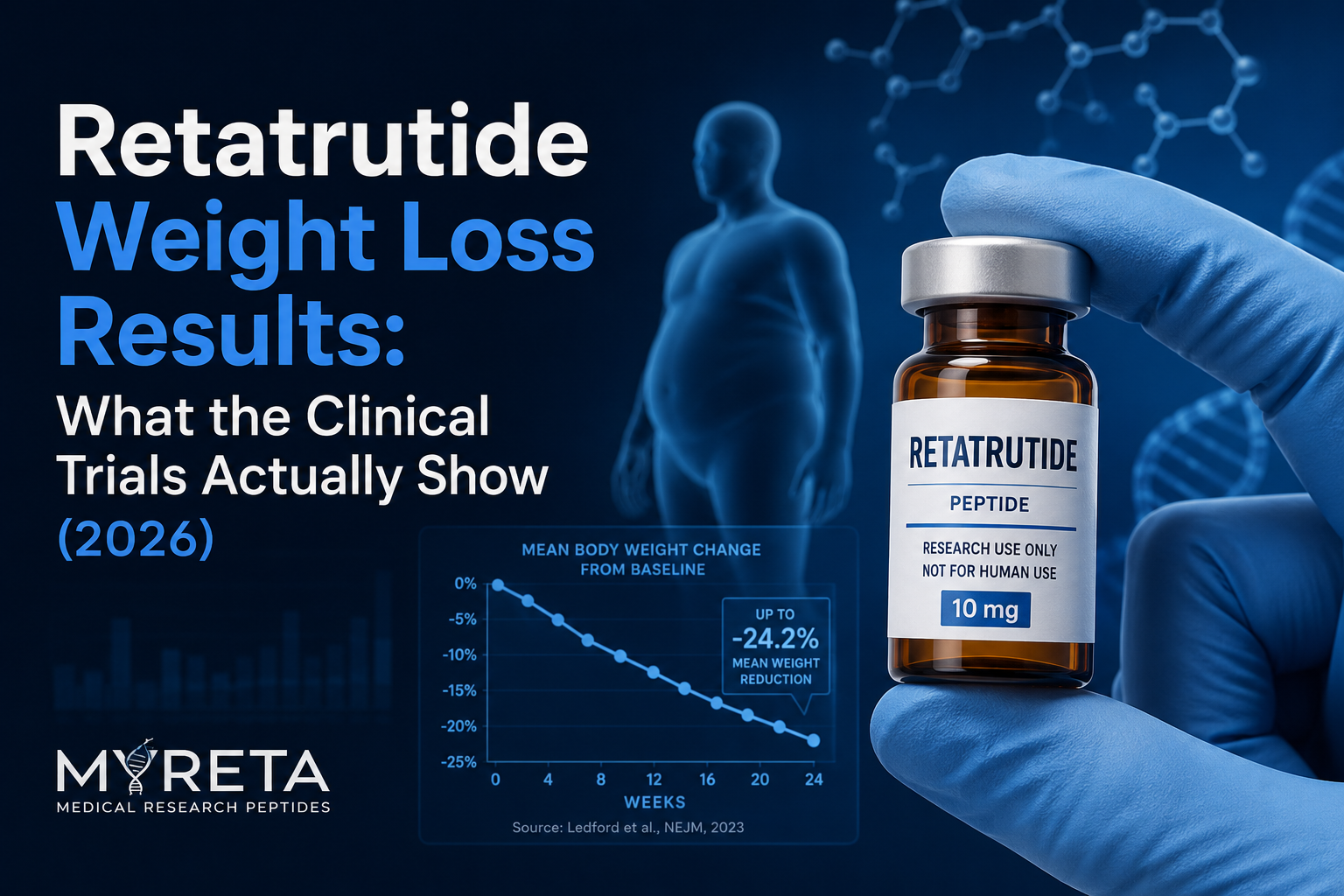
    Retatrutide produced a mean weight reduction of up to 24.2% over 48 weeks in Eli Lilly’s Phase 2 trial — and, unusually, the weight loss had not plateaued when the study ended. That single fact is why retatrutide (LY3437943) is currently the most talked-about compound in obesity research. This guide lays out exactly what the retatrutide weight loss results show, where the numbers come from, how it stacks up against semaglutide and tirzepatide, and the all-important UK research context. To understand the wider class context of what do peptides do in research, check out our plain-English guide. No hype — just the published data, accurately.

    On this page

    Key takeaways

    • Up to 24.2% mean body-weight reduction at the 12 mg dose over 48 weeks (Phase 2), versus roughly 2.1% on placebo.
    • That’s around 26 kg on average — and the curve was still falling at week 48, with no clear plateau.
    • It’s a triple agonist (GLP-1 + GIP + glucagon) — the glucagon arm is what sets it apart from semaglutide and tirzepatide.
    • It remains investigational: no MHRA or FDA marketing authorisation, and in the UK it’s supplied only as a research compound.
    • Phase 3 (TRIUMPH) is ongoing and will decide its clinical future.

    What is retatrutide?

    Retatrutide (development code LY3437943) is a once-weekly injectable peptide developed by Eli Lilly. It’s described as a “triple agonist” because it activates three metabolic receptors at once:

    • GLP-1 (glucagon-like peptide-1) — curbs appetite, slows gastric emptying
    • GIP (glucose-dependent insulinotropic polypeptide) — supports insulin response and appetite control
    • Glucagon receptor — the differentiator, linked to increased energy expenditure and fat metabolism

    Semaglutide (Wegovy/Ozempic) hits one of those receptors; tirzepatide (Mounjaro/Zepbound) hits two. Retatrutide hits all three — the mechanistic reason its trial numbers run higher.

    The headline weight-loss results

    The pivotal data come from the Phase 2 trial published in the New England Journal of Medicine (Jastreboff et al., 2023): 338 adults with obesity, randomised to retatrutide (1, 4, 8 or 12 mg) or placebo, for 48 weeks.

    • 12 mg dose: −24.2% mean body weight at 48 weeks — roughly 26 kg.
    • 8 mg dose: around −22%.
    • Placebo: approximately −2.1%.
    • No plateau: at the highest doses the weight curve was still declining at week 48 — meaning the 24.2% may understate the full effect over a longer period.

    That last point is what excited researchers most: most weight-loss agents flatten out, but retatrutide hadn’t. You can read the primary data in the NEJM Phase 2 publication. (For comparison, the “28.7%” figure floating around some sites isn’t the headline published mean — the robust, citable number is 24.2% at 48 weeks.)

    How retatrutide drives weight loss

    The triple mechanism works on three fronts at once:

    • Appetite regulation — the GLP-1 and GIP activity reduces hunger signalling and increases satiety, so less food is eaten without constant willpower.
    • Energy expenditure — the glucagon component is associated with increased fat metabolism and higher metabolic activity, in theory burning more rather than only eating less.
    • Blood-sugar control — improved glucose handling and reductions in HbA1c were seen in trial participants.

    It’s the glucagon arm — absent from semaglutide and tirzepatide — that researchers credit for the extra edge.

    Beyond weight: liver fat and metabolic health

    The results that arguably impressed clinicians most weren’t on the scales. In the trial, retatrutide was associated with dramatic reductions in liver fat, with a large proportion of participants who had fatty liver (steatosis) reaching normal liver-fat levels. Improvements in blood pressure, lipids and insulin sensitivity were also reported.

    This is the angle urologist Dr Alex Tatem highlighted on The Diary of a CEO when he described an unreleased compound that “tortures belly fat at a disproportionate rate” while delivering “the best improvements we’ve ever seen in… liver health” — predicting a “trillion-dollar drug when it comes out.” The visceral-fat-and-liver profile of retatrutide fits that description closely. (Our full breakdown of his interview is here.)

    Retatrutide vs semaglutide vs tirzepatide

    Approximate mean weight-loss figures from each compound’s pivotal trials:

    CompoundReceptor targetsApprox. mean weight loss
    Semaglutide (Wegovy)GLP-1~15% (STEP trials, 68 wks)
    Tirzepatide (Mounjaro/Zepbound)GLP-1 + GIP~20–22.5% (SURMOUNT)
    RetatrutideGLP-1 + GIP + glucagon~24.2% (Phase 2, 48 wks, still falling)

    A direct caveat for honesty: these come from different trials of different lengths and populations, so they’re indicative, not a head-to-head. But the trend — more receptors, more effect — is consistent.

    Phase 3: the TRIUMPH programme

    Retatrutide is now in Phase 3 trials (the TRIUMPH programme), the stage that evaluates long-term safety and effectiveness across much larger populations and decides whether it reaches the market. Until those complete and a regulator grants authorisation, retatrutide remains an investigational compound — promising data, not an approved medicine.

    Side effects in the trial

    Like other metabolic peptides, the side-effect profile was mostly gastrointestinal and dose-dependent:

    • Nausea, vomiting, diarrhoea and general GI discomfort were the most common.
    • Effects were more frequent at higher doses and during dose escalation.
    • Some participants discontinued over tolerability.

    Gradual dose titration was used to limit these — a standard approach across the GLP-1 class.

    The UK research context

    This is the part the hype tends to skip. Retatrutide has no MHRA marketing authorisation and no FDA approval — it is still in clinical trials. In the UK it cannot legally be sold or prescribed as a weight-loss medicine. What UK suppliers offer is retatrutide as a research compound, for laboratory use only — not for human consumption.

    So when you read “retatrutide weight loss results,” you’re reading clinical trial outcomes from Eli Lilly’s controlled studies — not a claim about a product you can buy and use. If you’re sourcing it for research, the only thing that separates a credible supplier from a risky one is verification: a batch-specific, third-party Certificate of Analysis confirming identity and ≥99% purity (see our quality testing page). Researchers handling lyophilised vials can work out exact concentrations with our free retatrutide reconstitution calculator.

    Frequently asked questions

    How much weight did people lose on retatrutide?

    In Eli Lilly’s Phase 2 trial, the 12 mg dose produced a mean reduction of about 24.2% of body weight over 48 weeks (roughly 26 kg), versus around 2.1% on placebo — and the loss had not plateaued by the study’s end.

    Is retatrutide better than tirzepatide or semaglutide?

    On trial averages, retatrutide’s ~24% exceeds tirzepatide’s ~20–22% and semaglutide’s ~15%, largely thanks to its added glucagon activity. But these are separate trials, and Phase 3 head-to-head data will tell the fuller story.

    Is retatrutide approved or available in the UK?

    No. It’s investigational, with no MHRA authorisation, and is supplied in the UK only as a research compound — not for human consumption.

    Does retatrutide help with fatty liver?

    Trial data showed substantial reductions in liver fat, with many participants who had steatosis reaching normal liver-fat levels — one of the most notable findings beyond weight loss.

    What are the main side effects?

    Predominantly gastrointestinal — nausea, vomiting and diarrhoea — and dose-dependent, which is why trials used gradual dose escalation.

    Final thoughts

    Retatrutide’s Phase 2 numbers — ~24.2% mean weight loss in 48 weeks, still falling, with striking liver-fat improvements — are why it’s described as potentially the most powerful obesity compound in development. The honest framing matters too: it’s investigational, the Phase 3 results aren’t in, and in the UK it’s a research compound only. If you’re researching it, start with verification — see current lab-tested stock on our retatrutide UK page, or the per-vial detail for Retaklik (Retatrutide) 60mg and Retatrutide 2.0 (45mg).

    Source: Jastreboff AM, et al. Triple–Hormone-Receptor Agonist Retatrutide for Obesity — A Phase 2 Trial. New England Journal of Medicine, 2023.

    This article is for informational and research purposes only and reports published clinical-trial data. Retatrutide is an investigational compound supplied for laboratory research use only and is not for human consumption. It has no MHRA or FDA marketing authorisation. Nothing here is medical advice.