Search BPC-157 UK and you get two kinds of result: a product page that wants your card details in about eight seconds, and a private clinic quoting £350 a month. Neither quite explains how to buy the compound without overpaying for something you can’t actually verify. This guide does. We will cover what BPC-157 genuinely is, what the research does and (importantly) does not show, the UK legal position in plain English, what a fair price looks like, and the one document that separates a properly verified supplier from a confident stranger with a vial and an opinion. For a complete background, read our guide on what do peptides do. No hype, no “miracle peptide” claims — just what a careful buyer needs to know.
Key takeaways
- BPC-157 is a synthetic 15-amino-acid peptide (a “pentadecapeptide”) studied mainly in animal models of tissue and gut repair. Human clinical evidence is still thin — anyone telling you otherwise is selling.
- In the UK it is sold strictly as a research chemical for laboratory use only. It has no MHRA marketing authorisation and is not for human consumption.
- BPC-157 is one of the most counterfeited peptides on the market. The batch-specific Certificate of Analysis (COA) is the only real proof of what is in the vial.
- Expect to see 5mg vials from roughly £15–£30. Price is a weak signal of quality; the COA and verified purity are the real ones.
- It rarely travels alone: BPC-157 is the backbone of popular research blends like Klikglow and the Wolverine Stack.
- For context, BPC-157 is on the WADA Prohibited List — relevant to anyone whose research touches competitive sport.
What is BPC-157?
BPC-157 stands for Body Protection Compound-157. It is a synthetic chain of 15 amino acids derived from a partial sequence of a protein found in human gastric juice — which is where the “body protection” name comes from. It does not occur in nature in this isolated form; it is made in a lab by solid-phase peptide synthesis.
Here are the specifications a serious supplier should be able to give you without reaching for a search engine:
| Property | Value |
|---|---|
| Full name | Body Protection Compound-157 (pentadecapeptide) |
| Molecular formula | C₂₂H₈₈N₁₆O₂₂ |
| Molecular weight | ~1419–1480 g/mol (acetate forms vary) |
| Amino acids | 15 (Gly-Glu-Pro-Pro-Pro-Gly-Lys-Pro-Ala-Asp-Asp-Ala-Gly-Leu-Val) |
| CAS number | 137525-51-0 (acetate salt) |
| Appearance | White to off-white lyophilised (freeze-dried) powder |
| Typical research purity | ≥99% (should be stated on the COA, not just the label) |
If a listing can’t produce a sequence, a formula and a purity figure, that tells you how well they actually know what they’re shipping.
What the research actually shows (and what it doesn’t)
This is where most BPC-157 pages quietly oversell, so let’s be straight with you.
The published BPC-157 literature is dominated by preclinical work — cell cultures and animal models, largely in rodents. In those models researchers have explored its role in tendon, ligament, muscle and gut-lining repair, and in pathways involving nitric oxide, angiogenesis (new blood-vessel formation) and growth-factor signalling. That body of work is genuinely interesting, and it is why the compound has such a following.
But — and it is a load-bearing “but” — robust human clinical trial data remain limited. There is no large, controlled efficacy trial in people that would license a treatment claim. A result observed in a rat tendon is a research finding, not a prediction about a human one. You can browse the primary literature yourself on PubMed and note how much of it is animal work. Promoting that as settled clinical fact is precisely the move regulators are watching for — and precisely the framing we avoid.
Our position: the science is worth taking seriously as research. That is also the practical reason every batch should be tested. If you intend to study a compound, step one is confirming it is, in fact, that compound.
Is BPC-157 legal in the UK?
Short version: BPC-157 is not a controlled drug in the UK, but it is also not an approved medicine. It has no marketing authorisation from the MHRA, so it cannot legally be sold or supplied for people to take. It can only be sold as a research chemical, for laboratory use only — not for human consumption.
That distinction isn’t small print; it is the entire legal basis the category stands on. Any UK seller attaching dosing instructions, health claims or “how to inject” advice to BPC-157 has stepped over that line — and a supplier relaxed about the regulations is usually just as relaxed about the analytics. Worth knowing too: BPC-157 sits on the World Anti-Doping Agency (WADA) Prohibited List, so it is banned in competitive sport regardless of everything above.
Why BPC-157 attracts so many fakes
Lyophilised peptide is the perfect disguise: a few milligrams of identical white powder in identical glass vials. You cannot distinguish ≥99% BPC-157 from under-dosed, degraded, or entirely different powder by sight, by smell, or even after reconstitution. Powder doesn’t blush — a mislabelled vial looks exactly as confident as the genuine article. The problem only becomes visible under a mass spectrometer.
So the market accumulates three failure modes: under-dosed (you paid for 5mg, you received 3mg), impure (sloppy synthesis and uninvited by-products), and mislabelled (a cheaper peptide entirely, or mostly mannitol bulking agent wearing a BPC-157 badge). Paying more doesn’t fix it — expensive fakes exist too. Demanding proof does.
The COA: the one check that actually matters
A Certificate of Analysis is a lab report confirming what is in a specific batch. Done properly, it is the most useful document in this entire category — the adult supervision in a market that otherwise runs on optimism. Done lazily, it is wallpaper. Here is how to tell them apart.
A COA worth trusting will:
- Be batch-specific. It must reference the exact batch/lot number on the vial you are buying — not a single certificate quietly reused across every order.
- Come from an independent third-party lab. In peptides, Janoshik is the name you’ll see most; a self-graded “we tested it ourselves” certificate is worth considerably less.
- Show purity by HPLC — a figure you want at ≥99% — and identity by mass spectrometry confirming the molecular weight matches BPC-157.
- Be dated and recent, and ideally independently verifiable, so the certificate can’t simply be edited in an image app.
An undated image, a certificate for a different batch, or a cheerful verbal “it’s fine” is itself the answer. This is the exact standard we hold ourselves to — see our Certificate of Analysis process and quality testing pages for how we do it.
BPC-157 UK price: what you should actually pay
In the UK, 5mg BPC-157 vials typically advertise from around £15 to £30, with bulk and multi-buy pricing pulling the per-vial cost down. That is the honest market range; anyone wildly outside it deserves a second look in either direction.
The figure the bargain-hunters miss is cost per verified milligram. A £15 vial that skips testing isn’t cheap — it is a gamble with a price tag. If it is under-dosed to 3mg, or it isn’t BPC-157 at all, your cost per real milligram is infinite, which is poor value in any currency. A slightly dearer vial with a batch COA and ≥99% purity becomes the cheaper purchase the moment you account for what you are actually receiving. Price is the weakest quality signal in the category; the COA is the strongest.
What good looks like: the buyer’s checklist
| Check | What good looks like | Red flag |
|---|---|---|
| COA | Batch-specific, third-party (e.g. Janoshik), verifiable | Generic image, no batch number, in-house only |
| Purity | ≥99% by HPLC, stated on the certificate | “High purity” with no number attached |
| Identity | Mass spec confirms ~1419–1480 g/mol | No mass spec data at all |
| Form | Lyophilised white powder, sealed vial | Pre-mixed liquid of unknown age |
| Labelling | “Research use only / not for human consumption” | Dosing or health claims on the listing |
| Dispatch | UK-based, tracked, sensible handling | Vague origin, no tracking, slow ambient post |
| Accountability | Real UK company details, contactable support | Anonymous seller, no returns policy, no address |
Handling & storage (the part that exposes a careless supplier)
We don’t give human-use instructions — but correct laboratory handling is part of judging a supplier, so the basics are worth knowing. Research-grade BPC-157 ships as a lyophilised powder precisely because dry peptide is far more stable than liquid. Stored sealed at -20°C, a good vial is generally stable for around two years. Once reconstituted (typically with bacteriostatic water in a lab setting), it is usually considered stable for up to roughly 28 days refrigerated at 2–8°C, minimising freeze-thaw cycles.
Why should a buyer care? Because a supplier who ships pre-mixed liquid of indeterminate age, or posts vials in a padded envelope with no thought to temperature, has just told you how much they understand the product they sell.
BPC-157 in the real world: Klikglow and the Wolverine Stack
In recovery research, BPC-157 rarely works the night shift alone — it is usually studied alongside its regular collaborators. That is exactly what our two most popular blends are built around, and BPC-157 is the common thread through both.
The headline act is KLIKGLOW (BPC-157 + TB-500 + GHK-Cu) 70mg — a triple-peptide research blend pairing BPC-157 with TB-500 and the copper peptide GHK-Cu for tissue, mobility and collagen studies. BPC-157 is the backbone of the formula. If you want the full molecular teardown — pharmacology, the evidence base and the regulatory framing, in rather more depth than a product label allows — we wrote a deliberately thorough Klikglow 70mg pharmacological analysis to sit beside it.
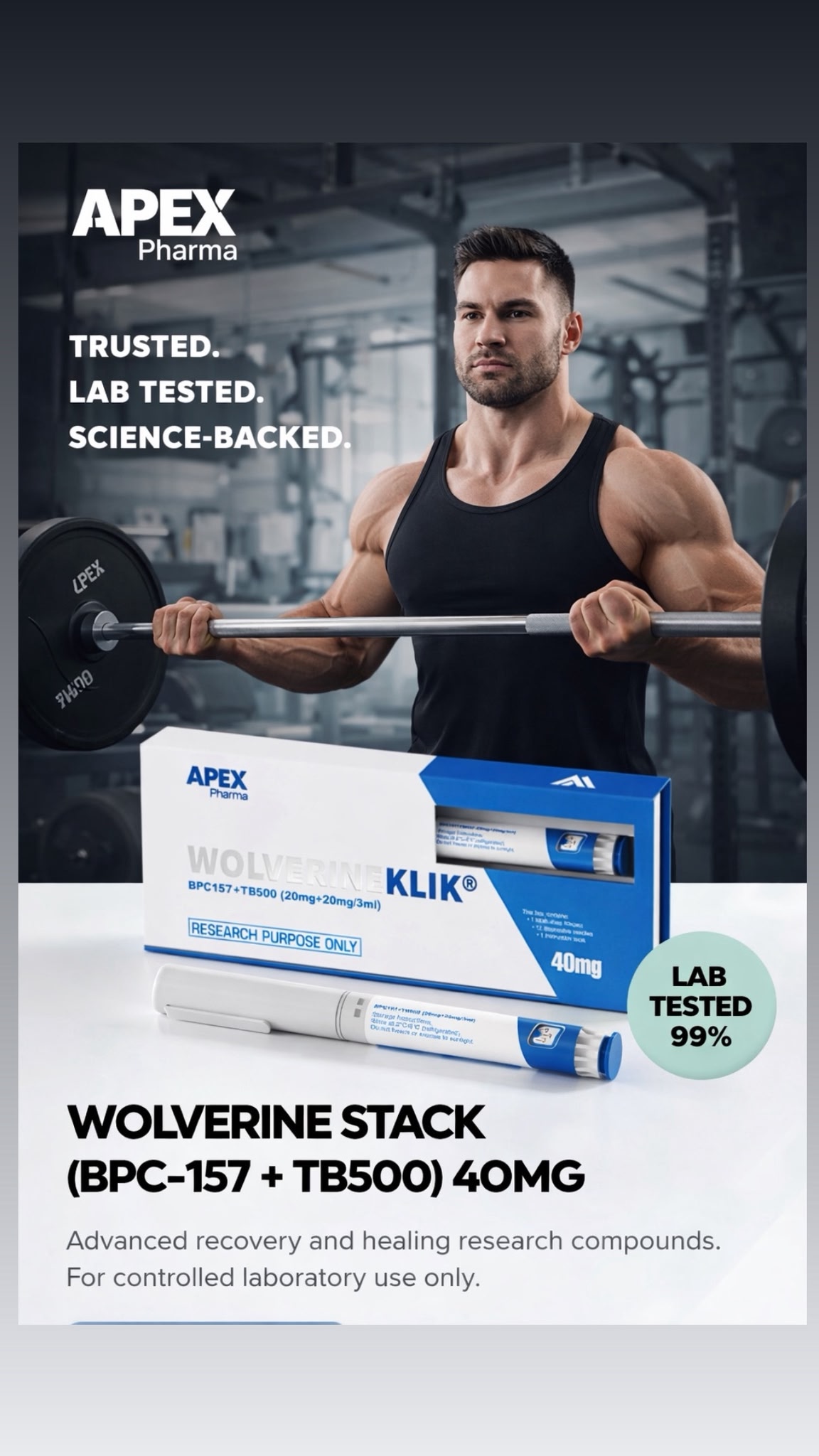
For a leaner pairing, the Wolverine Stack (BPC-157 + TB-500) combines the two repair-research staples without the copper peptide. Note that BPC-157 and TB-500 (thymosin beta-4) are distinct compounds with different sequences — frequently researched together, never interchangeable.
The rule that governs all of them: a blend is only as trustworthy as its least-tested ingredient, so every component should carry its own verification. A single COA stapled to a three-peptide product is two certificates short.
Where MyReta fits
We supply BPC-157 and related research peptides in the UK as lab-tested, research-use-only compounds — each with a batch-specific third-party COA and verified purity, dispatched from the UK. No mystery vials, no “trust us”, no claims we can’t hand you the certificate for. See current research stock in our shop, and for the universal checks on vetting any supplier, see our guide to buying research peptides in the UK.
Frequently asked questions
Is BPC-157 legal in the UK?
It is not a controlled drug, but it has no MHRA marketing authorisation — so it can only be sold as a research chemical for laboratory use, not for human consumption. It is also banned in competitive sport under the WADA Prohibited List.
How do I know if my BPC-157 is real?
Insist on a batch-specific, third-party COA (such as Janoshik) confirming ≥99% purity by HPLC and identity by mass spectrometry, matched to the lot number on your vial. Without one, you cannot verify it — and BPC-157 is heavily counterfeited.
How much does BPC-157 cost in the UK?
5mg vials typically advertise from around £15–£30, with bulk pricing lowering the per-vial cost. Judge value by cost per verified milligram, not the headline price — ultra-cheap, untested vials are where the fakes live.
What is the difference between BPC-157 and TB-500?
They are two distinct peptides with different amino-acid sequences, often studied together in tissue-repair research — our Wolverine Stack pairs the two, and our Klikglow blend adds GHK-Cu on top.
Does BPC-157 have strong human clinical evidence?
No. The published evidence is mostly preclinical (cell and animal studies). Controlled human trial data are limited, which is why no legitimate UK supplier should be making treatment or efficacy claims.
Why is BPC-157 sold “for research only”?
Because it has no medicine authorisation in the UK. The research-use-only framing is the legal basis for supplying it at all — and a supplier who respects that boundary is usually one who respects quality standards too.
The bottom line
Buying BPC-157 in the UK comes down to one habit: never buy a vial you can’t verify. Demand the batch-specific COA, check for ≥99% purity confirmed by an independent lab, ignore the suspiciously cheap and the suspiciously over-claimed alike, and buy from an accountable UK supplier who treats the science as research rather than a marketing prop. Do that and you are already ahead of most of the market. Browse lab-tested stock in our shop.
This article is for informational and research purposes only. BPC-157 is supplied for laboratory research use only and is not for human consumption. It has no MHRA marketing authorisation. Nothing here is medical advice.