Somewhere in the UK right now, there is a researcher standing in their kitchen at 11pm, holding a syringe, a vial of powder, and a very confused Alaskan malamute named Eddy who has just discovered that the kitchen floor is now slightly wet and extremely interesting. A splash of bacteriostatic water went one way. The researcher nearly went the other way, mid-pivot, mid-panic, narrowly avoiding a full ice-skating routine across the lino. Eddy, for his part, thought this was the best thing that had happened all week.
We are not naming names. We do not need to — if you have ever mixed a vial by hand, some version of this story has probably happened to you too. That is the whole reason this guide exists.
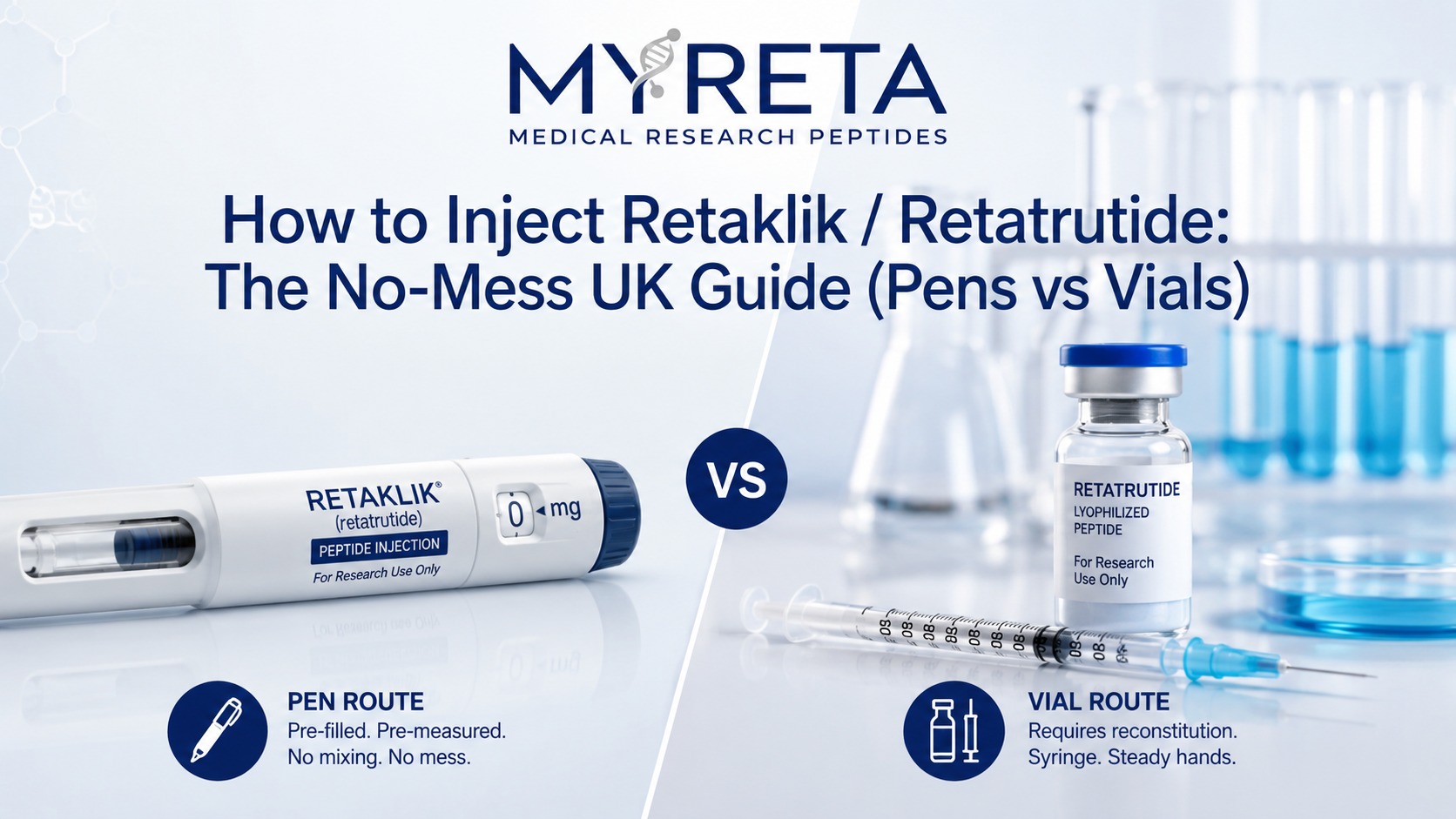
Injecting retatrutide — whether the box says Retaklik or plain retatrutide — comes in two very different flavours. There is the vial-and-syringe route, which turns you into a part-time lab technician every single week. And there is the pre-filled pen route, which turns the whole thing into “click a dial, done.” This guide walks through both, in plain English, so you know exactly what you are signing up for before the box even arrives (we also have a general UK guide on what do peptides do).
Quick note before we start: this is a practical, how-it-actually-works guide for research purposes. It is not medical advice and not a treatment plan for a person — the legal and safety detail is covered properly elsewhere on the site, linked below where it is relevant.
Key takeaways (the 30-second version)
- A Retaklik pen is retatrutide, pre-filled and pre-measured — no mixing, no syringes, no kitchen-floor incidents.
- A vial needs reconstitution — bacteriostatic water, a syringe, and steady hands, every single week, forever.
- A pen turns dosing into counting clicks, not doing maths at the kitchen counter at 11pm.
- Spilling, air bubbles, and “wait, was that 0.4ml or 0.04ml?” are vial problems. Pens do not have them.
- Your exact click count for any dose is one visit to our retaklik dosage calculator away — no mental arithmetic required.
- Whichever format you use, only trust a batch backed by a third-party COA, a hologram, and a batch code you can actually check.
Table of contents
- What “injecting” actually involves
- The vial route: reconstitution, in full comic detail
- The pen route: how a Retaklik pen actually works
- Pen vs vial: the honest side-by-side
- Step-by-step: using a Retaklik pen
- Working out your dose (without a calculator meltdown)
- Site rotation and basic technique
- Storage: keeping it happy (and away from Eddy)
- Standard Retaklik vs Retaklik 2.0: what is actually in the box
- The full vial walkthrough: reconstitution by the numbers
- Frequently asked questions
What “injecting” actually involves
Both formats deliver retatrutide the same basic way: a small injection just under the skin, called a subcutaneous injection. Think “just under the surface,” not into a muscle. It is the same general idea used across the whole GLP-1 research family, and it is genuinely one of the simplest injection types there is — a short needle, a small volume, done in seconds. The real difference between a pen and a vial is not the injection itself. It is everything that happens before it.
The vial route: reconstitution, in full comic detail
A vial arrives as a freeze-dried powder — basically peptide dust in a small glass bottle. Before you can inject anything, you have to turn that dust back into liquid yourself. This is called reconstitution, and it goes something like this, every single week, for as long as you are researching:
- Wipe the vial top with an alcohol swab, like you are politely introducing it to hygiene.
- Draw up an exact amount of bacteriostatic water into a syringe.
- Inject it into the vial slowly, down the side of the glass, so you do not blast the powder into a fine peptide snowstorm.
- Swirl gently — never shake, unless your goal is to personally offend the peptide.
- Wait for it to fully dissolve, which always takes exactly four minutes longer than you expect.
- Work out the concentration (mg per mL), then draw the correct volume for your specific dose, reading tiny lines on an insulin syringe that appear to have been printed by a very committed ant.
- Tap out any air bubbles, because an air bubble in a 0.1ml draw is basically 30% of your dose, gone, into the void.
None of that is hard, exactly. But it is a lot of small, fiddly steps, done by hand, under a kitchen light, with a bottle of liquid that is very good at finding gravity the moment you look away. This is how bacteriostatic water ends up on floors, on countertops, and — if you have a curious dog, cat, or nosy flatmate — occasionally on things that were not supposed to be involved at all. Consider it the price of admission for the vial route: more control over concentration, more steps to get there.
The pen route: how a Retaklik pen actually works
A Retaklik pen skips every single step above. It arrives already mixed, already measured, and already sealed by people whose entire job is getting that part right. You do not open it, dilute it, or calculate anything by hand. You dial a dose using a click wheel, prime the pen, and inject. That is the whole process.
Think of the difference like this: a vial is a flat-pack wardrobe, and you are the one assembling it, alone, with an Allen key and mounting frustration. A pen is the wardrobe arriving already built. Same wardrobe. Wildly different Tuesday evening.
Pen vs vial: the honest side-by-side
| What matters | Retaklik pen | Vial + bac water |
|---|---|---|
| Setup before injecting | None — ready to go | Full reconstitution, every week |
| Measuring your dose | Click dial does the maths | You measure by hand, every time |
| Mess risk | Basically zero | Spills, drips, air bubbles |
| Equipment needed | Just the pen | Bac water, syringes, alcohol swabs, a steady hand |
| Storage | Fridge, simple | Fridge, plus mixed-solution handling |
| Best for | Simplicity, consistency, first-timers | Flexibility, lower cost per mg |
Neither format is “wrong.” But if the idea of doing weekly kitchen chemistry does not appeal, or if you have already had your own Eddy-and-the-puddle moment, the pen removes that entire category of problem.
Step-by-step: using a Retaklik pen
- Wash your hands properly, like you are about to perform actual surgery on a sandwich.
- Check the pen — let it reach room temperature if it has been in the fridge, and check the hologram and batch code match the COA before you do anything else.
- Dial your dose using the click wheel. Not sure how many clicks you need? That is exactly what the retaklik dosage calculator is for — punch in your target dose, it hands back the click count.
- Prime the pen — a small test click to clear any air, the same idea as running a hose until it stops sputtering.
- Pick a site and rotate it (see the section below).
- Clean the skin with an alcohol wipe and let it air dry — do not blow on it, however tempting.
- Pinch, insert, press, hold for a few seconds so the full dose actually goes in, then release.
- Cap the pen, log the site you used, and pop the needle straight into a sharps bin. Never the household bin, never recapped by hand.
Total active mixing time: zero. Total time spent apologising to a pet for a spill: also zero.
Working out your dose (without a calculator meltdown)
Here is the honest bit: exactly how many clicks equal how many milligrams depends on which specific pen and strength you are holding, because different Retaklik formats pack a different amount of active compound into the same click. Rather than guess, or do the sums on the back of a delivery envelope, the numbers on your box are the source of truth — and our retaklik dosage calculator turns them into an exact click count in about four seconds. It is free, it is instant, and it is considerably less error-prone than mental arithmetic performed after a long day.
Site rotation and basic technique
A few simple habits keep injections comfortable and consistent, whichever format you use:
- Rotate your sites. Abdomen (at least 5cm from the navel) and outer thigh are the usual spots. Using the exact same patch every time is how you end up with a small firm lump — your skin remembers, even if you do not.
- Avoid broken, bruised, or irritated skin. Give it a rest and pick a different spot.
- Do not rub the site afterwards — gentle pressure with a clean swab is enough.
- Keep a simple log of which site you used and when. Future-you will thank present-you.
Storage: keeping it happy (and away from Eddy)
- Fridge, 2–8°C. Treat it like fresh milk, not tinned soup.
- Never freeze it. Freezing does the peptide no favours.
- Do not shake it. A calm life is a happy peptide.
- Keep it out of bright light, capped, and well away from kids, pets, and any dog with a habit of investigating things that smell interesting.
- Check the expiry and never use a pen that has been dropped or looks damaged, however tempting it is to just “see if it still works.”
Standard Retaklik vs Retaklik 2.0: what is actually in the box
“Retaklik” is not one single product — the box matters. Here is the plain-numbers breakdown:
| What matters | Standard Retaklik | Retaklik 2.0 |
|---|---|---|
| Active ingredient(s) | Retatrutide only | Retatrutide + cagrilintide |
| Total strength | 60mg per box | 45mg total mass (40mg retatrutide + 5mg cagrilintide) |
| Concentration / volume | 15mg per 0.6mL | 2.4mL total volume |
| Dosing format | Pre-divided into 4 fixed 15mg doses | Single multi-dose pen, dial-your-own via click system |
In short: standard Retaklik hands you four ready-made doses and no decisions to make. Retaklik 2.0 is a single pen you dial doses from, and it is studying a combination of compounds rather than retatrutide alone — useful if that dual-compound angle is what your research actually calls for. For the full breakdown of what makes 2.0 different at the molecular level, see our Retaklik vs Retatrutide guide.
If it is the 45mg combination format you are after, that is the Retaklik 2.0 45mg pen — independently verified to ≥99% purity, with a batch-specific COA and a tamper-evident hologram on every order. Looking for the plain retatrutide-only version instead? That is the Retaklik 40mg pen.
The full vial walkthrough: reconstitution by the numbers
Everything above makes the case for pens. But plenty of researchers still work with vials — and if that is you, doing it right matters far more than doing it fast. Here is the actual method, with real numbers, the way steady hands do it. Get these bits wrong and you are not just leaving a puddle for Eddy to investigate; you are risking an under-dose, a contaminated vial, or a batch of peptide you have quietly cooked.
1. Use bacteriostatic water — and nothing else
This is the non-negotiable one. You reconstitute with bacteriostatic water, never tap water and never the bottled stuff from the fridge door. The whole point of bacteriostatic water is the tiny amount of preservative in it that keeps microbes out of something destined to go under the skin. Ordinary water invites contamination and infection, and there is no clever workaround — no acceptable substitute exists.
2. Get the ratio right before you touch the powder
Your dose depends entirely on how much water you add, so decide this first. A common, easy-to-read setup: a 10mg vial mixed with 2ml of bacteriostatic water. On an insulin syringe, 2ml reads as 200 units, and that ratio leaves you with roughly 0.5mg of peptide for every 10 units you later draw. Keep the maths boring and round — it makes every dose after this one far easier to read. Not sure what your target works out to in units? Our retatrutide dosage calculator does the conversion for you, so you are never squinting at a syringe doing arithmetic in your head.
3. Add the water like a river, not a waterfall
Peptides are fragile. When you push the water in, aim the stream at the inside wall of the glass and let it run down gently — a slow river, not a waterfall crashing straight onto the powder. Blast it in and you can physically damage the molecules. If you see a lot of foaming, that is the vial telling you that you went too fast. Slow down.
4. Swirl — never shake
Once the water is in, swirl the vial gently until every last grain has dissolved. Do not shake it like a protein shaker, however satisfying that feels. Shaking, heat, and turbulence all stress the compound; a calm swirl keeps it intact. Give it the four extra minutes it always seems to need, and wait until the liquid is completely clear before moving on.
5. Injecting it: subcutaneous, fresh needle, clean site
The injection itself is the easy part — it is a subcutaneous jab, under the skin and into a fatty area, never into muscle. Good spots are the abdomen, love handles, glutes, or outer thigh. One detail experienced users mention: injecting into the stomach or love handles tends to bring appetite effects on a touch faster, while thighs and glutes give a more gradual ramp — so picking one area and staying consistent keeps your week-to-week experience even.
- Swap the needle. The needle you used to draw and mix the water is now blunt — fit a fresh insulin needle for the actual injection.
- Wipe the site with an alcohol pad and let it air dry.
- Pinch a fold of fat, insert the needle, and press the plunger steadily. Insulin needles are tiny — at worst it feels like a mosquito bite, and it rarely bleeds.
- Bin the needle straight into a sharps container. No reusing, no recapping by hand.
6. Store the mixed vial in the fridge
The moment powder becomes liquid, the clock starts. Keep the reconstituted vial in the fridge at 2–8°C, capped, out of the light, and — yes — well away from any curious malamute. Never freeze it, and give the top a quick alcohol wipe before each draw.
None of the above is medical advice or a dosing recommendation for a person; it is a plain-English description of the reconstitution process for research use only. Your COA and product labelling are always the source of truth for what is actually in your vial.
Frequently asked questions
Do I need to reconstitute a Retaklik pen?
No. Retaklik pens arrive pre-filled and pre-measured. Reconstitution — mixing bacteriostatic water with a powder — is only a vial thing.
Is a pen actually better than a vial?
For ease of use, yes — a pen removes mixing, measuring, and mess entirely. A vial can work out cheaper per milligram, but it asks more of you every single week. Pick based on how much weekly lab-technician energy you have to spare.
How many clicks is my dose?
It depends on your specific pen and strength, so rather than guess, use the retaklik dosage calculator — enter your target dose and it gives you the exact click count instantly.
Is Retaklik 2.0 the same as standard Retaklik?
No. Standard Retaklik is retatrutide only, split into four fixed 15mg doses. Retaklik 2.0 is a 45mg combination pen (40mg retatrutide plus 5mg cagrilintide) with dial-your-own dosing. See our full comparison guide for the detail.
Can I reuse a needle?
No. A new, sterile needle every time, disposed of straight into a sharps bin. Reusing needles blunts them fast and is not worth the discomfort or the risk.
What if I spill some during reconstitution?
It happens more often than anyone admits. If you lose a meaningful amount, do not try to estimate and inject anyway — treat that dose as compromised and mix again if you have the supplies, or switch to a pen and remove the problem entirely.
How do I know my pen is genuine?
Check the tamper-evident hologram and the unique batch code on the box, then cross-reference that batch against the published third-party COA before you use it. If a supplier cannot provide both, that is your answer.
Where can I get a verified Retaklik pen in the UK?
Every pen from MyReta’s Retaklik 2.0 45mg range ships with a batch-specific Janoshik COA, a tamper-evident hologram, and next-day UK delivery — so you can check exactly what arrived before you use it.
Final word
The injection itself takes seconds either way. What actually separates a smooth Tuesday evening from a kitchen-floor incident is everything that happens before the needle goes in — and that is precisely where a pen wins. No mixing, no maths, no small dog investigating a puddle of bacteriostatic water. If that sounds like an upgrade, the Retaklik 2.0 45mg pen is ready to ship, verified batch by batch, so the only thing you have to think about is the click count — and even that, the retaklik dosage calculator will happily do for you.
For research use only.