Tag: Research

  • MOTS-C Side Effects & The Cancer Question: UK Guide 2026

    MOTS-C Side Effects & The Cancer Question: UK Guide 2026

    MOTS-C side effects are the reason most people give up on this peptide before they understand it. Some folks feel brilliant. Others go bright red, feel wiped out, and quietly bin the whole idea. And hovering over all of it is the cancer question that nobody seems to answer properly — just a shrug and a change of subject.

    Here is the honest version. MOTS-C is not complicated. It only looks complicated because most explanations work backwards from the reaction instead of forwards from the mechanism. Get the mechanism right and everything else falls into place, including why two people can run the same compound and have completely opposite experiences.

    This guide is for research and information only. MOTS-C has no MHRA marketing authorisation in the UK and is supplied strictly for laboratory research use, not for human consumption.

    Key takeaways

    • MOTS-C is not synthetic in origin. It is coded in your mitochondrial DNA, and your cells have been making it your whole life.
    • Levels fall with age and with poor metabolic health. Exercise pushes them up.
    • The mechanism runs: folate cycle → AICAR builds up → AMPK switches on.
    • The two most reported MOTS-C side effects — flushing and fatigue — are downstream of that same mechanism, not separate problems.
    • On cancer, the published data points the opposite way to the fear. Levels are lower in ovarian cancer patients, and lab-added MOTS-C slowed tumour cell growth.
    • Human safety trials are still missing. That is the honest limit of what anyone can claim.

    MOTS-C is not something a lab invented

    This is the bit almost everyone gets wrong from the first sentence.

    MOTS-C is not a novel molecule someone dreamed up in a beaker. It is a short 16-amino-acid peptide encoded in mitochondrial DNA. Mitochondria are the little power stations inside nearly every cell you own, and they have been producing this signal across multiple tissues since before you could walk.

    Sit with that for a second. Your body already knows the signal. It knows how to receive it, read it and act on it. Nothing foreign is being introduced.

    What changes with age is simpler than you would expect. Levels drop. Sitting still keeps them low. Poor metabolic health drags them lower still. The same things that quietly wear down your metabolism over twenty years also wear down this signal.

    Exercise is the natural lever. Moving properly raises MOTS-C in muscle tissue and in circulation. That is part of why exercise does so much for metabolic health — it is not just calories burned, it is the messages your mitochondria send when you stress them the right amount.

    Adding MOTS-C from outside amplifies that same pathway. You are turning up a volume dial your body already built, on a track it may have stopped playing as loudly.

    My mitochondria used to be a stand-up comedian. Now they just do the odd ATP-earance.

    How MOTS-C actually works: folate, AICAR and AMPK

    Right, mechanism. Stay with me, because everything else in this article hangs off it.

    Inside the cell, MOTS-C interferes with something called the folate cycle — specifically the branch used to build new purines from scratch. When that cycle gets nudged, a compound called AICAR starts to pile up.

    AICAR is basically a smoke alarm. It tells the cell that energy is tight and it needs to adapt. That alarm flips a master switch called AMPK, which decides how the cell handles energy.

    When AMPK switches on, three things happen at once:

    1. Insulin sensitivity improves. Cells start listening to insulin properly again.
    2. GLUT transporters activate. Glucose moves into muscle cells through routes that do not need insulin to unlock the door.
    3. Mitochondrial biogenesis turns on. Cells start building brand new mitochondria.

    That is the same cascade exercise triggers. Stress a cell with a hard session and the energy sensor fires, and your metabolism responds. MOTS-C reaches the same switch without the sweat, which is why the nickname “exercise in a bottle” stuck. We covered that nickname properly in our piece on MOTS-c peptide benefits.

    A quick reality check though: it is a mechanism, not a magic wand. It will not build you a squat, teach you to run, or fix a diet made of meal deals.

    The part that makes MOTS-C genuinely unusual

    Most peptides do their job and stay put. MOTS-C does not.

    Under metabolic stress it leaves the mitochondria and moves into the cell nucleus — the head office. Once there it starts influencing stress-response genes directly, changing how the cell reads its own survival and adaptation instructions.

    That was a genuine surprise when it was first described. A signal from the power station walking into head office and rewriting the memo is not how the textbook used to read. You can read the full mechanistic review in the Journal of Translational Medicine.

    Here is the important consequence. What MOTS-C does next depends entirely on what it has to work with. Give it a solid metabolic foundation and the signal lands well. Give it a system that is already struggling and you stress that system before it can adapt.

    Hold that thought. It explains almost every bad experience people report.

    The MOTS-C cancer question, answered properly

    This is the question that stops people, so let us do it properly rather than shrug.

    The fear is not completely invented. There is real nuance in the biology of AMPK — that energy-sensing switch can behave differently depending on what is happening inside a given cell. That context dependency is well documented in the literature.

    Somewhere along the line, someone connected that general AMPK nuance to MOTS-C specifically, and the concern spread like a rumour in a group chat.

    The problem is that it is a theoretical worry about a pathway, not a finding about this peptide. And when you look at what has actually been published on MOTS-C, the direction runs the opposite way to the fear.

    In ovarian cancer research, MOTS-C levels were found to be lower in patient serum and tumour tissue, and lower levels tracked with worse outcomes. Not higher. Lower.

    When MOTS-C was added to ovarian cancer cells in the lab, it slowed their growth. A 2024 paper in Advanced Science reported that exogenous MOTS-C dose-dependently inhibited proliferation, migration and invasion of those cells. The signal moved in a protective direction, not a permissive one.

    Now think about the age pattern. MOTS-C declines as you get older. Cancer risk rises as you get older. If this peptide fed tumours, you would expect that correlation to run the other way round.

    Two honest caveats, because you deserve them:

    • Correlation is not causation. The link is not proven.
    • There are no large human safety trials. Nobody can call this proven safe. Anyone who does is selling something.

    So the fair summary is this: the fear is built on a real mechanism aimed at the wrong target, and the published data on MOTS-C itself does not support it. That is not the same as a clean bill of health, and we are not going to pretend it is.

    Why some people react badly to MOTS-C

    Now the practical bit. These are the reported reactions, why they happen, and what they actually mean.

    1. The histamine reaction: flushing, itching, injection site flare

    This is the most commonly reported MOTS-C side effect by a distance. Red face, warm skin, sometimes a bit of chest tightness, often a raised itchy patch at the injection site.

    People assume it is an allergy or a bad batch. Usually it is neither.

    Remember that folate cycle nudge from earlier? Here is where it comes back. MOTS-C carries a positive charge. Subcutaneous fat is stuffed with mast cells, and mast cells are twitchy around positively charged compounds. They respond by releasing histamine. The metabolic activation MOTS-C triggers may add to that histamine load on top.

    So the reaction and the result come from the same place. It is not the body rejecting the compound. It is the body responding to the mechanism.

    What is reported to help, in research settings:

    • Start low and increase slowly rather than jumping straight in.
    • Let the solution come to room temperature first. Cold liquid into warm tissue is nobody’s friend.
    • Administer slowly rather than fast.
    • Change the site rather than hammering the same spot.

    Most reports describe it settling down as the system adjusts. If it does not settle, or if breathing is affected at all, that is a stop-and-get-medical-advice situation, not a push-through situation.

    2. Fatigue: the flat battery problem

    This one confuses people most, because it feels backwards. You take something meant to raise energy and you feel worse.

    The reason is straightforward once you see it.

    MOTS-C increases demand on your mitochondria. It turns the signal up. If those mitochondria are already damaged, stressed or running on fumes, turning the signal up is like revving a knackered engine. The system hits its actual ceiling first, and the ceiling is low.

    That is what the crash looks like. Great for three days, then a brick wall. Or feeling rough from day one.

    This is exactly why SS-31 is so often sequenced before MOTS-C in research protocols. SS-31 (elamipretide) is studied as a mitochondrial repair compound — it works on the membrane side of the problem. Repair the engine, then ask it to work harder. Our full SS-31 pharmacology profile covers that mechanism in depth, and the SS-31 research pen sits in the shop alongside MOTS-C for that reason.

    You cannot optimise a system you have not repaired. Foundation first, every time.

    3. The steep calorie deficit clash

    Quick but important.

    Running a hard calorie deficit while adding MOTS-C is asking the metabolism to ramp energy production up while you are starving it of fuel. AMPK is already firing hard under deficit conditions. Layer more activation on top and you can push it into overdrive.

    That combination is where a lot of “I felt awful” reports come from. Not a bad vial. Bad timing.

    4. Homocysteine and MTHFR

    This one will not apply to most people, but it matters if it applies to you.

    MOTS-C acts on the folate–methionine cycle. In theory that could shift homocysteine levels in someone carrying an MTHFR variant. If that is on your radar, it is a sensible thing to have on a lab panel rather than a guess.

    Reported MOTS-C protocols in the research literature

    Worth saying clearly: this section describes what appears in research protocols and published discussion. It is not a dosing instruction, and MOTS-C is not authorised for human use in the UK.

    With that stated, the patterns that come up most often look like this:

    ElementCommonly reported approach
    Standard frequencyOnce weekly, single administration
    TimingMorning
    Loading phaseSome protocols front-load three times weekly for two weeks, then drop back to weekly
    Cycle length8 to 12 weeks maximum
    BreakOne to two months off afterwards
    Repeat cyclesFrequently described as a one-off structured cycle rather than a permanent fixture

    The recurring theme is restraint. More is not better here. The Reddit approach of “double it and see” is how you turn an interesting mechanism into a bad week.

    Where MOTS-C sits in a sequence

    Sequencing matters more than dose with this one.

    SS-31 first, to address existing mitochondrial damage. Then, as that cycle nears its end, MOTS-C is introduced — so the activation signal arrives at a system that can actually receive it. That is the logic behind the SS-31 and MOTS-C pairing you see referenced as a mitochondrial reset sequence.

    It is also why MOTS-C is a poor starter compound. It is a layer, not a foundation. In most structured protocols it appears well after the basics are in place, not in week one.

    MOTS-C alongside GLP-1 style compounds

    This pairing gets asked about a lot, and mechanistically it is a fair question.

    GLP-1 receptor agonists work through hormonal incretin receptors on the outside of the cell. MOTS-C works inside the cell, through AMPK and mitochondrial stress signalling. Different doors, same building.

    There are no head-to-head trials, so nobody can claim a proven synergy. But the mechanisms are not competing — they approach the same metabolic problem from opposite ends. If you are researching that side of things, our breakdown of the retatrutide TRIUMPH Phase 3 data covers the incretin half of the picture.

    Buying MOTS-C in the UK: what actually matters

    If you are looking to buy MOTS-C in the UK, the legal position is simple. It is not a controlled drug, but it has no MHRA marketing authorisation. That means it can only be supplied as a research chemical for laboratory use, and never for human consumption.

    The quality position is simpler still. You cannot tell purity by looking. White powder is white powder, and a nice box proves nothing.

    The only thing that proves anything is a batch-specific, third-party Certificate of Analysis that matches the lot number on your vial or pen. Purity confirmed by HPLC, identity confirmed by mass spectrometry, issued by an independent lab you can actually contact.

    We publish ours. You can see how batches are tested on our Certificates of Analysis and quality testing pages, and there is a full walkthrough in our guide to reading a peptide COA properly.

    For pricing and supplier vetting specifically, our MOTS-C UK buyer’s guide goes through cost per verified milligram and the red flags worth walking away from. Our own research pen is the MOTS-C KLIK PEN 40mg at £165, supplied with a batch COA.

    Frequently asked questions

    What are the most common MOTS-C side effects?

    Flushing, warm or itchy skin, and injection site reactions are reported most often, followed by fatigue. Both are linked to the compound’s mechanism rather than being separate problems.

    Does MOTS-C cause cancer?

    There is no published evidence that MOTS-C causes cancer. The concern comes from general nuance around the AMPK pathway, not from MOTS-C data. Published research found MOTS-C levels were lower in ovarian cancer patients, and added MOTS-C slowed cancer cell growth in the lab. Human safety trials are still lacking, so nothing is proven either way.

    Why does MOTS-C make some people flush?

    MOTS-C carries a positive charge and subcutaneous tissue is rich in mast cells, which release histamine in response to positively charged compounds. The metabolic activation it triggers may add to that histamine load. It is a mechanism response, not usually an allergy.

    Why does MOTS-C make me tired instead of energised?

    It increases demand on the mitochondria. If those mitochondria are already compromised, the extra demand exposes the ceiling rather than raising it. This is why repair compounds such as SS-31 are commonly sequenced first in research protocols.

    Should SS-31 be used before MOTS-C?

    In most published sequencing discussion, yes. SS-31 is studied for mitochondrial repair, MOTS-C for mitochondrial activation. Repairing before activating is the logic behind running SS-31 first and introducing MOTS-C as that cycle winds down.

    Is MOTS-C legal in the UK?

    MOTS-C is not a controlled substance in the UK, but it holds no MHRA marketing authorisation. It can only be sold and supplied as a research chemical for laboratory use, not for human consumption.

    Can MOTS-C affect homocysteine levels?

    Theoretically, yes. MOTS-C acts on the folate–methionine cycle, so anyone carrying an MTHFR variant may want homocysteine included on a lab panel rather than assumed.

    The bottom line

    Most MOTS-C side effects are not the compound failing. They are the compound working on a system that was not ready for it.

    The flushing is the mechanism. The fatigue is the ceiling. The cancer fear is a real piece of biology pointed at the wrong target, and what has actually been published on MOTS-C runs in the opposite direction — while still falling well short of proof.

    Foundation first, repair before activation, restraint over enthusiasm, and a batch COA before any of it. That is the whole game.

    If you are researching this compound, see the lab-tested MOTS-C KLIK PEN 40mg or browse the full research peptide range. Every batch is independently verified to 99%+ purity with a certificate you can check yourself.

    This article is for informational and research purposes only. MOTS-C is supplied strictly for laboratory research use and is not for human consumption. It has no MHRA marketing authorisation. Nothing here is medical advice, and nothing here should be taken as a recommendation to use any compound in humans or animals. Always speak to a qualified healthcare professional about your own health.
  • Retatrutide TRIUMPH Results: Phase 3 Weight-Loss & Diabetes Data (2026)

    Retatrutide TRIUMPH Results: Phase 3 Weight-Loss & Diabetes Data (2026)

    Retatrutide just posted the biggest weight-loss numbers of any obesity drug tested so far. In 2026 its large Phase 3 trials — the TRIUMPH programme and the TRANSCEND-T2D diabetes study — finally gave us the proper, regulator-grade data everyone had been waiting years for. Here’s what the trials actually showed, in plain English, with the figures checked against Eli Lilly’s own releases and The Lancet.

    On this page

    Key takeaways

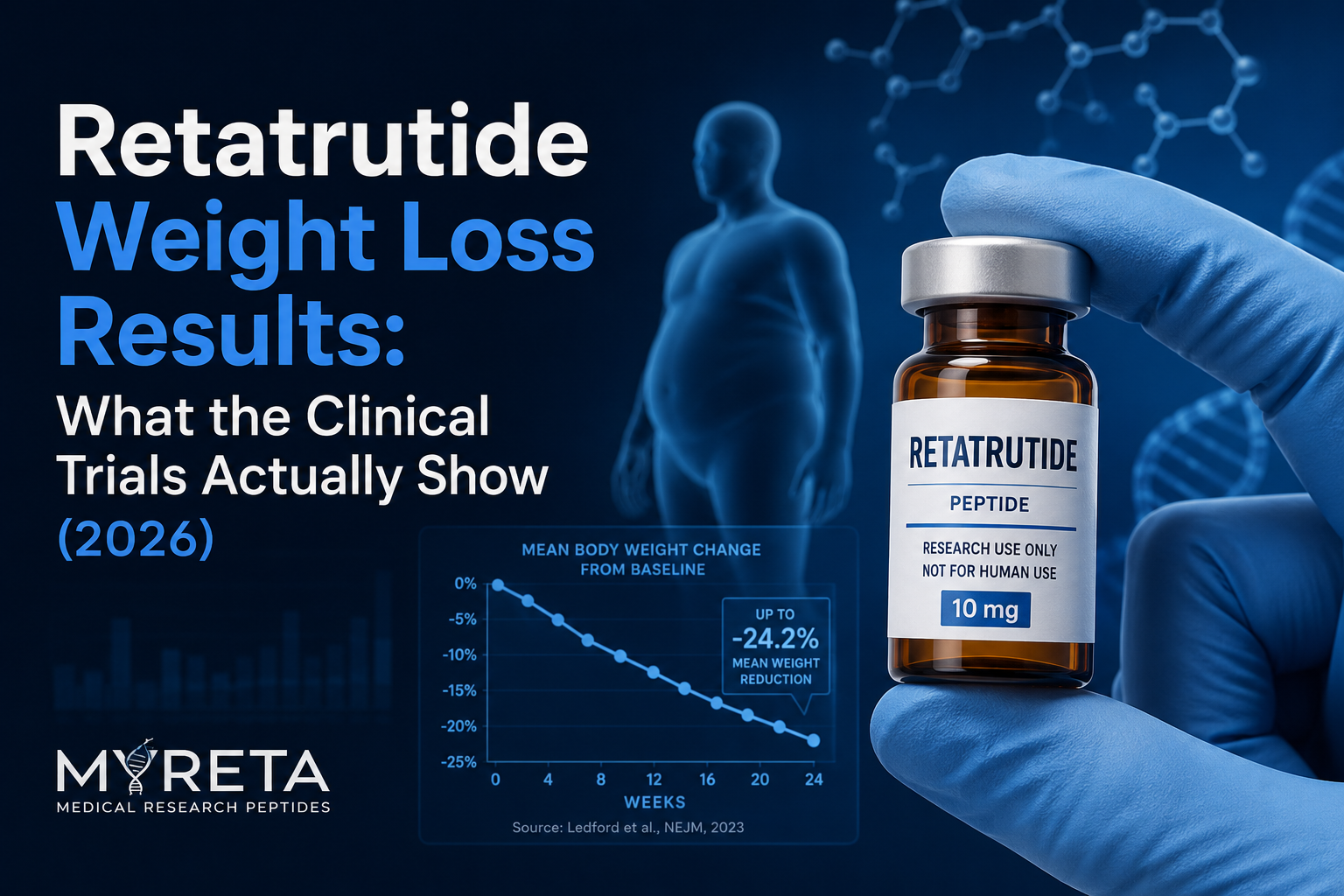
    • TRIUMPH-1 showed 28.3% mean weight loss at 80 weeks on the 12 mg dose, versus 2.2% on placebo.
    • 45.3% of people on 12 mg lost 30% or more of their body weight — the highest proportion ever reported for a weight-loss medicine.
    • People with a higher starting BMI who carried on to 104 weeks lost an average of 30.3% (about 85 lb).
    • TRANSCEND-T2D-1 cut HbA1c by up to 1.94% and body weight by up to 16.8% in type 2 diabetes, published in The Lancet.
    • Retatrutide still has no MHRA or FDA approval — these are trial results, and in the UK it remains a research compound for laboratory use only.

    What retatrutide is (the “triple agonist” bit)

    Retatrutide (lab code LY3437943) is what scientists call a triple agonist. That sounds like a wrestling move, but it just means the drug switches on three different hunger-and-metabolism receptors at once — GLP-1, GIP, and glucagon — instead of one or two. Semaglutide (Wegovy) hits one. Tirzepatide (Mounjaro) hits two. Retatrutide goes for the full set, like someone who can’t walk past a buy-one-get-one-free sign.

    For years the only data came from a small Phase 2 trial. That changed in 2026, when the big Phase 3 results landed — the kind regulators actually look at. (New to the compound? Start with what retatrutide actually is.)

    TRIUMPH-1: the headline obesity trial

    TRIUMPH-1 enrolled 2,339 adults with obesity, or overweight plus a weight-related health problem, but no diabetes. They were given retatrutide at 4 mg, 9 mg, or 12 mg, or a placebo (a dummy dose used for comparison), once a week for 80 weeks. Eli Lilly announced the topline results on 21 May 2026.

    DoseMean weight loss at 80 weeks
    4 mg19.0%
    9 mg25.9%
    12 mg28.3%
    Placebo2.2%

    The number that made headlines: 45.3% of people on the 12 mg dose lost 30% or more of their body weight — territory previously seen mostly after weight-loss surgery, and the highest share ever reported for an anti-obesity drug. A jab doing a job once reserved for an operating theatre.

    It kept going, too. Participants with a higher baseline BMI who stayed on 12 mg through 104 weeks lost an average of 30.3% of their body weight — around 85 lb.

    For rough context, tirzepatide came in around 20–22.5% and semaglutide 2.4 mg around 14.9% in their own Phase 3 obesity trials. Different trials with different people, so it isn’t a perfectly fair race — but the trend is clear. For a plain-English look at the numbers on their own, see our retatrutide weight-loss results guide.

    TRANSCEND-T2D-1: retatrutide and type 2 diabetes

    A separate trial, TRANSCEND-T2D-1, tested retatrutide in 537 adults who do have type 2 diabetes and whose blood sugar wasn’t controlled by diet and exercise alone. Over 40 weeks it:

    • cut HbA1c (a marker of average blood sugar over months) by 1.69% to 1.94% across the doses, versus 0.81% on placebo;
    • cut body weight by 11.5% to 16.8%, versus 2.5% on placebo.

    The results were published in The Lancet in June 2026 — the medical world’s equivalent of getting your name in lights.

    The wider TRIUMPH programme: knee and sleep apnoea

    TRIUMPH isn’t a single trial. It’s a family of Phase 3 studies that began in 2023 and has enrolled more than 5,800 participants, testing retatrutide not just for weight but for the conditions that extra weight causes:

    • Knee osteoarthritis (TRIUMPH-4). People with obesity and knee OA on 12 mg lost an average of 28.7% of body weight at 68 weeks, and knee-pain scores (WOMAC) dropped by up to 75.8%.
    • Obstructive sleep apnoea (a substudy within TRIUMPH-1). Among participants with severe sleep apnoea, the apnoea-hypopnoea index fell by 60.6% from a severe baseline — a big improvement in overnight breathing.

    If those benefits hold up, retatrutide starts to look less like a weight-loss drug with nice side effects and more like a treatment for the diseases that excess weight drives in the first place.

    ADA 2026 and where approval stands

    The TRIUMPH-1 and TRANSCEND-T2D-1 data were presented at the American Diabetes Association’s 86th Scientific Sessions on 6 June 2026 — think of it as the World Cup of diabetes research, just with more lanyards and fewer penalty shoot-outs.

    Worth saying plainly: retatrutide still doesn’t have MHRA or FDA approval. Phase 3 is the stage before approval, not after it. These are trial results, not a green light to prescribe it. In the UK it remains available only as a research compound for laboratory use — not for human consumption — until a regulator says otherwise. If you need lab-tested retatrutide for research, see our UK retatrutide range, all supplied with a batch-specific Certificate of Analysis.

    Frequently asked questions

    What did the retatrutide TRIUMPH-1 trial find?

    In 2,339 adults with obesity and no diabetes, retatrutide produced mean weight loss of 28.3% at 80 weeks on the 12 mg dose, versus 2.2% on placebo. 45.3% of 12 mg participants lost 30% or more of their body weight, and those with a higher baseline BMI who continued to 104 weeks lost an average of 30.3%.

    How does retatrutide compare to Mounjaro and Wegovy?

    Retatrutide is a triple agonist (GLP-1, GIP and glucagon), whereas tirzepatide/Mounjaro is a dual agonist and semaglutide/Wegovy is a single GLP-1 agonist. In their respective Phase 3 obesity trials tirzepatide reached roughly 20–22.5% and semaglutide 2.4 mg about 14.9%, compared with retatrutide’s 28.3% at 12 mg — though these are separate trials and not head-to-head.

    What did TRANSCEND-T2D-1 show?

    In 537 adults with type 2 diabetes, over 40 weeks retatrutide reduced HbA1c by up to 1.94% and body weight by up to 16.8%, versus 0.81% and 2.5% on placebo. The results were published in The Lancet in June 2026.

    Is retatrutide approved in the UK?

    No. It has no MHRA or FDA marketing authorisation. TRIUMPH and TRANSCEND are Phase 3 trial results, not a regulatory approval. In the UK retatrutide is supplied only as a research compound for laboratory use, not for human consumption.

    What is the TRIUMPH programme?

    A family of Phase 3 trials that began in 2023 and has enrolled more than 5,800 participants, testing retatrutide for weight management and related conditions including knee osteoarthritis (TRIUMPH-4) and obstructive sleep apnoea (a TRIUMPH-1 substudy), with further results expected.

    Related retatrutide reading

    Final thoughts

    The 2026 data is genuinely significant: the largest Phase 3 weight-loss numbers published to date, plus real improvements in blood sugar, knee pain and sleep apnoea. It’s still investigational, and nothing here is medical advice — but for anyone following the science, retatrutide has clearly raised the bar.

    For the full breakdown of retatrutide’s published weight-loss data, see our clinical trial results guide. If you’re sourcing retatrutide for research purposes, browse our UK retatrutide range and always check for a batch-specific, third-party Certificate of Analysis confirming ≥99% purity — see our quality testing page for how we verify stock.

    This article is for informational and research purposes only and reports published clinical-trial data. Retatrutide is an investigational compound with no MHRA or FDA marketing authorisation, supplied for laboratory research use only and not for human consumption. Nothing here is medical advice.

  • How to Inject Retaklik / Retatrutide: The No-Mess UK Guide (Pens vs Vials)

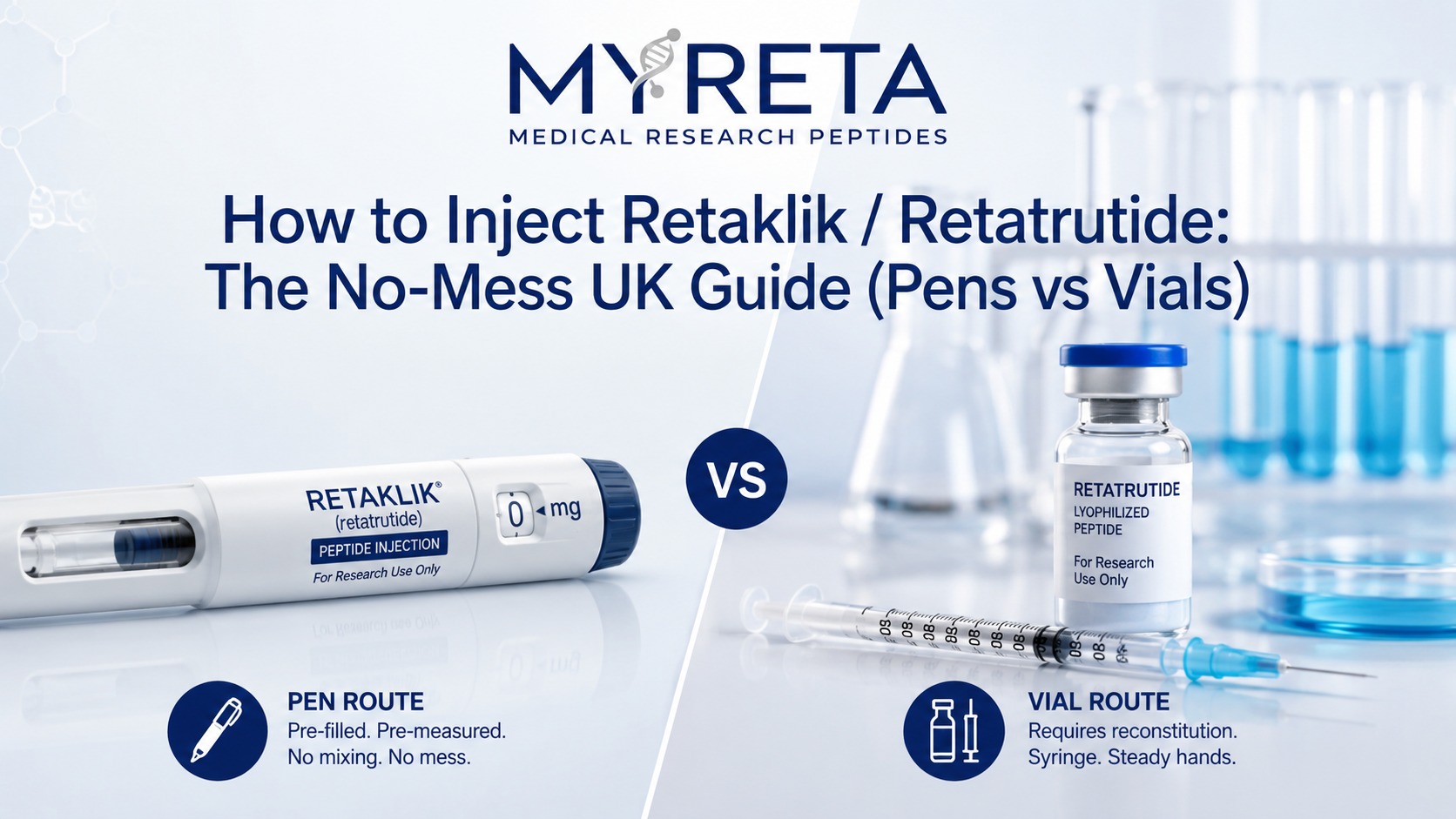
    How to Inject Retaklik / Retatrutide: The No-Mess UK Guide (Pens vs Vials)

    Somewhere in the UK right now, there is a researcher standing in their kitchen at 11pm, holding a syringe, a vial of powder, and a very confused Alaskan malamute named Eddy who has just discovered that the kitchen floor is now slightly wet and extremely interesting. A splash of bacteriostatic water went one way. The researcher nearly went the other way, mid-pivot, mid-panic, narrowly avoiding a full ice-skating routine across the lino. Eddy, for his part, thought this was the best thing that had happened all week.

    We are not naming names. We do not need to — if you have ever mixed a vial by hand, some version of this story has probably happened to you too. That is the whole reason this guide exists.

    Injecting retatrutide — whether the box says Retaklik or plain retatrutide — comes in two very different flavours. There is the vial-and-syringe route, which turns you into a part-time lab technician every single week. And there is the pre-filled pen route, which turns the whole thing into “click a dial, done.” This guide walks through both, in plain English, so you know exactly what you are signing up for before the box even arrives (we also have a general UK guide on what do peptides do).

    Quick note before we start: this is a practical, how-it-actually-works guide for research purposes. It is not medical advice and not a treatment plan for a person — the legal and safety detail is covered properly elsewhere on the site, linked below where it is relevant.

    Key takeaways (the 30-second version)

    • A Retaklik pen is retatrutide, pre-filled and pre-measured — no mixing, no syringes, no kitchen-floor incidents.
    • A vial needs reconstitution — bacteriostatic water, a syringe, and steady hands, every single week, forever.
    • A pen turns dosing into counting clicks, not doing maths at the kitchen counter at 11pm.
    • Spilling, air bubbles, and “wait, was that 0.4ml or 0.04ml?” are vial problems. Pens do not have them.
    • Your exact click count for any dose is one visit to our retaklik dosage calculator away — no mental arithmetic required.
    • Whichever format you use, only trust a batch backed by a third-party COA, a hologram, and a batch code you can actually check.

    Table of contents

    What “injecting” actually involves

    Both formats deliver retatrutide the same basic way: a small injection just under the skin, called a subcutaneous injection. Think “just under the surface,” not into a muscle. It is the same general idea used across the whole GLP-1 research family, and it is genuinely one of the simplest injection types there is — a short needle, a small volume, done in seconds. The real difference between a pen and a vial is not the injection itself. It is everything that happens before it.

    The vial route: reconstitution, in full comic detail

    A vial arrives as a freeze-dried powder — basically peptide dust in a small glass bottle. Before you can inject anything, you have to turn that dust back into liquid yourself. This is called reconstitution, and it goes something like this, every single week, for as long as you are researching:

    • Wipe the vial top with an alcohol swab, like you are politely introducing it to hygiene.
    • Draw up an exact amount of bacteriostatic water into a syringe.
    • Inject it into the vial slowly, down the side of the glass, so you do not blast the powder into a fine peptide snowstorm.
    • Swirl gently — never shake, unless your goal is to personally offend the peptide.
    • Wait for it to fully dissolve, which always takes exactly four minutes longer than you expect.
    • Work out the concentration (mg per mL), then draw the correct volume for your specific dose, reading tiny lines on an insulin syringe that appear to have been printed by a very committed ant.
    • Tap out any air bubbles, because an air bubble in a 0.1ml draw is basically 30% of your dose, gone, into the void.

    None of that is hard, exactly. But it is a lot of small, fiddly steps, done by hand, under a kitchen light, with a bottle of liquid that is very good at finding gravity the moment you look away. This is how bacteriostatic water ends up on floors, on countertops, and — if you have a curious dog, cat, or nosy flatmate — occasionally on things that were not supposed to be involved at all. Consider it the price of admission for the vial route: more control over concentration, more steps to get there.

    The pen route: how a Retaklik pen actually works

    A Retaklik pen skips every single step above. It arrives already mixed, already measured, and already sealed by people whose entire job is getting that part right. You do not open it, dilute it, or calculate anything by hand. You dial a dose using a click wheel, prime the pen, and inject. That is the whole process.

    Think of the difference like this: a vial is a flat-pack wardrobe, and you are the one assembling it, alone, with an Allen key and mounting frustration. A pen is the wardrobe arriving already built. Same wardrobe. Wildly different Tuesday evening.

    Pen vs vial: the honest side-by-side

    What mattersRetaklik penVial + bac water
    Setup before injectingNone — ready to goFull reconstitution, every week
    Measuring your doseClick dial does the mathsYou measure by hand, every time
    Mess riskBasically zeroSpills, drips, air bubbles
    Equipment neededJust the penBac water, syringes, alcohol swabs, a steady hand
    StorageFridge, simpleFridge, plus mixed-solution handling
    Best forSimplicity, consistency, first-timersFlexibility, lower cost per mg

    Neither format is “wrong.” But if the idea of doing weekly kitchen chemistry does not appeal, or if you have already had your own Eddy-and-the-puddle moment, the pen removes that entire category of problem.

    Step-by-step: using a Retaklik pen

    1. Wash your hands properly, like you are about to perform actual surgery on a sandwich.
    2. Check the pen — let it reach room temperature if it has been in the fridge, and check the hologram and batch code match the COA before you do anything else.
    3. Dial your dose using the click wheel. Not sure how many clicks you need? That is exactly what the retaklik dosage calculator is for — punch in your target dose, it hands back the click count.
    4. Prime the pen — a small test click to clear any air, the same idea as running a hose until it stops sputtering.
    5. Pick a site and rotate it (see the section below).
    6. Clean the skin with an alcohol wipe and let it air dry — do not blow on it, however tempting.
    7. Pinch, insert, press, hold for a few seconds so the full dose actually goes in, then release.
    8. Cap the pen, log the site you used, and pop the needle straight into a sharps bin. Never the household bin, never recapped by hand.

    Total active mixing time: zero. Total time spent apologising to a pet for a spill: also zero.

    Working out your dose (without a calculator meltdown)

    Here is the honest bit: exactly how many clicks equal how many milligrams depends on which specific pen and strength you are holding, because different Retaklik formats pack a different amount of active compound into the same click. Rather than guess, or do the sums on the back of a delivery envelope, the numbers on your box are the source of truth — and our retaklik dosage calculator turns them into an exact click count in about four seconds. It is free, it is instant, and it is considerably less error-prone than mental arithmetic performed after a long day.

    Site rotation and basic technique

    A few simple habits keep injections comfortable and consistent, whichever format you use:

    • Rotate your sites. Abdomen (at least 5cm from the navel) and outer thigh are the usual spots. Using the exact same patch every time is how you end up with a small firm lump — your skin remembers, even if you do not.
    • Avoid broken, bruised, or irritated skin. Give it a rest and pick a different spot.
    • Do not rub the site afterwards — gentle pressure with a clean swab is enough.
    • Keep a simple log of which site you used and when. Future-you will thank present-you.

    Storage: keeping it happy (and away from Eddy)

    • Fridge, 2–8°C. Treat it like fresh milk, not tinned soup.
    • Never freeze it. Freezing does the peptide no favours.
    • Do not shake it. A calm life is a happy peptide.
    • Keep it out of bright light, capped, and well away from kids, pets, and any dog with a habit of investigating things that smell interesting.
    • Check the expiry and never use a pen that has been dropped or looks damaged, however tempting it is to just “see if it still works.”

    Standard Retaklik vs Retaklik 2.0: what is actually in the box

    “Retaklik” is not one single product — the box matters. Here is the plain-numbers breakdown:

    What mattersStandard RetaklikRetaklik 2.0
    Active ingredient(s)Retatrutide onlyRetatrutide + cagrilintide
    Total strength60mg per box45mg total mass (40mg retatrutide + 5mg cagrilintide)
    Concentration / volume15mg per 0.6mL2.4mL total volume
    Dosing formatPre-divided into 4 fixed 15mg dosesSingle multi-dose pen, dial-your-own via click system

    In short: standard Retaklik hands you four ready-made doses and no decisions to make. Retaklik 2.0 is a single pen you dial doses from, and it is studying a combination of compounds rather than retatrutide alone — useful if that dual-compound angle is what your research actually calls for. For the full breakdown of what makes 2.0 different at the molecular level, see our Retaklik vs Retatrutide guide.

    If it is the 45mg combination format you are after, that is the Retaklik 2.0 45mg pen — independently verified to ≥99% purity, with a batch-specific COA and a tamper-evident hologram on every order. Looking for the plain retatrutide-only version instead? That is the Retaklik 40mg pen.

    The full vial walkthrough: reconstitution by the numbers

    Everything above makes the case for pens. But plenty of researchers still work with vials — and if that is you, doing it right matters far more than doing it fast. Here is the actual method, with real numbers, the way steady hands do it. Get these bits wrong and you are not just leaving a puddle for Eddy to investigate; you are risking an under-dose, a contaminated vial, or a batch of peptide you have quietly cooked.

    1. Use bacteriostatic water — and nothing else

    This is the non-negotiable one. You reconstitute with bacteriostatic water, never tap water and never the bottled stuff from the fridge door. The whole point of bacteriostatic water is the tiny amount of preservative in it that keeps microbes out of something destined to go under the skin. Ordinary water invites contamination and infection, and there is no clever workaround — no acceptable substitute exists.

    2. Get the ratio right before you touch the powder

    Your dose depends entirely on how much water you add, so decide this first. A common, easy-to-read setup: a 10mg vial mixed with 2ml of bacteriostatic water. On an insulin syringe, 2ml reads as 200 units, and that ratio leaves you with roughly 0.5mg of peptide for every 10 units you later draw. Keep the maths boring and round — it makes every dose after this one far easier to read. Not sure what your target works out to in units? Our retatrutide dosage calculator does the conversion for you, so you are never squinting at a syringe doing arithmetic in your head.

    3. Add the water like a river, not a waterfall

    Peptides are fragile. When you push the water in, aim the stream at the inside wall of the glass and let it run down gently — a slow river, not a waterfall crashing straight onto the powder. Blast it in and you can physically damage the molecules. If you see a lot of foaming, that is the vial telling you that you went too fast. Slow down.

    4. Swirl — never shake

    Once the water is in, swirl the vial gently until every last grain has dissolved. Do not shake it like a protein shaker, however satisfying that feels. Shaking, heat, and turbulence all stress the compound; a calm swirl keeps it intact. Give it the four extra minutes it always seems to need, and wait until the liquid is completely clear before moving on.

    5. Injecting it: subcutaneous, fresh needle, clean site

    The injection itself is the easy part — it is a subcutaneous jab, under the skin and into a fatty area, never into muscle. Good spots are the abdomen, love handles, glutes, or outer thigh. One detail experienced users mention: injecting into the stomach or love handles tends to bring appetite effects on a touch faster, while thighs and glutes give a more gradual ramp — so picking one area and staying consistent keeps your week-to-week experience even.

    • Swap the needle. The needle you used to draw and mix the water is now blunt — fit a fresh insulin needle for the actual injection.
    • Wipe the site with an alcohol pad and let it air dry.
    • Pinch a fold of fat, insert the needle, and press the plunger steadily. Insulin needles are tiny — at worst it feels like a mosquito bite, and it rarely bleeds.
    • Bin the needle straight into a sharps container. No reusing, no recapping by hand.

    6. Store the mixed vial in the fridge

    The moment powder becomes liquid, the clock starts. Keep the reconstituted vial in the fridge at 2–8°C, capped, out of the light, and — yes — well away from any curious malamute. Never freeze it, and give the top a quick alcohol wipe before each draw.

    None of the above is medical advice or a dosing recommendation for a person; it is a plain-English description of the reconstitution process for research use only. Your COA and product labelling are always the source of truth for what is actually in your vial.

    Frequently asked questions

    Do I need to reconstitute a Retaklik pen?

    No. Retaklik pens arrive pre-filled and pre-measured. Reconstitution — mixing bacteriostatic water with a powder — is only a vial thing.

    Is a pen actually better than a vial?

    For ease of use, yes — a pen removes mixing, measuring, and mess entirely. A vial can work out cheaper per milligram, but it asks more of you every single week. Pick based on how much weekly lab-technician energy you have to spare.

    How many clicks is my dose?

    It depends on your specific pen and strength, so rather than guess, use the retaklik dosage calculator — enter your target dose and it gives you the exact click count instantly.

    Is Retaklik 2.0 the same as standard Retaklik?

    No. Standard Retaklik is retatrutide only, split into four fixed 15mg doses. Retaklik 2.0 is a 45mg combination pen (40mg retatrutide plus 5mg cagrilintide) with dial-your-own dosing. See our full comparison guide for the detail.

    Can I reuse a needle?

    No. A new, sterile needle every time, disposed of straight into a sharps bin. Reusing needles blunts them fast and is not worth the discomfort or the risk.

    What if I spill some during reconstitution?

    It happens more often than anyone admits. If you lose a meaningful amount, do not try to estimate and inject anyway — treat that dose as compromised and mix again if you have the supplies, or switch to a pen and remove the problem entirely.

    How do I know my pen is genuine?

    Check the tamper-evident hologram and the unique batch code on the box, then cross-reference that batch against the published third-party COA before you use it. If a supplier cannot provide both, that is your answer.

    Where can I get a verified Retaklik pen in the UK?

    Every pen from MyReta’s Retaklik 2.0 45mg range ships with a batch-specific Janoshik COA, a tamper-evident hologram, and next-day UK delivery — so you can check exactly what arrived before you use it.

    Final word

    The injection itself takes seconds either way. What actually separates a smooth Tuesday evening from a kitchen-floor incident is everything that happens before the needle goes in — and that is precisely where a pen wins. No mixing, no maths, no small dog investigating a puddle of bacteriostatic water. If that sounds like an upgrade, the Retaklik 2.0 45mg pen is ready to ship, verified batch by batch, so the only thing you have to think about is the click count — and even that, the retaklik dosage calculator will happily do for you.

    For research use only.

  • Retatrutide 40mg Pen UK: Doses, Pen Guide, Price & COA (2026)

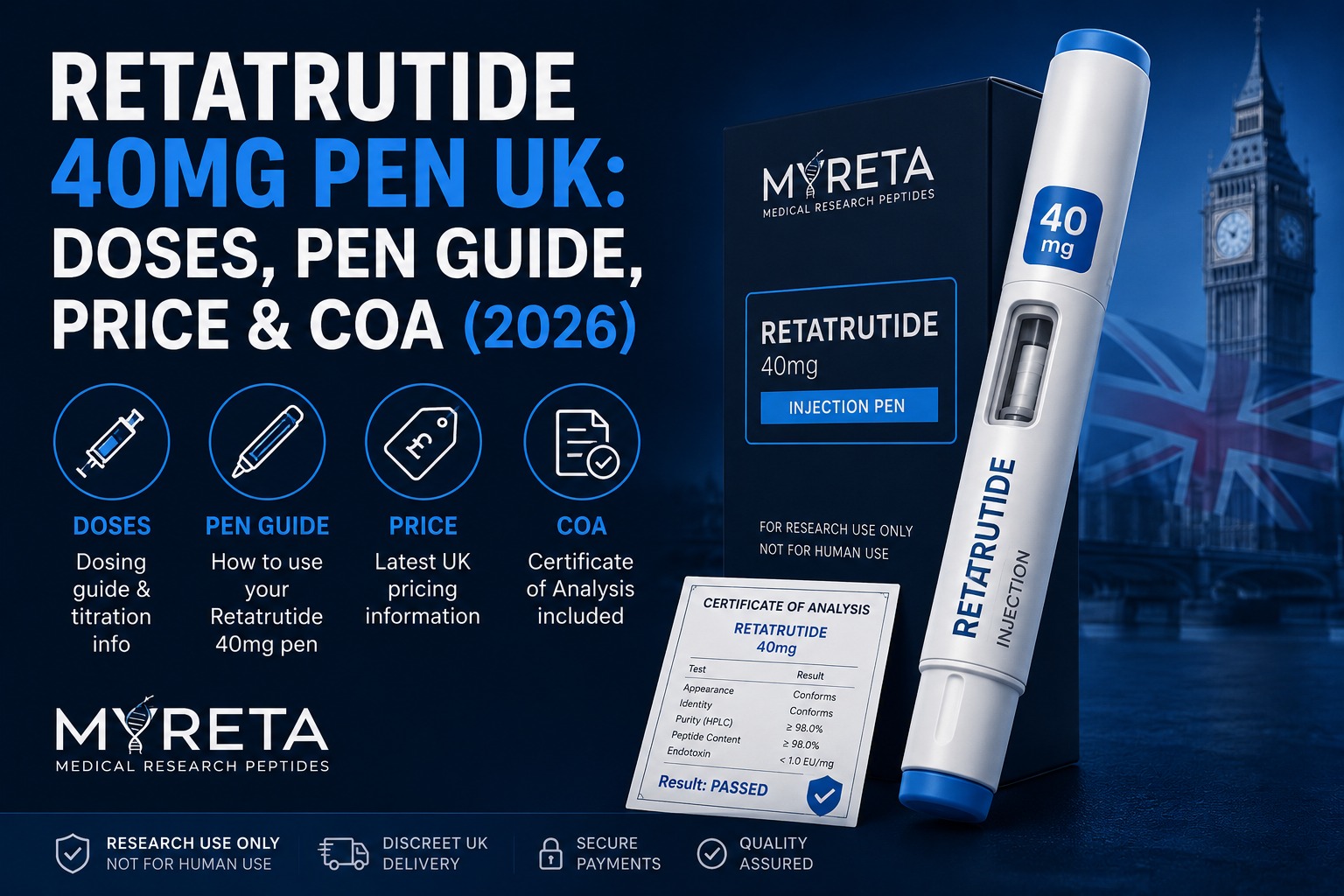
    Retatrutide 40mg Pen UK: Doses, Pen Guide, Price & COA (2026)

    So you have seen the words “retatrutide 40mg pen” and thought: what is that, why 40mg, how many doses do I get, and is the one I am looking at even real? Good — those are exactly the right questions. This guide answers all of them in plain English: the pen format, how the click system works, dosing and titration context, what a fair UK price looks like, how to read a COA, and what every researcher should check before ordering. If you are starting from the basics, we also have a UK guide on what do peptides do. No jargon soup, no lab-coat lecture.

    One note up front: retatrutide is a research peptide, supplied for laboratory research only and not for human use in the UK.

    Key takeaways (the 30-second version)

    • A retatrutide 40mg pen is a pre-filled pen holding 40 milligrams of retatrutide in total — a triple-receptor research peptide (GLP-1, GIP and glucagon).
    • The 40mg is the whole tank, not one dose. How long it lasts depends on the dose size you draw.
    • On a Retatrutide 2.0 pen, 3 clicks = 0.5mg and 6 clicks = 1mg — so a 40mg pen has roughly 240 clicks in it.
    • A pen means no mixing, no bac water, no syringes — the easy-mode format next to a vial.
    • The only thing that proves what is inside is a batch-specific third-party COA (think Janoshik), backed by a hologram and unique batch code you can check the second it arrives.
    • UK 40mg pens usually sit around £150–£180. Buy on cost per verified milligram, not the lowest sticker.

    Short version: the only thing that separates a real pen from an expensive fake is proof you can check — and that is exactly what MyReta is built to solve.

    Table of contents

    What is a retatrutide 40mg pen?

    Retatrutide is a peptide that pokes three receptors at once: GLP-1, GIP and glucagon. Most weight-research peptides only hit one or two. Retatrutide hits all three, which is why scientists call it a “triple agonist” and why it gets so much attention. A 2023 Phase 2 trial in the New England Journal of Medicine is the study most people are talking about.

    A 40mg pen is that peptide, already mixed and sealed inside a pre-filled injector pen, with 40 milligrams of it in total. Think of it like a marker pen with a dial: the ink is already inside, and you set how much comes out. No bottle to open, no powder to mix, no separate syringe of water to add.

    Why does 40mg matter? Because it is one of the larger, better-value pen sizes on the UK research market. A bigger tank usually means a lower price per milligram and fewer reorders. It is the sweet spot most researchers land on. For the wider science and the UK legal picture, our main Retatrutide UK page has you covered; this guide stays laser-focused on the pen.

    Retatrutide 40mg pen vs vial: what is the difference?

    Retatrutide comes two ways: as a pen (pre-filled, ready) or as a vial (a little bottle of dry powder you mix yourself). Both can be excellent. They just ask different things of you.

    With a vial you have to reconstitute it — add bacteriostatic water, work out the right amount, swirl gently, and draw each dose with an insulin syringe while doing a bit of mental arithmetic every time. A pen skips all of that: it is pre-mixed, and you dial the dose. Here is the honest side-by-side:

    What mattersPre-filled penVial + bac water
    FormatReady to use, sealedDry powder you mix
    Ease of useHigh — dial and goLower — mixing required
    Measuring / dosingClick system does the mathsYou measure each dose by hand
    StorageFridge, simpleFridge, plus bac-water handling
    COA availabilityShould come with batch COAShould come with batch COA
    Cost per mgSlightly higherOften lower
    Best forSimplicity, consistencyFlexibility, lowest cost per mg

    New to this? The pen is the gentler start. If you do choose a vial, our how to reconstitute retatrutide guide walks the mixing step-by-step.

    Retatrutide dosing: how the 40mg pen is usually understood

    This is not a dosing plan for a person — it is how dosing is understood in the research context, so the pen maths makes sense.

    Three things decide what a “dose” means on a pen:

    • Concentration — how much peptide is packed into the liquid.
    • The click system — how many clicks the device gives per milligram (more on this below).
    • The intended research protocol — what the study is set up to look at.

    In the Phase 2 research, retatrutide was given once weekly and titrated — started low and stepped up slowly so the gut had time to settle. A common pattern: 2mg to begin, then 4mg, then 8mg, up to 12mg in some arms — a research reference, not a recommendation. Always follow the supplier’s device guide and the COA.

    How many doses are in a 40mg retatrutide pen?

    This is the question almost no one answers properly, so here it is in plain numbers. 40mg is the total in the pen, not one dose. How many doses you get is just simple division:

    If each dose is…Doses in a 40mg penRoughly how many weeks (once weekly)
    0.5 mg80 doses~80 weeks
    1 mg40 doses~40 weeks
    2 mg20 doses~20 weeks
    4 mg10 doses~10 weeks
    8 mg5 doses~5 weeks
    12 mgabout 3 doses~3 weeks

    So a 40mg pen is a lot of small doses or a few big ones. Once you picture it as a fuel tank, the number stops being scary.

    Retatrutide pen guide: how the click system works

    Most research pens use a click dial. You turn the end of the pen and it clicks, one notch at a time. Each click pushes out a tiny, measured amount — so instead of measuring liquid by eye, you just count clicks.

    On the Retatrutide 2.0 pen, the click system is straightforward:

    • 3 clicks = 0.5 mg
    • 6 clicks = 1 mg

    From there the maths is easy — every 6 clicks adds another milligram:

    Target doseClicks
    0.5 mg3 clicks
    1 mg6 clicks
    2 mg12 clicks
    4 mg24 clicks
    8 mg48 clicks
    12 mg72 clicks

    Here is a neat way to picture the whole pen: at 6 clicks per milligram, a 40mg pen holds about 240 clicks in total. That is your full tank, counted out in little notches.

    Two honest caveats. First, the number of clicks per milligram depends on the specific device and its concentration — the figures above are for the Retatrutide 2.0 pen, so always check the guide that comes with your pen. Second, a pen is built around three simple moves: dial (turn to your dose), prime (push out a tiny test amount first to clear air, like flicking a hose until it runs clean), and dispense (press and hold). The leaflet in the box is the boss — follow it.

    How long does one 40mg pen last?

    Because research dosing is usually stepped up over time, a single 40mg pen does not last a fixed number of weeks — it depends on the ramp. Here is a worked example using a typical step-up, just so you can see the maths:

    WeeksDose each weekUsed in this blockLeft in the 40mg pen
    1–42 mg8 mg32 mg
    5–84 mg16 mg16 mg
    9–108 mg16 mg0 mg

    Add it up and one 40mg pen covers roughly the first 10 weeks of a standard step-up. Hold a steady low dose and it stretches much further; jump straight to big doses and it empties faster. Want to plan your own numbers without doing sums on the back of an envelope? That is exactly what a dosing calculator is for — ask us and we will point you to ours.

    Retatrutide 40mg pen price UK 2026

    Most UK 40mg pens land around £150–£180. To compare sensibly, look at both the price per pen and the price per milligram — bigger pens usually win on the latter, the same way a family-size cereal box does:

    Pen sizeTypical UK priceRough price per mgGood for
    20 mg~£120~£6.00Trying it out, short studies
    30 mg~£149~£4.97Middle ground
    40 mg~£165–£175~£4.13–£4.38Best all-round value
    50 mg~£176–£220~£3.52–£4.40Longer research runs

    Why cheap is not always better. A £130 pen with no COA is not cheap — it is a mystery box with a price tag. If it is under-filled, or it is not even retatrutide, your “cost per real milligram” is basically infinite, because you got nothing you can trust. When you weigh up price, weigh up the whole package: COA, purity, third-party testing, storage and cold-chain, customer support, and supplier reputation. A slightly dearer pen that ticks those boxes is the cheaper buy the moment you count what you actually received. We make the full case in our cheapest retatrutide UK breakdown and price guide.

    What should a retatrutide COA show?

    A Certificate of Analysis (COA) is the lab report that proves what is in your batch. A shiny pen tells you nothing — the label is just a sticker. A COA worth trusting shows all of this:

    On the COAWhat you want to see
    Compound identityConfirmed as retatrutide (not a cheaper stand-in)
    Purity≥99%
    Batch / lot numberPresent, and matches your pen
    Test dateRecent and clearly dated
    Testing labIndependent third party (e.g. Janoshik)
    HPLC / LC-MSHPLC for purity, mass spec for identity
    Endotoxin / microbialReported where available — a sign of a careful supplier

    For a deeper walkthrough of how to read each number, see how to verify a peptide COA in the UK, plus our own COA page and quality testing page.

    How to check if a 40mg pen is legit

    You do not need to be an expert to smell a dodgy pen. Run down this red-flag list — if you tick more than one or two, walk away:

    • No COA — or only a blurry image with no lab named.
    • No batch number, or one that does not match the pen.
    • Unrealistic claims (miracle results, “100% guaranteed”).
    • No storage guidance — a real supplier tells you to keep it cold.
    • No clear concentration or click guide.
    • No supplier details — no company, no contact, no returns.
    • Suspiciously low pricing — if it is way under the market, ask why.

    The best suppliers make this easy: a tamper-evident hologram and a unique batch code on the back of the box that you match to the COA the moment it arrives. If a seller gets twitchy when you ask to verify a batch — that twitchiness is your answer.

    Retaklik 40mg vs retatrutide 40mg — what is the difference?

    This one trips everyone up, so let us clear it fast. Retatrutide is the compound — the actual peptide. Retaklik is a brand name used for retatrutide products. So a “retaklik 40mg” pen and a “retatrutide 40mg” pen are talking about the same core compound, just under different labels. It is a bit like “hoover” and “vacuum cleaner.” Our Retaklik UK guide tells the full brand story, and the homepage covers Retaklik 40mg and Retatrutide UK in one place.

    Storage and handling

    Peptides are a bit fussy, but the rules are easy:

    • Keep it cold. Fridge temperature, around 2–8°C. Treat it like fresh milk, not tinned beans.
    • Never freeze it. Freezing can wreck the peptide — keep it off the ice shelf.
    • Do not shake it. A gentle life is a happy peptide.
    • Keep it out of bright light, capped, and away from kids and pets.
    • Check the expiry and follow the supplier’s cold-chain instructions — do not use a pen that has been dropped or looks damaged.

    Side effects and safety: what the research shows

    Retatrutide is a research compound, not a treatment. So this is a plain-English round-up of what trials and the wider GLP-1 family have reported — not advice for anyone to dose themselves.

    Common, mild effects seen in trials

    Most reported effects were tummy-related. They mostly showed up during the step-up weeks and then calmed down as the body got used to it:

    • Feeling sick (nausea)
    • Being sick (vomiting)
    • Diarrhoea or constipation
    • Less hunger
    • Feeling tired

    Where an injection is involved, the spot can react too — a bit of redness, mild swelling, bruising, itching, or a small firm lump if the same spot is used again and again. These are usually minor and fade in a few days. Rotating the spot each time helps.

    When to get help fast

    Some signs are not “wait and see”. Get medical help quickly for any of these:

    • Bad or lasting tummy pain (a possible sign of pancreatitis)
    • Signs of an allergy — rash, a swollen face, or trouble breathing
    • Pain in the upper-right belly, fever, or yellow skin (a possible gallbladder problem)
    • Lots of vomiting or diarrhoea with dizziness or very little wee (dehydration)
    • A racing heart, dizziness, or fainting
    • New or changing eyesight problems, especially with diabetes

    In the UK, call 999 for anything severe or life-threatening, or NHS 111 for urgent advice. A suspected bad reaction to a medicine can be reported through the MHRA Yellow Card scheme.

    Extra care points for this family of compounds

    Researchers flag a few areas of caution for incretin-class compounds: a past history of pancreatitis or gallbladder trouble, thyroid worries, pregnancy or breastfeeding, and use alongside insulin or similar medicines (which can push blood sugar too low). This class can also slow how fast the stomach empties, which may change how other medicines are taken up. That is background from the literature, not dosing advice.

    To be crystal clear: retatrutide is not licensed for human use in the UK. Anyone looking for a real weight or metabolic treatment should talk to a GP or pharmacist about approved options like semaglutide or tirzepatide.

    Retatrutide 40mg pen UK: who is it for?

    Plainly: this is for research customers, not for medical treatment. Retatrutide pens are bought by people studying the compound — its triple action on the GLP-1, GIP and glucagon receptor pathways, and how those pathways behave in metabolic research. If you are looking for a treatment for a person, this is not that, and a pharmacy or GP is the right door. If you are a researcher who wants a verifiable, pre-filled, easy-to-handle format, a 40mg pen is a sensible pick.

    Where to get a lab-tested retatrutide 40mg pen

    If you want a 40mg pen you can actually verify, that is the whole reason MyReta exists. Our Retatrutide 2.0 40mg pen ships with a batch-specific third-party COA, plus the tamper-evident hologram and unique batch code on the box so you can check it the second it arrives — and it uses the simple click system above (3 clicks = 0.5mg, 6 clicks = 1mg).

    Heads up: the 40mg pen is currently out of stock — we are restocking within about a week. Keep an eye on the product page for the restock, and meanwhile our where to buy retatrutide UK guide covers what to check before you buy from anyone. For the full range and the science, start at the Retatrutide UK homepage.

    Frequently asked questions

    Is retatrutide available in the UK?

    Yes, as a research peptide for laboratory use only. It is not a licensed medicine in the UK and is not approved for human use, so it cannot be prescribed or sold for treatment.

    Is a 40mg pen better than a vial?

    For ease of use, yes. A pen is pre-mixed, so there is no reconstitution and no measuring maths — you just count clicks. A vial is often cheaper per milligram but you mix and measure it yourself.

    How many doses are in a 40mg retatrutide pen?

    It depends on dose size: 80 doses at 0.5mg, 40 at 1mg, 20 at 2mg, 10 at 4mg, 5 at 8mg, or about 3 at 12mg. The 40mg is the total in the pen, not one dose.

    How long does a 40mg pen last?

    On a typical research step-up (2mg, then 4mg, then 8mg) one 40mg pen covers roughly the first 10 weeks. Held at a steady low dose it lasts much longer; used at high doses it empties faster.

    How does the click system work on a Retatrutide 2.0 pen?

    3 clicks equals 0.5mg and 6 clicks equals 1mg, so every 6 clicks adds another milligram (12 clicks = 2mg, 24 = 4mg, and so on). A 40mg pen holds about 240 clicks. Always check the guide for your specific pen.

    What does COA mean?

    COA stands for Certificate of Analysis — a lab report confirming a batch’s identity (by mass spec) and purity (by HPLC). It is the only real proof of what is inside your pen.

    What purity should I look for?

    Aim for ≥99% purity by HPLC on a batch-specific, third-party COA. Lower figures can mean synthesis by-products or off-target material.

    Is retatrutide the same as tirzepatide?

    No. Tirzepatide is a dual agonist (GLP-1 and GIP). Retatrutide is a triple agonist, adding glucagon as a third target. They are different compounds.

    Does retatrutide need to be refrigerated?

    Yes. Store it cold, around 2–8°C, out of light, and never freeze or shake it. Follow the supplier’s cold-chain instructions.

    Why is retatrutide expensive?

    It is a complex triple-agonist peptide, and quality suppliers add third-party testing, cold-chain handling and verification. Cheaper, untested products often cost more in the end because you cannot trust what is inside.

    Can you buy retatrutide online in the UK?

    You can buy it online as a research peptide for laboratory use only. It is not sold for human use. Always check the COA, batch details and supplier transparency first.

    What should I check before buying a 40mg pen?

    Check the concentration and click guide, the batch-specific COA (≥99% purity, independent lab), the batch number and hologram, storage instructions, and clear supplier details. If any are missing, treat it as a red flag.

    Where is retatrutide injected, and how often?

    In the trials it was given once a week as a small jab under the skin (subcutaneous), usually in the belly or the outer thigh. The spot is swapped each time so the same patch of skin does not get sore or lumpy. This is research background, not advice to inject anyone.

    Can you join a retatrutide clinical trial in the UK?

    You can look for live studies on the NHS “Be Part of Research” site (bepartofresearch.nihr.ac.uk) or on ClinicalTrials.gov. You may need a GP or specialist to refer you and check if you can take part.

    Scientific references

    1. Triple–Hormone-Receptor Agonist Retatrutide for Obesity — A Phase 2 Trial (NEJM, 2023)
    2. Retatrutide for people with type 2 diabetes — a Phase 2 trial (The Lancet, 2023)
    3. LY3437943 (retatrutide), a triple GIP/GLP-1/glucagon agonist — Phase 1b trial
    4. MHRA: avoid illegal online weight-loss medicines
    5. MHRA Drug Safety Update: GLP-1 / GIP agonists — pancreatitis warnings
    6. NICE TA875: Semaglutide for overweight and obesity
    7. NICE TA1026: Tirzepatide for overweight and obesity
    8. Incretin-based drugs and gallbladder / biliary disease (The Lancet)

    Final word for UK research customers

    A retatrutide 40mg pen is a pre-filled, ready-to-use research peptide with 40mg in the tank — roughly 240 clicks, enough for many small doses or a handful of big ones. The pen format saves you the mixing and the maths. The one thing that really matters is being able to verify what is inside — and that is exactly what MyReta solves: every pen ships with a batch-specific third-party COA, a tamper-evident hologram and a unique batch code you can check the moment it arrives. So check the concentration, COA, batch details and storage before you order — or simply start with a 40mg pen that already ticks every box.

    For research use only. Not for human consumption. Retatrutide is not licensed for human use in the UK.

  • Retaklik UK: What It Is, How the Pen Works & Where to Source It

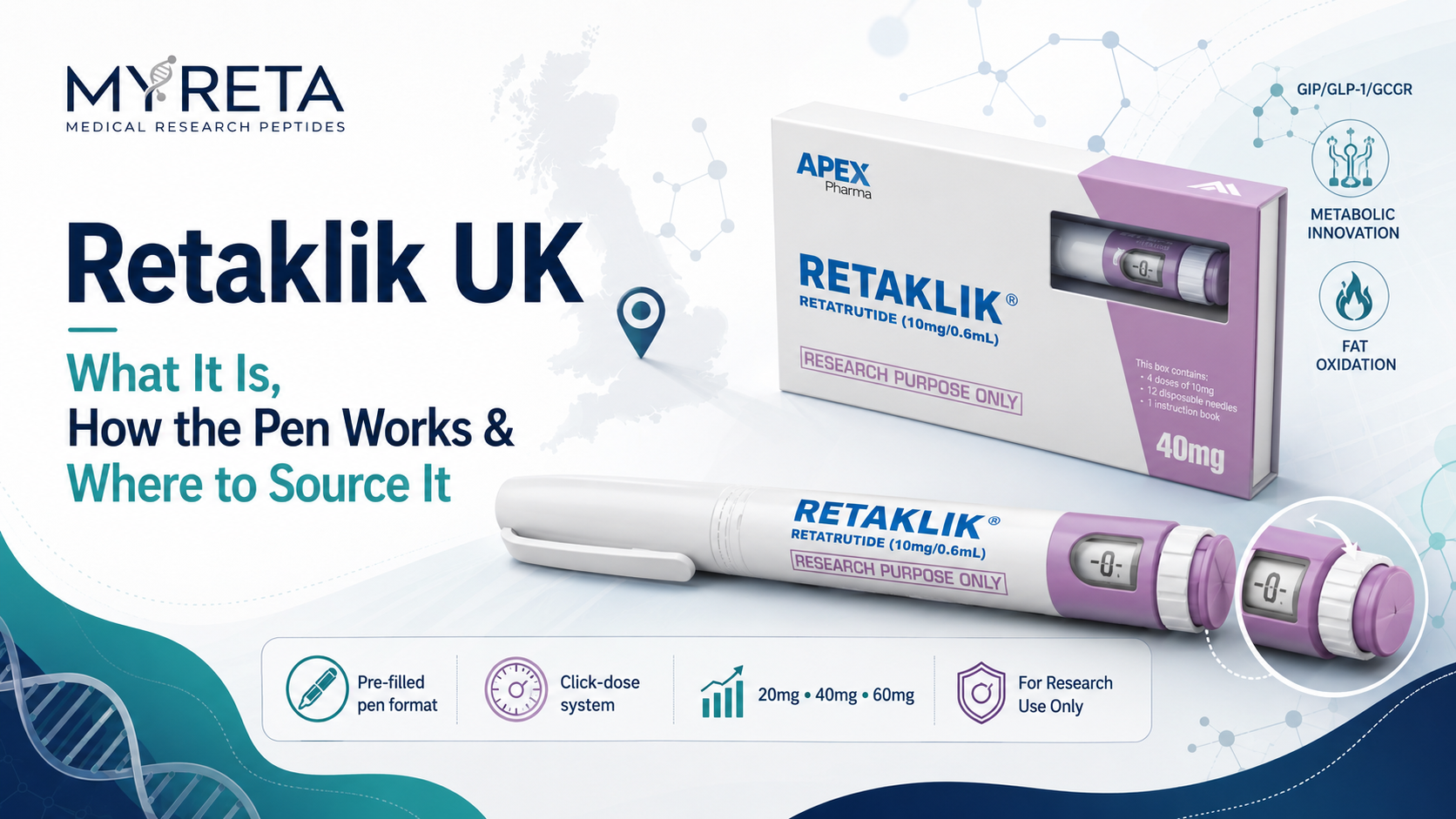
    Retaklik UK: What It Is, How the Pen Works & Where to Source It

    You’ve come across the name Retaklik. Maybe you saw it on a research catalogue, maybe a colleague mentioned it in the same breath as retatrutide, or maybe you’re trying to figure out whether it’s a brand, a compound, or something else entirely. You’re not alone — the terminology around injectable research peptide formats can be genuinely confusing, and “Retaklik” sits right in the middle of that confusion.

    This guide cuts through it. We’ll cover exactly what Retaklik is, how the pen format works, how to read the click-dose system, how it differs from vial-based retatrutide, and what to look for when sourcing it in the UK for research applications.


    What Is Retaklik?

    Retaklik is a brand name for retatrutide (LY3437943) supplied in a multi-dose injection pen format. The active compound is identical to lyophilised retatrutide vials — a synthetic triple receptor agonist targeting GLP-1, GIP, and glucagon (GCGR) pathways simultaneously — but Retaklik delivers it pre-filled in a click-dial pen rather than requiring reconstitution with bacteriostatic water.

    Retatrutide itself is an investigational peptide currently in Phase 3 clinical trials (the TRIUMPH programme) by Eli Lilly. As a research compound available in the UK, it is supplied by specialist peptide laboratories under a research-use-only designation, and Retaklik is one of the pen-format presentations researchers are increasingly requesting.

    Key fact: The “klik” in Retaklik refers to the click-dial dosing mechanism on the pen itself. Each click of the dial dispenses a precise, fixed quantity of retatrutide solution — making dose consistency straightforward to maintain across a research protocol without the need for syringes and vials.


    Retaklik vs Retatrutide Vials — What’s the Difference?

    Both deliver the same compound. The difference is entirely in the format and the research workflow it suits.

    FeatureRetaklik PenRetatrutide Vial (Lyophilised)
    Reconstitution requiredNo — pre-filled solutionYes — BAC water needed
    Dose measurementClick dial (fixed per click)Syringe draw (calculated volume)
    Equipment neededPen + needle tip onlyBAC water, syringe, needle, vial
    Dose flexibilityClick increments onlyAny dose (full calculator control)
    Storage (unopened)Refrigerated (2–8°C)Freezer (-20°C) up to 24 months
    Ideal forConsistent weekly protocolsCustom dosing, titration flexibility

    For researchers running a fixed weekly schedule where dose consistency matters more than granular control, the Retaklik pen offers a more streamlined workflow. For protocols requiring precise sub-milligram titration or custom concentrations, lyophilised vials with a retatrutide calculator give more flexibility.


    Retaklik Pen Variants: 20mg, 40mg, and 60mg

    Retaklik research pens are typically available in three fill sizes — 20mg, 40mg, and 60mg. These refer to the total retatrutide content per pen, not the per-dose amount. The 40mg variant is the most commonly used in UK research settings, providing enough compound for extended study periods without requiring frequent reorders.

    Pen SizeTotal ContentDoses at 2mg/weekDoses at 5mg/weekDoses at 10mg/week
    20mg pen20mg retatrutide10 doses4 doses2 doses
    40mg pen40mg retatrutide20 doses8 doses4 doses
    60mg pen60mg retatrutide30 doses12 doses6 doses

    MyReta stocks the Retaklik 40mg pen, independently verified to 99%+ purity by Janoshik Analytical, with UK next-day delivery available.


    How to Dial Your Retaklik Dose — The Click System Explained

    The defining feature of the Retaklik pen is its click-dial mechanism. Unlike a syringe where you calculate volume, the pen delivers a fixed quantity per click. On standard Retaklik pens, 1 click = 1/6 mg (approximately 0.167 mg) of retatrutide, with a maximum of 60 clicks per injection.

    Always verify your specific pen’s click-dose specification before beginning a research protocol. Different manufacturers may use different click-weight ratios. MyReta provides click-count reference charts with each pen order.

    Using the standard 1 click = 1/6 mg specification, common research doses convert as follows:

    Target DoseClicks (any pen size)Notes
    1mg6 clicksTypical initiation dose
    2mg12 clicks 
    2.5mg15 clicks 
    5mg30 clicks 
    7.5mg45 clicks 
    10mg60 clicksMaximum per single injection

    For doses between click increments, dial to the nearest whole click. For protocols requiring greater precision, a lyophilised vial and insulin syringe — paired with the MyReta reconstitution calculator — offers more granular control.


    Retaklik Research Titration Framework

    Published Phase 2 trial data for retatrutide used a structured dose-escalation approach, starting low and increasing every four weeks. For research applications following a similar model, a typical progression might look like:

    Research WeekDoseClicks (Retaklik pen)Phase
    Weeks 1–42mg weekly12 clicksInitiation
    Weeks 5–84mg weekly24 clicksEscalation 1
    Weeks 9–128mg weekly48 clicksEscalation 2
    Week 13+Up to 12mg weeklyUp to 72 clicks*Maintenance

    *Doses above 60 clicks (10mg) require splitting across two injection sites. This is consistent with standard research practice for high-volume subcutaneous injections.

    Note: The above is a reference framework drawn from published Phase 2 clinical data. It is not a dosing recommendation. All research protocols should be designed by a qualified principal investigator with reference to published literature and ethical approval where applicable.


    Storing Your Retaklik Pen

    Unlike lyophilised peptide vials that can be frozen long-term, Retaklik pens are supplied as a ready-made solution and should be stored refrigerated at 2–8°C at all times. Keep the pen in its protective cap between uses, away from direct light.

    ConditionRecommendation
    Unopened penRefrigerated, 2–8°C — do not freeze
    In-use penRefrigerated between each use, cap replaced
    Light exposureAvoid — keep in box or sleeve
    Freeze-thaw cyclesAvoid entirely for pen-format solution

    Why Purity Matters When Sourcing Retaklik in the UK

    The UK research peptide market has grown quickly, and “Retaklik” is now appearing across several supplier catalogues. The problem is that the term is effectively unregulated as a product name — any supplier can call their retatrutide pen “Retaklik” regardless of what is actually in it.

    For meaningful research outcomes, purity is not optional. An unknown impurity profile doesn’t just raise ethical questions — it invalidates your data. What to look for from any UK Retaklik supplier:

    • HPLC purity test — confirms active compound percentage
    • Independent third-party lab testing — removes supplier self-certification bias
    • Certificate of Analysis (CoA) — batch-specific purity record you can verify
    • UK-based fulfilment — faster delivery, no customs delays

    MyReta’s Retaklik 40mg pen is independently tested by Janoshik Analytical to 99%+ HPLC purity on every batch. The Certificate of Analysis is available on request and linked from each product listing.


    Use the Free Retaklik Dose Calculator

    If your research protocol uses vial-format retatrutide alongside or instead of the Retaklik pen, MyReta’s free reconstitution calculator handles concentration, volume per dose, U-100 syringe units, and doses per vial automatically.

    The calculator also includes a Retaklik click reference chart covering 1mg, 2.5mg, 5mg, 7.5mg, and 10mg doses across 20mg, 40mg, and 60mg pen sizes — useful whether you are using pens or vials.


    Frequently Asked Questions — Retaklik UK

    What is Retaklik?

    Retaklik is a brand name for retatrutide (LY3437943) supplied in a pre-filled, multi-dose injection pen. The compound is a synthetic triple GLP-1/GIP/glucagon receptor agonist. It is supplied for research and laboratory use only in the UK.

    Is Retaklik the same as retatrutide?

    Yes, in terms of active compound. Retaklik is a pen-format presentation of retatrutide. The “klik” element refers to the click-dial dosing mechanism. The pharmacology is identical to vial-format retatrutide — the difference is how it is delivered and measured.

    How many clicks is 1mg on a Retaklik pen?

    On standard Retaklik pens, 1 click = 1/6 mg, meaning 6 clicks delivers 1mg. Always verify the click-weight specification for your specific pen, as different manufacturers may use different ratios.

    What sizes does Retaklik come in?

    Retaklik research pens are typically available in 20mg, 40mg, and 60mg fill sizes. The 40mg pen is the most widely used in UK research contexts. MyReta stocks the 40mg variant.

    How should Retaklik be stored?

    Retaklik pens should be stored refrigerated at 2–8°C and should not be frozen. Keep the pen capped between uses and away from direct light. Unlike lyophilised retatrutide vials — which can be frozen at -20°C for long-term storage — the pre-filled solution format is sensitive to freeze-thaw cycles.

    Can I buy Retaklik in the UK?

    Retaklik (retatrutide) is available in the UK from specialist research peptide suppliers for laboratory and research purposes only. It is not approved by the MHRA for clinical or consumer use. MyReta supplies independently lab-tested Retaklik 40mg pens with UK next-day delivery. For research use only.

    What is the maximum dose per Retaklik injection?

    The maximum per-injection volume on standard Retaklik pens is 60 clicks, which equals 10mg. Doses above 10mg should be split across two separate injection sites to remain within safe subcutaneous injection volumes.

    Does Retaklik need to be reconstituted?

    No. Unlike lyophilised retatrutide vials, Retaklik pens come pre-filled as a ready-to-use solution. No BAC water, no mixing, no syringe calculation needed. Simply dial your dose in clicks. If you prefer vial-format for more precise dosing control, use the MyReta free reconstitution calculator.

    Is Retaklik the same as the Eli Lilly drug?

    The compound retatrutide (LY3437943) is the same active molecule being investigated by Eli Lilly in the TRIUMPH Phase 3 trials. Research-grade Retaklik pens supply this compound for laboratory study only — they are not a licensed pharmaceutical product and are not approved for clinical use.

    How do I calculate Retaklik doses?

    For click-to-dose conversion, use: clicks × (1⁄6) = mg. For example, 30 clicks = 5mg. For vial-format retatrutide, the MyReta reconstitution calculator handles all calculations automatically, and also includes a Retaklik click reference chart.


    Related retatrutide reading


    Source research-grade Retaklik in the UK: MyReta stocks the Retaklik 40mg pen — independently verified to 99%+ HPLC purity by Janoshik Analytical, with UK next-day delivery and 24/7 research support. For research use only.