Tag: Retatrutide

  • Retatrutide TRIUMPH Results: Phase 3 Weight-Loss & Diabetes Data (2026)

    Retatrutide TRIUMPH Results: Phase 3 Weight-Loss & Diabetes Data (2026)

    Retatrutide just posted the biggest weight-loss numbers of any obesity drug tested so far. In 2026 its large Phase 3 trials — the TRIUMPH programme and the TRANSCEND-T2D diabetes study — finally gave us the proper, regulator-grade data everyone had been waiting years for. Here’s what the trials actually showed, in plain English, with the figures checked against Eli Lilly’s own releases and The Lancet.

    On this page

    Key takeaways

    • TRIUMPH-1 showed 28.3% mean weight loss at 80 weeks on the 12 mg dose, versus 2.2% on placebo.
    • 45.3% of people on 12 mg lost 30% or more of their body weight — the highest proportion ever reported for a weight-loss medicine.
    • People with a higher starting BMI who carried on to 104 weeks lost an average of 30.3% (about 85 lb).
    • TRANSCEND-T2D-1 cut HbA1c by up to 1.94% and body weight by up to 16.8% in type 2 diabetes, published in The Lancet.
    • Retatrutide still has no MHRA or FDA approval — these are trial results, and in the UK it remains a research compound for laboratory use only.

    What retatrutide is (the “triple agonist” bit)

    Retatrutide (lab code LY3437943) is what scientists call a triple agonist. That sounds like a wrestling move, but it just means the drug switches on three different hunger-and-metabolism receptors at once — GLP-1, GIP, and glucagon — instead of one or two. Semaglutide (Wegovy) hits one. Tirzepatide (Mounjaro) hits two. Retatrutide goes for the full set, like someone who can’t walk past a buy-one-get-one-free sign.

    For years the only data came from a small Phase 2 trial. That changed in 2026, when the big Phase 3 results landed — the kind regulators actually look at. (New to the compound? Start with what retatrutide actually is.)

    TRIUMPH-1: the headline obesity trial

    TRIUMPH-1 enrolled 2,339 adults with obesity, or overweight plus a weight-related health problem, but no diabetes. They were given retatrutide at 4 mg, 9 mg, or 12 mg, or a placebo (a dummy dose used for comparison), once a week for 80 weeks. Eli Lilly announced the topline results on 21 May 2026.

    DoseMean weight loss at 80 weeks
    4 mg19.0%
    9 mg25.9%
    12 mg28.3%
    Placebo2.2%

    The number that made headlines: 45.3% of people on the 12 mg dose lost 30% or more of their body weight — territory previously seen mostly after weight-loss surgery, and the highest share ever reported for an anti-obesity drug. A jab doing a job once reserved for an operating theatre.

    It kept going, too. Participants with a higher baseline BMI who stayed on 12 mg through 104 weeks lost an average of 30.3% of their body weight — around 85 lb.

    For rough context, tirzepatide came in around 20–22.5% and semaglutide 2.4 mg around 14.9% in their own Phase 3 obesity trials. Different trials with different people, so it isn’t a perfectly fair race — but the trend is clear. For a plain-English look at the numbers on their own, see our retatrutide weight-loss results guide.

    TRANSCEND-T2D-1: retatrutide and type 2 diabetes

    A separate trial, TRANSCEND-T2D-1, tested retatrutide in 537 adults who do have type 2 diabetes and whose blood sugar wasn’t controlled by diet and exercise alone. Over 40 weeks it:

    • cut HbA1c (a marker of average blood sugar over months) by 1.69% to 1.94% across the doses, versus 0.81% on placebo;
    • cut body weight by 11.5% to 16.8%, versus 2.5% on placebo.

    The results were published in The Lancet in June 2026 — the medical world’s equivalent of getting your name in lights.

    The wider TRIUMPH programme: knee and sleep apnoea

    TRIUMPH isn’t a single trial. It’s a family of Phase 3 studies that began in 2023 and has enrolled more than 5,800 participants, testing retatrutide not just for weight but for the conditions that extra weight causes:

    • Knee osteoarthritis (TRIUMPH-4). People with obesity and knee OA on 12 mg lost an average of 28.7% of body weight at 68 weeks, and knee-pain scores (WOMAC) dropped by up to 75.8%.
    • Obstructive sleep apnoea (a substudy within TRIUMPH-1). Among participants with severe sleep apnoea, the apnoea-hypopnoea index fell by 60.6% from a severe baseline — a big improvement in overnight breathing.

    If those benefits hold up, retatrutide starts to look less like a weight-loss drug with nice side effects and more like a treatment for the diseases that excess weight drives in the first place.

    ADA 2026 and where approval stands

    The TRIUMPH-1 and TRANSCEND-T2D-1 data were presented at the American Diabetes Association’s 86th Scientific Sessions on 6 June 2026 — think of it as the World Cup of diabetes research, just with more lanyards and fewer penalty shoot-outs.

    Worth saying plainly: retatrutide still doesn’t have MHRA or FDA approval. Phase 3 is the stage before approval, not after it. These are trial results, not a green light to prescribe it. In the UK it remains available only as a research compound for laboratory use — not for human consumption — until a regulator says otherwise. If you need lab-tested retatrutide for research, see our UK retatrutide range, all supplied with a batch-specific Certificate of Analysis.

    Frequently asked questions

    What did the retatrutide TRIUMPH-1 trial find?

    In 2,339 adults with obesity and no diabetes, retatrutide produced mean weight loss of 28.3% at 80 weeks on the 12 mg dose, versus 2.2% on placebo. 45.3% of 12 mg participants lost 30% or more of their body weight, and those with a higher baseline BMI who continued to 104 weeks lost an average of 30.3%.

    How does retatrutide compare to Mounjaro and Wegovy?

    Retatrutide is a triple agonist (GLP-1, GIP and glucagon), whereas tirzepatide/Mounjaro is a dual agonist and semaglutide/Wegovy is a single GLP-1 agonist. In their respective Phase 3 obesity trials tirzepatide reached roughly 20–22.5% and semaglutide 2.4 mg about 14.9%, compared with retatrutide’s 28.3% at 12 mg — though these are separate trials and not head-to-head.

    What did TRANSCEND-T2D-1 show?

    In 537 adults with type 2 diabetes, over 40 weeks retatrutide reduced HbA1c by up to 1.94% and body weight by up to 16.8%, versus 0.81% and 2.5% on placebo. The results were published in The Lancet in June 2026.

    Is retatrutide approved in the UK?

    No. It has no MHRA or FDA marketing authorisation. TRIUMPH and TRANSCEND are Phase 3 trial results, not a regulatory approval. In the UK retatrutide is supplied only as a research compound for laboratory use, not for human consumption.

    What is the TRIUMPH programme?

    A family of Phase 3 trials that began in 2023 and has enrolled more than 5,800 participants, testing retatrutide for weight management and related conditions including knee osteoarthritis (TRIUMPH-4) and obstructive sleep apnoea (a TRIUMPH-1 substudy), with further results expected.

    Related retatrutide reading

    Final thoughts

    The 2026 data is genuinely significant: the largest Phase 3 weight-loss numbers published to date, plus real improvements in blood sugar, knee pain and sleep apnoea. It’s still investigational, and nothing here is medical advice — but for anyone following the science, retatrutide has clearly raised the bar.

    For the full breakdown of retatrutide’s published weight-loss data, see our clinical trial results guide. If you’re sourcing retatrutide for research purposes, browse our UK retatrutide range and always check for a batch-specific, third-party Certificate of Analysis confirming ≥99% purity — see our quality testing page for how we verify stock.

    This article is for informational and research purposes only and reports published clinical-trial data. Retatrutide is an investigational compound with no MHRA or FDA marketing authorisation, supplied for laboratory research use only and not for human consumption. Nothing here is medical advice.

  • Retatrutide 40mg Pen UK: Doses, Pen Guide, Price & COA (2026)

    Retatrutide 40mg Pen UK: Doses, Pen Guide, Price & COA (2026)

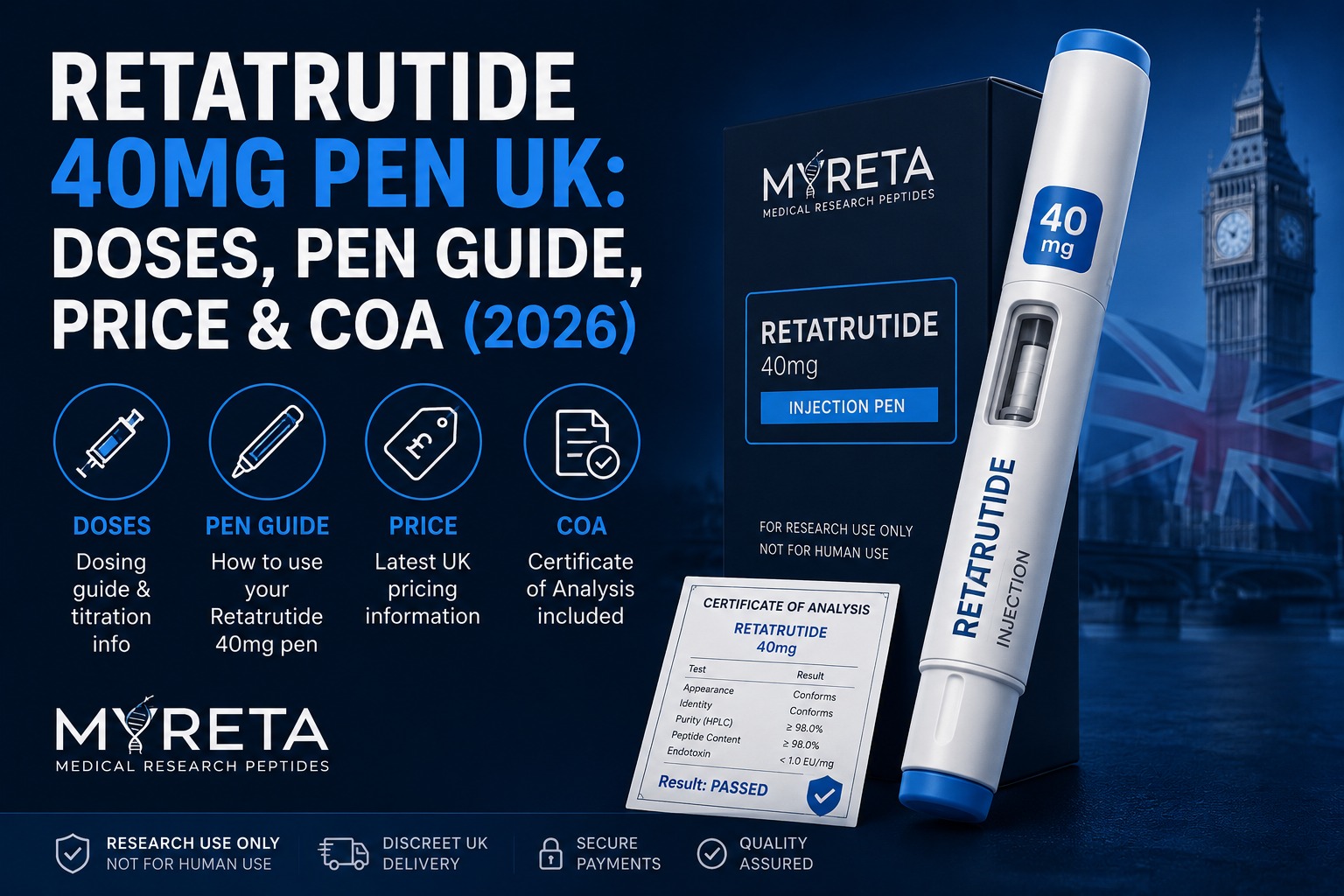
    So you have seen the words “retatrutide 40mg pen” and thought: what is that, why 40mg, how many doses do I get, and is the one I am looking at even real? Good — those are exactly the right questions. This guide answers all of them in plain English: the pen format, how the click system works, dosing and titration context, what a fair UK price looks like, how to read a COA, and what every researcher should check before ordering. If you are starting from the basics, we also have a UK guide on what do peptides do. No jargon soup, no lab-coat lecture.

    One note up front: retatrutide is a research peptide, supplied for laboratory research only and not for human use in the UK.

    Key takeaways (the 30-second version)

    • A retatrutide 40mg pen is a pre-filled pen holding 40 milligrams of retatrutide in total — a triple-receptor research peptide (GLP-1, GIP and glucagon).
    • The 40mg is the whole tank, not one dose. How long it lasts depends on the dose size you draw.
    • On a Retatrutide 2.0 pen, 3 clicks = 0.5mg and 6 clicks = 1mg — so a 40mg pen has roughly 240 clicks in it.
    • A pen means no mixing, no bac water, no syringes — the easy-mode format next to a vial.
    • The only thing that proves what is inside is a batch-specific third-party COA (think Janoshik), backed by a hologram and unique batch code you can check the second it arrives.
    • UK 40mg pens usually sit around £150–£180. Buy on cost per verified milligram, not the lowest sticker.

    Short version: the only thing that separates a real pen from an expensive fake is proof you can check — and that is exactly what MyReta is built to solve.

    Table of contents

    What is a retatrutide 40mg pen?

    Retatrutide is a peptide that pokes three receptors at once: GLP-1, GIP and glucagon. Most weight-research peptides only hit one or two. Retatrutide hits all three, which is why scientists call it a “triple agonist” and why it gets so much attention. A 2023 Phase 2 trial in the New England Journal of Medicine is the study most people are talking about.

    A 40mg pen is that peptide, already mixed and sealed inside a pre-filled injector pen, with 40 milligrams of it in total. Think of it like a marker pen with a dial: the ink is already inside, and you set how much comes out. No bottle to open, no powder to mix, no separate syringe of water to add.

    Why does 40mg matter? Because it is one of the larger, better-value pen sizes on the UK research market. A bigger tank usually means a lower price per milligram and fewer reorders. It is the sweet spot most researchers land on. For the wider science and the UK legal picture, our main Retatrutide UK page has you covered; this guide stays laser-focused on the pen.

    Retatrutide 40mg pen vs vial: what is the difference?

    Retatrutide comes two ways: as a pen (pre-filled, ready) or as a vial (a little bottle of dry powder you mix yourself). Both can be excellent. They just ask different things of you.

    With a vial you have to reconstitute it — add bacteriostatic water, work out the right amount, swirl gently, and draw each dose with an insulin syringe while doing a bit of mental arithmetic every time. A pen skips all of that: it is pre-mixed, and you dial the dose. Here is the honest side-by-side:

    What mattersPre-filled penVial + bac water
    FormatReady to use, sealedDry powder you mix
    Ease of useHigh — dial and goLower — mixing required
    Measuring / dosingClick system does the mathsYou measure each dose by hand
    StorageFridge, simpleFridge, plus bac-water handling
    COA availabilityShould come with batch COAShould come with batch COA
    Cost per mgSlightly higherOften lower
    Best forSimplicity, consistencyFlexibility, lowest cost per mg

    New to this? The pen is the gentler start. If you do choose a vial, our how to reconstitute retatrutide guide walks the mixing step-by-step.

    Retatrutide dosing: how the 40mg pen is usually understood

    This is not a dosing plan for a person — it is how dosing is understood in the research context, so the pen maths makes sense.

    Three things decide what a “dose” means on a pen:

    • Concentration — how much peptide is packed into the liquid.
    • The click system — how many clicks the device gives per milligram (more on this below).
    • The intended research protocol — what the study is set up to look at.

    In the Phase 2 research, retatrutide was given once weekly and titrated — started low and stepped up slowly so the gut had time to settle. A common pattern: 2mg to begin, then 4mg, then 8mg, up to 12mg in some arms — a research reference, not a recommendation. Always follow the supplier’s device guide and the COA.

    How many doses are in a 40mg retatrutide pen?

    This is the question almost no one answers properly, so here it is in plain numbers. 40mg is the total in the pen, not one dose. How many doses you get is just simple division:

    If each dose is…Doses in a 40mg penRoughly how many weeks (once weekly)
    0.5 mg80 doses~80 weeks
    1 mg40 doses~40 weeks
    2 mg20 doses~20 weeks
    4 mg10 doses~10 weeks
    8 mg5 doses~5 weeks
    12 mgabout 3 doses~3 weeks

    So a 40mg pen is a lot of small doses or a few big ones. Once you picture it as a fuel tank, the number stops being scary.

    Retatrutide pen guide: how the click system works

    Most research pens use a click dial. You turn the end of the pen and it clicks, one notch at a time. Each click pushes out a tiny, measured amount — so instead of measuring liquid by eye, you just count clicks.

    On the Retatrutide 2.0 pen, the click system is straightforward:

    • 3 clicks = 0.5 mg
    • 6 clicks = 1 mg

    From there the maths is easy — every 6 clicks adds another milligram:

    Target doseClicks
    0.5 mg3 clicks
    1 mg6 clicks
    2 mg12 clicks
    4 mg24 clicks
    8 mg48 clicks
    12 mg72 clicks

    Here is a neat way to picture the whole pen: at 6 clicks per milligram, a 40mg pen holds about 240 clicks in total. That is your full tank, counted out in little notches.

    Two honest caveats. First, the number of clicks per milligram depends on the specific device and its concentration — the figures above are for the Retatrutide 2.0 pen, so always check the guide that comes with your pen. Second, a pen is built around three simple moves: dial (turn to your dose), prime (push out a tiny test amount first to clear air, like flicking a hose until it runs clean), and dispense (press and hold). The leaflet in the box is the boss — follow it.

    How long does one 40mg pen last?

    Because research dosing is usually stepped up over time, a single 40mg pen does not last a fixed number of weeks — it depends on the ramp. Here is a worked example using a typical step-up, just so you can see the maths:

    WeeksDose each weekUsed in this blockLeft in the 40mg pen
    1–42 mg8 mg32 mg
    5–84 mg16 mg16 mg
    9–108 mg16 mg0 mg

    Add it up and one 40mg pen covers roughly the first 10 weeks of a standard step-up. Hold a steady low dose and it stretches much further; jump straight to big doses and it empties faster. Want to plan your own numbers without doing sums on the back of an envelope? That is exactly what a dosing calculator is for — ask us and we will point you to ours.

    Retatrutide 40mg pen price UK 2026

    Most UK 40mg pens land around £150–£180. To compare sensibly, look at both the price per pen and the price per milligram — bigger pens usually win on the latter, the same way a family-size cereal box does:

    Pen sizeTypical UK priceRough price per mgGood for
    20 mg~£120~£6.00Trying it out, short studies
    30 mg~£149~£4.97Middle ground
    40 mg~£165–£175~£4.13–£4.38Best all-round value
    50 mg~£176–£220~£3.52–£4.40Longer research runs

    Why cheap is not always better. A £130 pen with no COA is not cheap — it is a mystery box with a price tag. If it is under-filled, or it is not even retatrutide, your “cost per real milligram” is basically infinite, because you got nothing you can trust. When you weigh up price, weigh up the whole package: COA, purity, third-party testing, storage and cold-chain, customer support, and supplier reputation. A slightly dearer pen that ticks those boxes is the cheaper buy the moment you count what you actually received. We make the full case in our cheapest retatrutide UK breakdown and price guide.

    What should a retatrutide COA show?

    A Certificate of Analysis (COA) is the lab report that proves what is in your batch. A shiny pen tells you nothing — the label is just a sticker. A COA worth trusting shows all of this:

    On the COAWhat you want to see
    Compound identityConfirmed as retatrutide (not a cheaper stand-in)
    Purity≥99%
    Batch / lot numberPresent, and matches your pen
    Test dateRecent and clearly dated
    Testing labIndependent third party (e.g. Janoshik)
    HPLC / LC-MSHPLC for purity, mass spec for identity
    Endotoxin / microbialReported where available — a sign of a careful supplier

    For a deeper walkthrough of how to read each number, see how to verify a peptide COA in the UK, plus our own COA page and quality testing page.

    How to check if a 40mg pen is legit

    You do not need to be an expert to smell a dodgy pen. Run down this red-flag list — if you tick more than one or two, walk away:

    • No COA — or only a blurry image with no lab named.
    • No batch number, or one that does not match the pen.
    • Unrealistic claims (miracle results, “100% guaranteed”).
    • No storage guidance — a real supplier tells you to keep it cold.
    • No clear concentration or click guide.
    • No supplier details — no company, no contact, no returns.
    • Suspiciously low pricing — if it is way under the market, ask why.

    The best suppliers make this easy: a tamper-evident hologram and a unique batch code on the back of the box that you match to the COA the moment it arrives. If a seller gets twitchy when you ask to verify a batch — that twitchiness is your answer.

    Retaklik 40mg vs retatrutide 40mg — what is the difference?

    This one trips everyone up, so let us clear it fast. Retatrutide is the compound — the actual peptide. Retaklik is a brand name used for retatrutide products. So a “retaklik 40mg” pen and a “retatrutide 40mg” pen are talking about the same core compound, just under different labels. It is a bit like “hoover” and “vacuum cleaner.” Our Retaklik UK guide tells the full brand story, and the homepage covers Retaklik 40mg and Retatrutide UK in one place.

    Storage and handling

    Peptides are a bit fussy, but the rules are easy:

    • Keep it cold. Fridge temperature, around 2–8°C. Treat it like fresh milk, not tinned beans.
    • Never freeze it. Freezing can wreck the peptide — keep it off the ice shelf.
    • Do not shake it. A gentle life is a happy peptide.
    • Keep it out of bright light, capped, and away from kids and pets.
    • Check the expiry and follow the supplier’s cold-chain instructions — do not use a pen that has been dropped or looks damaged.

    Side effects and safety: what the research shows

    Retatrutide is a research compound, not a treatment. So this is a plain-English round-up of what trials and the wider GLP-1 family have reported — not advice for anyone to dose themselves.

    Common, mild effects seen in trials

    Most reported effects were tummy-related. They mostly showed up during the step-up weeks and then calmed down as the body got used to it:

    • Feeling sick (nausea)
    • Being sick (vomiting)
    • Diarrhoea or constipation
    • Less hunger
    • Feeling tired

    Where an injection is involved, the spot can react too — a bit of redness, mild swelling, bruising, itching, or a small firm lump if the same spot is used again and again. These are usually minor and fade in a few days. Rotating the spot each time helps.

    When to get help fast

    Some signs are not “wait and see”. Get medical help quickly for any of these:

    • Bad or lasting tummy pain (a possible sign of pancreatitis)
    • Signs of an allergy — rash, a swollen face, or trouble breathing
    • Pain in the upper-right belly, fever, or yellow skin (a possible gallbladder problem)
    • Lots of vomiting or diarrhoea with dizziness or very little wee (dehydration)
    • A racing heart, dizziness, or fainting
    • New or changing eyesight problems, especially with diabetes

    In the UK, call 999 for anything severe or life-threatening, or NHS 111 for urgent advice. A suspected bad reaction to a medicine can be reported through the MHRA Yellow Card scheme.

    Extra care points for this family of compounds

    Researchers flag a few areas of caution for incretin-class compounds: a past history of pancreatitis or gallbladder trouble, thyroid worries, pregnancy or breastfeeding, and use alongside insulin or similar medicines (which can push blood sugar too low). This class can also slow how fast the stomach empties, which may change how other medicines are taken up. That is background from the literature, not dosing advice.

    To be crystal clear: retatrutide is not licensed for human use in the UK. Anyone looking for a real weight or metabolic treatment should talk to a GP or pharmacist about approved options like semaglutide or tirzepatide.

    Retatrutide 40mg pen UK: who is it for?

    Plainly: this is for research customers, not for medical treatment. Retatrutide pens are bought by people studying the compound — its triple action on the GLP-1, GIP and glucagon receptor pathways, and how those pathways behave in metabolic research. If you are looking for a treatment for a person, this is not that, and a pharmacy or GP is the right door. If you are a researcher who wants a verifiable, pre-filled, easy-to-handle format, a 40mg pen is a sensible pick.

    Where to get a lab-tested retatrutide 40mg pen

    If you want a 40mg pen you can actually verify, that is the whole reason MyReta exists. Our Retatrutide 2.0 40mg pen ships with a batch-specific third-party COA, plus the tamper-evident hologram and unique batch code on the box so you can check it the second it arrives — and it uses the simple click system above (3 clicks = 0.5mg, 6 clicks = 1mg).

    Heads up: the 40mg pen is currently out of stock — we are restocking within about a week. Keep an eye on the product page for the restock, and meanwhile our where to buy retatrutide UK guide covers what to check before you buy from anyone. For the full range and the science, start at the Retatrutide UK homepage.

    Frequently asked questions

    Is retatrutide available in the UK?

    Yes, as a research peptide for laboratory use only. It is not a licensed medicine in the UK and is not approved for human use, so it cannot be prescribed or sold for treatment.

    Is a 40mg pen better than a vial?

    For ease of use, yes. A pen is pre-mixed, so there is no reconstitution and no measuring maths — you just count clicks. A vial is often cheaper per milligram but you mix and measure it yourself.

    How many doses are in a 40mg retatrutide pen?

    It depends on dose size: 80 doses at 0.5mg, 40 at 1mg, 20 at 2mg, 10 at 4mg, 5 at 8mg, or about 3 at 12mg. The 40mg is the total in the pen, not one dose.

    How long does a 40mg pen last?

    On a typical research step-up (2mg, then 4mg, then 8mg) one 40mg pen covers roughly the first 10 weeks. Held at a steady low dose it lasts much longer; used at high doses it empties faster.

    How does the click system work on a Retatrutide 2.0 pen?

    3 clicks equals 0.5mg and 6 clicks equals 1mg, so every 6 clicks adds another milligram (12 clicks = 2mg, 24 = 4mg, and so on). A 40mg pen holds about 240 clicks. Always check the guide for your specific pen.

    What does COA mean?

    COA stands for Certificate of Analysis — a lab report confirming a batch’s identity (by mass spec) and purity (by HPLC). It is the only real proof of what is inside your pen.

    What purity should I look for?

    Aim for ≥99% purity by HPLC on a batch-specific, third-party COA. Lower figures can mean synthesis by-products or off-target material.

    Is retatrutide the same as tirzepatide?

    No. Tirzepatide is a dual agonist (GLP-1 and GIP). Retatrutide is a triple agonist, adding glucagon as a third target. They are different compounds.

    Does retatrutide need to be refrigerated?

    Yes. Store it cold, around 2–8°C, out of light, and never freeze or shake it. Follow the supplier’s cold-chain instructions.

    Why is retatrutide expensive?

    It is a complex triple-agonist peptide, and quality suppliers add third-party testing, cold-chain handling and verification. Cheaper, untested products often cost more in the end because you cannot trust what is inside.

    Can you buy retatrutide online in the UK?

    You can buy it online as a research peptide for laboratory use only. It is not sold for human use. Always check the COA, batch details and supplier transparency first.

    What should I check before buying a 40mg pen?

    Check the concentration and click guide, the batch-specific COA (≥99% purity, independent lab), the batch number and hologram, storage instructions, and clear supplier details. If any are missing, treat it as a red flag.

    Where is retatrutide injected, and how often?

    In the trials it was given once a week as a small jab under the skin (subcutaneous), usually in the belly or the outer thigh. The spot is swapped each time so the same patch of skin does not get sore or lumpy. This is research background, not advice to inject anyone.

    Can you join a retatrutide clinical trial in the UK?

    You can look for live studies on the NHS “Be Part of Research” site (bepartofresearch.nihr.ac.uk) or on ClinicalTrials.gov. You may need a GP or specialist to refer you and check if you can take part.

    Scientific references

    1. Triple–Hormone-Receptor Agonist Retatrutide for Obesity — A Phase 2 Trial (NEJM, 2023)
    2. Retatrutide for people with type 2 diabetes — a Phase 2 trial (The Lancet, 2023)
    3. LY3437943 (retatrutide), a triple GIP/GLP-1/glucagon agonist — Phase 1b trial
    4. MHRA: avoid illegal online weight-loss medicines
    5. MHRA Drug Safety Update: GLP-1 / GIP agonists — pancreatitis warnings
    6. NICE TA875: Semaglutide for overweight and obesity
    7. NICE TA1026: Tirzepatide for overweight and obesity
    8. Incretin-based drugs and gallbladder / biliary disease (The Lancet)

    Final word for UK research customers

    A retatrutide 40mg pen is a pre-filled, ready-to-use research peptide with 40mg in the tank — roughly 240 clicks, enough for many small doses or a handful of big ones. The pen format saves you the mixing and the maths. The one thing that really matters is being able to verify what is inside — and that is exactly what MyReta solves: every pen ships with a batch-specific third-party COA, a tamper-evident hologram and a unique batch code you can check the moment it arrives. So check the concentration, COA, batch details and storage before you order — or simply start with a 40mg pen that already ticks every box.

    For research use only. Not for human consumption. Retatrutide is not licensed for human use in the UK.
  • How to Reconstitute Retatrutide: Step-by-Step UK Guide (2026)

    How to Reconstitute Retatrutide: Step-by-Step UK Guide (2026)

    So your vial of retatrutide has arrived, it’s sitting there looking like a tiny puff of freeze-dried cloud, and you’re wondering what on earth to do next. Good news: reconstituting it is genuinely straightforward once someone shows you the order of operations. Bad news: get the order wrong and you can waste a perfectly good vial. This is your step-by-step UK guide to how to reconstitute retatrutide properly — for research use only — with the maths handled for you at the end. To see how this fits into the broader picture of what do peptides do, see our plain-English guide.

    Key takeaways

    • Reconstituting means adding bacteriostatic (BAC) water to the freeze-dried powder to make a measurable solution.
    • The golden rule: aim the water at the side of the vial, never blast it onto the powder.
    • Swirl, don’t shake. This is a peptide, not a cocktail.
    • Use bacteriostatic water, not plain sterile water, for multi-use vials.
    • Use a calculator to get concentration and volume exactly right — guesswork is how vials get wasted.

    First, why peptides have to be reconstituted at all

    Retatrutide ships as a lyophilised (freeze-dried) powder because it’s far more stable that way for shipping and storage. Reconstitution simply means adding liquid — bacteriostatic water — to turn that powder back into a measurable solution for research handling.

    It’s also why peptides come as powder-in-a-vial rather than a pill. As urologist Dr Alex Tatem explained on The Diary of a CEO, if you swallowed a peptide your gut would break it into pieces like any protein — “your body wouldn’t be able to tell the difference between that and a piece of chicken.” That’s the reasoning behind the vial-and-solution format. Retatrutide itself is Eli Lilly’s investigational triple-agonist (LY3437943), still in clinical trials, as documented in its Phase 2 results in the New England Journal of Medicine. Worth repeating up front: it has no MHRA authorisation and is supplied strictly for laboratory research, not human use.

    What you’ll need

    • Your retatrutide vial (note the total mg printed on it — e.g. 10mg, 20mg, 45mg)
    • Bacteriostatic water (BAC water)
    • A sterile syringe to draw the water
    • Alcohol swabs
    • A clean, calm surface — this is a no-rushing job

    Bacteriostatic vs sterile water: use the right one

    Reach for bacteriostatic water, not plain sterile or distilled water. BAC water contains a small amount of benzyl alcohol (around 0.9%) that suppresses bacterial growth, which is what allows a reconstituted multi-use vial to stay stable over days in the fridge. Plain sterile water has no preservative and is better suited to single-use scenarios. For most research handling of a multi-dose vial, BAC water is the sensible default.

    How to reconstitute retatrutide, step by step

    Step 1 — Let everything reach room temperature

    If your vial has been in the fridge, give it a few minutes out. Cold glass and cold powder are less cooperative.

    Step 2 — Swab both stoppers

    Wipe the tops of the retatrutide vial and the BAC water vial with an alcohol swab. Boring, essential.

    Step 3 — Draw your bacteriostatic water

    Pull the amount of BAC water your calculation calls for into the syringe (the maths is below). The volume you choose sets your concentration, so this is the decision that matters most.

    Step 4 — Add the water against the glass, slowly

    Insert the needle and let the water run gently down the inside wall of the vial. Don’t fire it directly onto the powder like you’re putting out a small fire — peptides are delicate, and a direct jet can damage them.

    Step 5 — Swirl, don’t shake

    Gently swirl or roll the vial until the powder fully dissolves and the solution turns clear. Shaking introduces froth and mechanical stress the peptide doesn’t need. If you’ve ever been told off for shaking a protein shake too hard, channel the opposite energy.

    Step 6 — Store it correctly

    Once reconstituted, retatrutide should be refrigerated. Keep it cold, keep it dark, keep it labelled with the date.

    Storage & stability at a glance

    StateStorageTypical stability
    Lyophilised (unopened)-20°C, sealedLong-term (months+)
    Reconstituted (in BAC water)2–8°C, darkCommonly used within a few weeks
    Any stateAvoid repeated freeze-thawEach cycle risks degradation

    The maths: getting your concentration right

    This is the part people overthink. Your concentration is simply the peptide amount divided by the water you added:

    VialBAC water addedConcentrationOn a U-100 syringe
    10mg1mL10mg/mL10 units = 1mg
    20mg2mL10mg/mL10 units = 1mg
    45mg1.5mL30mg/mL10 units = 3mg

    Rather than do this on the back of an envelope at 11pm, use our free retatrutide reconstitution calculator. Enter your vial size, the BAC water you’re adding, and your intended research measure — it instantly returns the concentration, the volume per measure, and how many measures the vial contains.

    Common mistakes (and how to dodge them)

    • Blasting the powder directly — aim for the wall, always.
    • Shaking — froth is the enemy; swirl.
    • Guessing the water volume — this sets your whole concentration. Use the calculator.
    • Using plain water — reach for bacteriostatic water for multi-use vials.
    • Storing at room temperature afterwards — back in the fridge it goes.
    • Repeated freeze-thaw — hard on the peptide; minimise cycles.
    • Starting with a low-purity vial — no amount of careful mixing fixes a dodgy product. Which brings us to…

    Reconstitution only matters if the vial is real

    You can follow every step to the letter, but if the powder itself is under-dosed or impure, you’re carefully mixing a question mark. That’s why we supply retatrutide with batch-specific third-party Certificates of Analysis — see our COA page and quality testing page, and our guide to verifying a peptide COA. If you’re still choosing a supplier, our guide on where to buy retatrutide in the UK covers exactly what to check. You can see current stock on our retatrutide UK page.

    Frequently asked questions

    How much bacteriostatic water do I add to retatrutide?

    It depends on the concentration you want. A common choice is 1mL of BAC water per 10mg of peptide, giving 10mg/mL. Use a calculator to match the water to your intended research measures.

    Can you shake retatrutide to mix it faster?

    No — swirl gently instead. Shaking can degrade the peptide and creates froth that makes accurate measuring harder.

    How long does reconstituted retatrutide last?

    Stored refrigerated (2–8°C) and handled cleanly, reconstituted peptide is typically used within a few weeks. Keep it cold, dark, and avoid repeated freeze-thaw.

    What water do I use to reconstitute retatrutide?

    Bacteriostatic water. Its small amount of preservative helps keep multi-use vials stable, unlike plain sterile water.

    Where can I get a retatrutide reconstitution calculator?

    Right here — our free retatrutide reconstitution calculator does the concentration and volume maths instantly.

    The bottom line

    Reconstituting retatrutide is easy when you respect the order: room temperature, swab, add water against the glass, swirl don’t shake, refrigerate. Get the water volume right with our calculator, start with a COA-backed vial, and the whole thing becomes a two-minute job rather than a gamble.

    This article is for informational and research purposes only. Retatrutide is an investigational compound supplied for laboratory research use only and is not for human consumption. Nothing here is medical advice.

  • Retatrutide Weight Loss Results: What the Clinical Trials Actually Show (2026)

    Retatrutide Weight Loss Results: What the Clinical Trials Actually Show (2026)

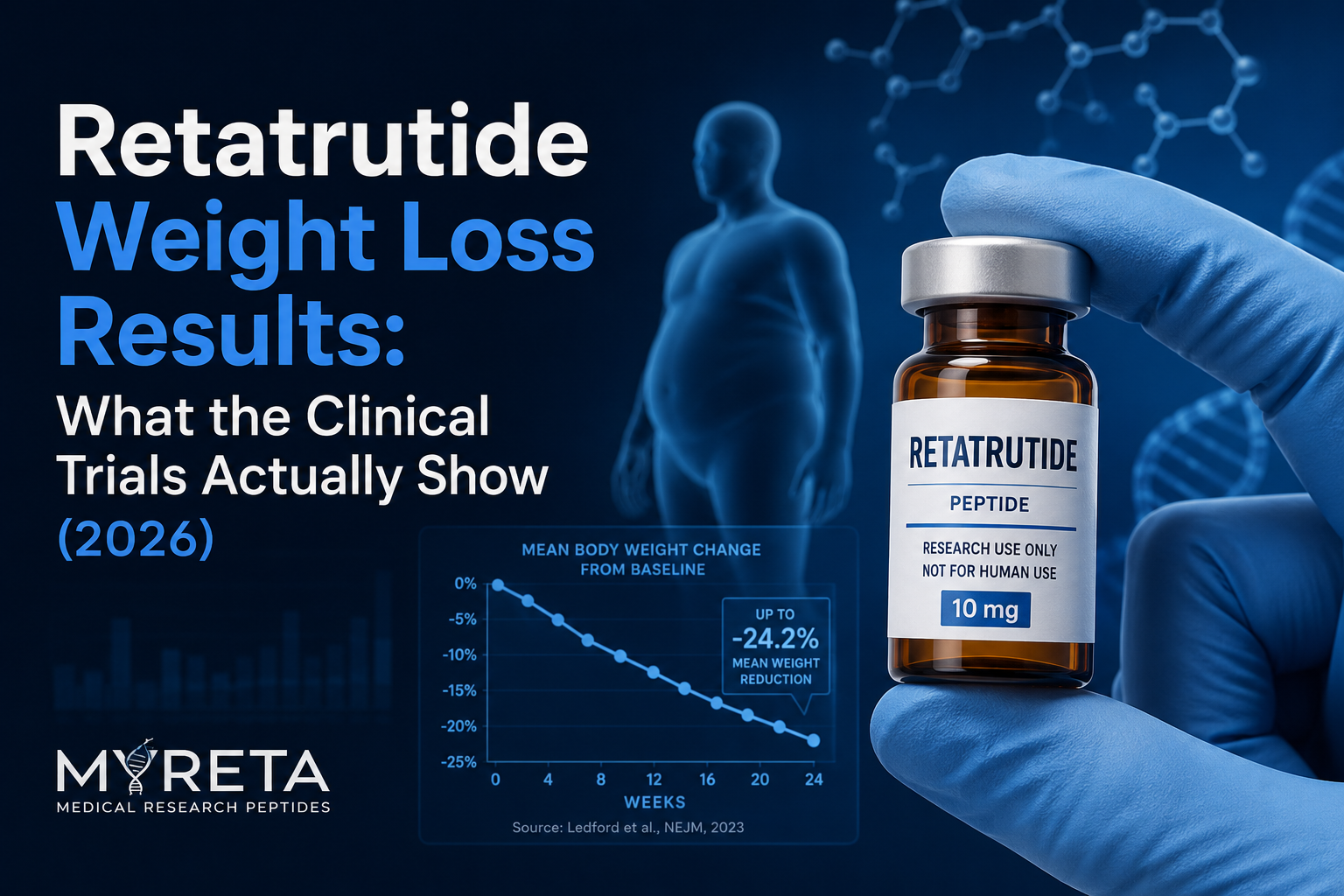
    Retatrutide produced a mean weight reduction of up to 24.2% over 48 weeks in Eli Lilly’s Phase 2 trial — and, unusually, the weight loss had not plateaued when the study ended. That single fact is why retatrutide (LY3437943) is currently the most talked-about compound in obesity research. This guide lays out exactly what the retatrutide weight loss results show, where the numbers come from, how it stacks up against semaglutide and tirzepatide, and the all-important UK research context. To understand the wider class context of what do peptides do in research, check out our plain-English guide. No hype — just the published data, accurately.

    On this page

    Key takeaways

    • Up to 24.2% mean body-weight reduction at the 12 mg dose over 48 weeks (Phase 2), versus roughly 2.1% on placebo.
    • That’s around 26 kg on average — and the curve was still falling at week 48, with no clear plateau.
    • It’s a triple agonist (GLP-1 + GIP + glucagon) — the glucagon arm is what sets it apart from semaglutide and tirzepatide.
    • It remains investigational: no MHRA or FDA marketing authorisation, and in the UK it’s supplied only as a research compound.
    • Phase 3 (TRIUMPH) is ongoing and will decide its clinical future.

    What is retatrutide?

    Retatrutide (development code LY3437943) is a once-weekly injectable peptide developed by Eli Lilly. It’s described as a “triple agonist” because it activates three metabolic receptors at once:

    • GLP-1 (glucagon-like peptide-1) — curbs appetite, slows gastric emptying
    • GIP (glucose-dependent insulinotropic polypeptide) — supports insulin response and appetite control
    • Glucagon receptor — the differentiator, linked to increased energy expenditure and fat metabolism

    Semaglutide (Wegovy/Ozempic) hits one of those receptors; tirzepatide (Mounjaro/Zepbound) hits two. Retatrutide hits all three — the mechanistic reason its trial numbers run higher.

    The headline weight-loss results

    The pivotal data come from the Phase 2 trial published in the New England Journal of Medicine (Jastreboff et al., 2023): 338 adults with obesity, randomised to retatrutide (1, 4, 8 or 12 mg) or placebo, for 48 weeks.

    • 12 mg dose: −24.2% mean body weight at 48 weeks — roughly 26 kg.
    • 8 mg dose: around −22%.
    • Placebo: approximately −2.1%.
    • No plateau: at the highest doses the weight curve was still declining at week 48 — meaning the 24.2% may understate the full effect over a longer period.

    That last point is what excited researchers most: most weight-loss agents flatten out, but retatrutide hadn’t. You can read the primary data in the NEJM Phase 2 publication. (For comparison, the “28.7%” figure floating around some sites isn’t the headline published mean — the robust, citable number is 24.2% at 48 weeks.)

    How retatrutide drives weight loss

    The triple mechanism works on three fronts at once:

    • Appetite regulation — the GLP-1 and GIP activity reduces hunger signalling and increases satiety, so less food is eaten without constant willpower.
    • Energy expenditure — the glucagon component is associated with increased fat metabolism and higher metabolic activity, in theory burning more rather than only eating less.
    • Blood-sugar control — improved glucose handling and reductions in HbA1c were seen in trial participants.

    It’s the glucagon arm — absent from semaglutide and tirzepatide — that researchers credit for the extra edge.

    Beyond weight: liver fat and metabolic health

    The results that arguably impressed clinicians most weren’t on the scales. In the trial, retatrutide was associated with dramatic reductions in liver fat, with a large proportion of participants who had fatty liver (steatosis) reaching normal liver-fat levels. Improvements in blood pressure, lipids and insulin sensitivity were also reported.

    This is the angle urologist Dr Alex Tatem highlighted on The Diary of a CEO when he described an unreleased compound that “tortures belly fat at a disproportionate rate” while delivering “the best improvements we’ve ever seen in… liver health” — predicting a “trillion-dollar drug when it comes out.” The visceral-fat-and-liver profile of retatrutide fits that description closely. (Our full breakdown of his interview is here.)

    Retatrutide vs semaglutide vs tirzepatide

    Approximate mean weight-loss figures from each compound’s pivotal trials:

    CompoundReceptor targetsApprox. mean weight loss
    Semaglutide (Wegovy)GLP-1~15% (STEP trials, 68 wks)
    Tirzepatide (Mounjaro/Zepbound)GLP-1 + GIP~20–22.5% (SURMOUNT)
    RetatrutideGLP-1 + GIP + glucagon~24.2% (Phase 2, 48 wks, still falling)

    A direct caveat for honesty: these come from different trials of different lengths and populations, so they’re indicative, not a head-to-head. But the trend — more receptors, more effect — is consistent.

    Phase 3: the TRIUMPH programme

    Retatrutide is now in Phase 3 trials (the TRIUMPH programme), the stage that evaluates long-term safety and effectiveness across much larger populations and decides whether it reaches the market. Until those complete and a regulator grants authorisation, retatrutide remains an investigational compound — promising data, not an approved medicine.

    Side effects in the trial

    Like other metabolic peptides, the side-effect profile was mostly gastrointestinal and dose-dependent:

    • Nausea, vomiting, diarrhoea and general GI discomfort were the most common.
    • Effects were more frequent at higher doses and during dose escalation.
    • Some participants discontinued over tolerability.

    Gradual dose titration was used to limit these — a standard approach across the GLP-1 class.

    The UK research context

    This is the part the hype tends to skip. Retatrutide has no MHRA marketing authorisation and no FDA approval — it is still in clinical trials. In the UK it cannot legally be sold or prescribed as a weight-loss medicine. What UK suppliers offer is retatrutide as a research compound, for laboratory use only — not for human consumption.

    So when you read “retatrutide weight loss results,” you’re reading clinical trial outcomes from Eli Lilly’s controlled studies — not a claim about a product you can buy and use. If you’re sourcing it for research, the only thing that separates a credible supplier from a risky one is verification: a batch-specific, third-party Certificate of Analysis confirming identity and ≥99% purity (see our quality testing page). Researchers handling lyophilised vials can work out exact concentrations with our free retatrutide reconstitution calculator.

    Frequently asked questions

    How much weight did people lose on retatrutide?

    In Eli Lilly’s Phase 2 trial, the 12 mg dose produced a mean reduction of about 24.2% of body weight over 48 weeks (roughly 26 kg), versus around 2.1% on placebo — and the loss had not plateaued by the study’s end.

    Is retatrutide better than tirzepatide or semaglutide?

    On trial averages, retatrutide’s ~24% exceeds tirzepatide’s ~20–22% and semaglutide’s ~15%, largely thanks to its added glucagon activity. But these are separate trials, and Phase 3 head-to-head data will tell the fuller story.

    Is retatrutide approved or available in the UK?

    No. It’s investigational, with no MHRA authorisation, and is supplied in the UK only as a research compound — not for human consumption.

    Does retatrutide help with fatty liver?

    Trial data showed substantial reductions in liver fat, with many participants who had steatosis reaching normal liver-fat levels — one of the most notable findings beyond weight loss.

    What are the main side effects?

    Predominantly gastrointestinal — nausea, vomiting and diarrhoea — and dose-dependent, which is why trials used gradual dose escalation.

    Final thoughts

    Retatrutide’s Phase 2 numbers — ~24.2% mean weight loss in 48 weeks, still falling, with striking liver-fat improvements — are why it’s described as potentially the most powerful obesity compound in development. The honest framing matters too: it’s investigational, the Phase 3 results aren’t in, and in the UK it’s a research compound only. If you’re researching it, start with verification — see current lab-tested stock on our retatrutide UK page, or the per-vial detail for Retaklik (Retatrutide) 60mg and Retatrutide 2.0 (45mg).

    Source: Jastreboff AM, et al. Triple–Hormone-Receptor Agonist Retatrutide for Obesity — A Phase 2 Trial. New England Journal of Medicine, 2023.

    This article is for informational and research purposes only and reports published clinical-trial data. Retatrutide is an investigational compound supplied for laboratory research use only and is not for human consumption. It has no MHRA or FDA marketing authorisation. Nothing here is medical advice.